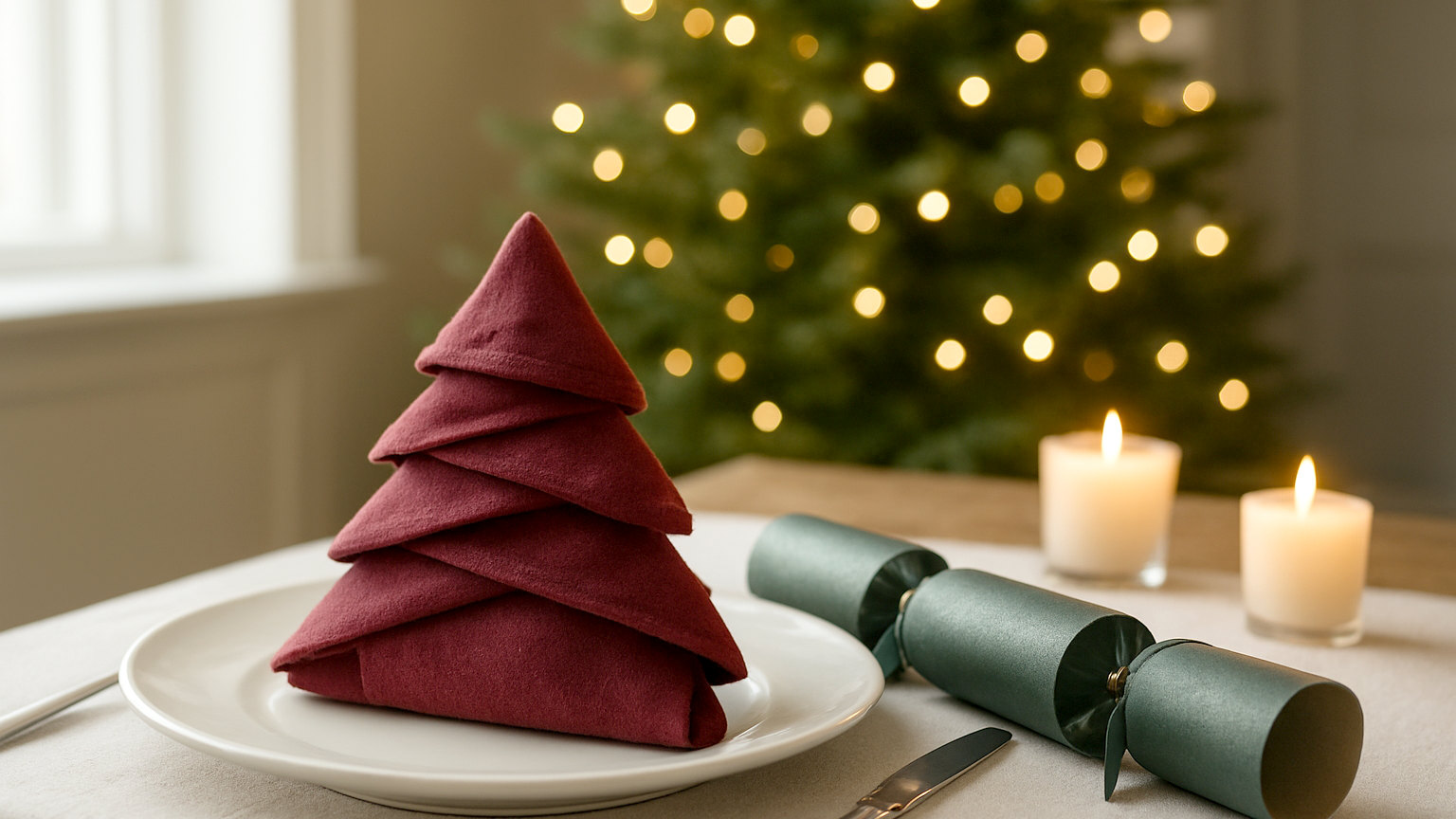
Elaborate napkin folding is a poor use of Christmas Eve. The complicated ones take a couple of minutes each, which is twenty minutes for a table of ten, they require ironing first, and they collapse the moment somebody picks one up. The folds worth knowing take under a minute, hold their shape, and look considerably better than anything constructed.
What is the simplest fold that looks deliberate?
Fold the napkin into a loose rectangle, lay it flat on the plate, and lay a sprig of rosemary, bay or spruce across it with a length of twine tied once around. It takes fifteen seconds, it costs nothing if you have a garden, it smells good, and it looks like somebody thought about it. This is the fold to use if you only learn one.
What is the pocket fold for?
Holding the cutlery, which saves space on a crowded table. Fold the napkin in four, then fold the top layer down to make a band, then fold the sides underneath. The cutlery slides into the band. It is the most useful fold on a table that is short of width, because it turns the napkin into a container rather than another object competing for room.
What about a simple roll?
Roll the napkin loosely from one corner, lay it diagonally across the plate, and secure it with a ring, a length of twine or a strip of ribbon. It suits a long narrow plate and it is the fastest of all, at perhaps eight seconds each. Loose is important: a tightly rolled napkin looks stiff and is awkward to unroll at the table.
Fold everything the night before. A folded napkin holds perfectly well overnight and it is twenty minutes off Christmas morning.
What can you tie them with?
Baker twine, ribbon, a strip of the wrapping paper you are already using, a length of ivy, or a proper napkin ring. Something seasonal tucked under the tie does most of the work: a sprig of herb, a cinnamon stick, a dried orange slice, a small bauble, a name tag. The tie is what turns a folded napkin into a decoration and it costs pennies.
Do napkin rings help?
They make the fastest folds look finished, which is their real value. They are also worth having because they can be reused every year and stored in a small box. A set can be made in twenty minutes from cardboard tubes covered in paper or fabric, or from wire and beads, which is a good job for a child on the twenty-third.
Should you use fabric or paper?
Fabric if you have them, since paper napkins tear during a long meal and a Christmas dinner is a long meal. Fabric also folds better, holds a crease and looks considerably better in photographs. If they need ironing, do it days ahead rather than on the morning. Good quality paper napkins are perfectly acceptable and are considerably better than thin ones that disintegrate.
Where should the napkin go?
On the plate, to the left of the cutlery, or in the glass, and it genuinely does not matter which as long as it is consistent down the table. On the plate is the easiest and works well if the plates are going out to be filled, since the napkins come off as a set. In the glass takes up no table space at all, which on a crowded table is the deciding argument.
How many napkins do you need?
One per person plus several spare, since Christmas dinner produces more spillages than any other meal of the year and a napkin that has been used on a gravy accident is not going back on a lap.
Keeping a few folded and ready on a sideboard rather than in a drawer means nobody has to leave the table to find one, which is the small detail that keeps a long meal running smoothly.