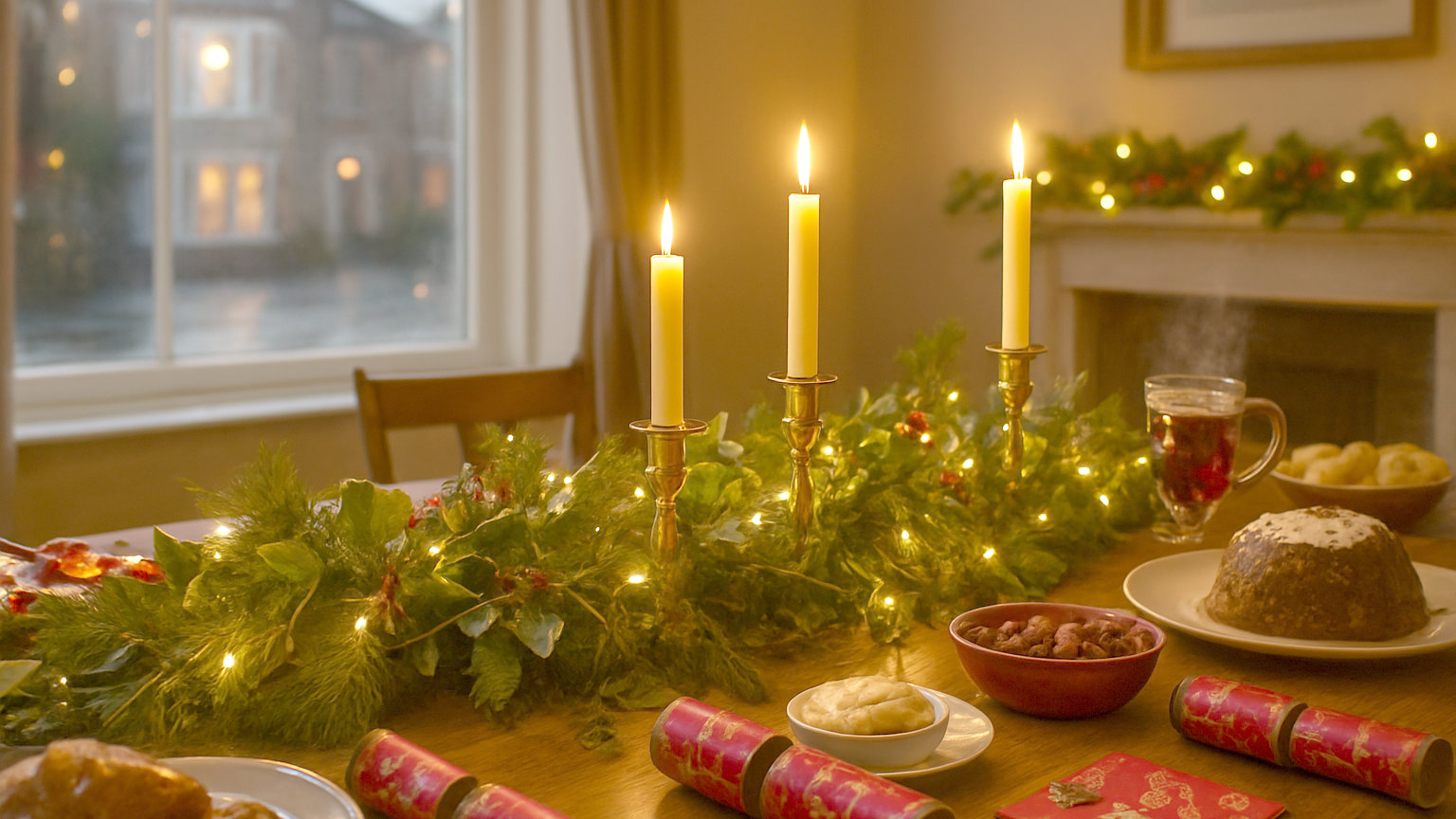
Garlands sag in the middle, slip off the end of a mantelpiece and pull adhesive hooks out of walls, all of which happen because a garland is considerably heavier than it looks and because the fixings are asked to hold a downward pull rather than a static weight. Getting the length and the fixings right at the start prevents all three.
How much do you actually need?
More than the measurement of the surface, because a garland that follows a bannister needs extra for the curve and one that swags needs extra for the drop. For a straight run, add about a quarter. For a spiralled bannister, add half again. For swags, measure the drop you want at the lowest point and add twice that for each swag. Running out two thirds of the way up a staircase is the standard frustration.
What holds the weight on a bannister?
Cable ties or florist wire, wrapped around the rail at intervals of about 45cm and pulled tight, then trimmed and turned so the ends are underneath. This is invisible from a distance, takes no damage, and is far more secure than ribbon, which slips. Ribbon bows can then be tied over the ties for decoration, which is the usual arrangement and looks deliberate.
What about a mantelpiece?
The weight wants securing rather than balancing, since a garland resting on a mantel will slide off within a day. Small adhesive hooks under the front lip, out of sight, hold it well. Alternatively, weight each end with something heavy sitting on top of the garland at the corners, such as a candlestick or a stack of books. Command style hooks come off cleanly in January if they are removed properly.
Fix at both ends first, then the middle, then the points between. Working along from one end is what produces the sag that has to be redone.
How do you stop it sagging?
Support it at intervals no greater than about 45cm and fix both ends before anything in between. On a long run, adding one extra fixing in the centre first and working outwards from there distributes the weight evenly. If a sag has already developed, an additional fixing at the lowest point pulls it back up without redoing the whole run.
How do you work lights through it?
Lights first, before the garland goes up, threaded through the length of it on the ground where you can see what you are doing. Battery sets are ideal here, since a mains cable running along a bannister or a mantel is both visible and a nuisance. Position the battery pack at one end where it can be tucked behind something and reached to switch on.
Which fixings avoid damage?
Cable ties around any rail, post or railing. Adhesive hooks rated for the weight, applied to a clean dry surface. Small cup hooks in a shelf edge, which leave a tiny hole. Nothing nailed, screwed or stapled into a wall for a fortnight of decoration. Test any adhesive hook on an inconspicuous patch first, particularly on painted wood, where removal can lift the paint.
How do you keep a fresh garland alive?
Mist it every few days with a spray bottle, and keep it away from radiators, which is difficult on a mantelpiece above a working fire and is the reason those dry out fastest. A garland over a fireplace that is actually lit will not last, and an artificial base with a few fresh sprigs wired in is the sensible compromise in that position.
What can you use instead of fresh foliage?
A good artificial garland, which can be kept for years, wired with a few fresh sprigs of eucalyptus or rosemary each December to give it scent and movement. Nobody looking at it will identify which parts are which.
Alternatively a garland of dried orange slices, cinnamon bundles and pine cones on twine, which costs almost nothing, keeps for several seasons and suits a mantelpiece where fresh greenery would dry out within days.