
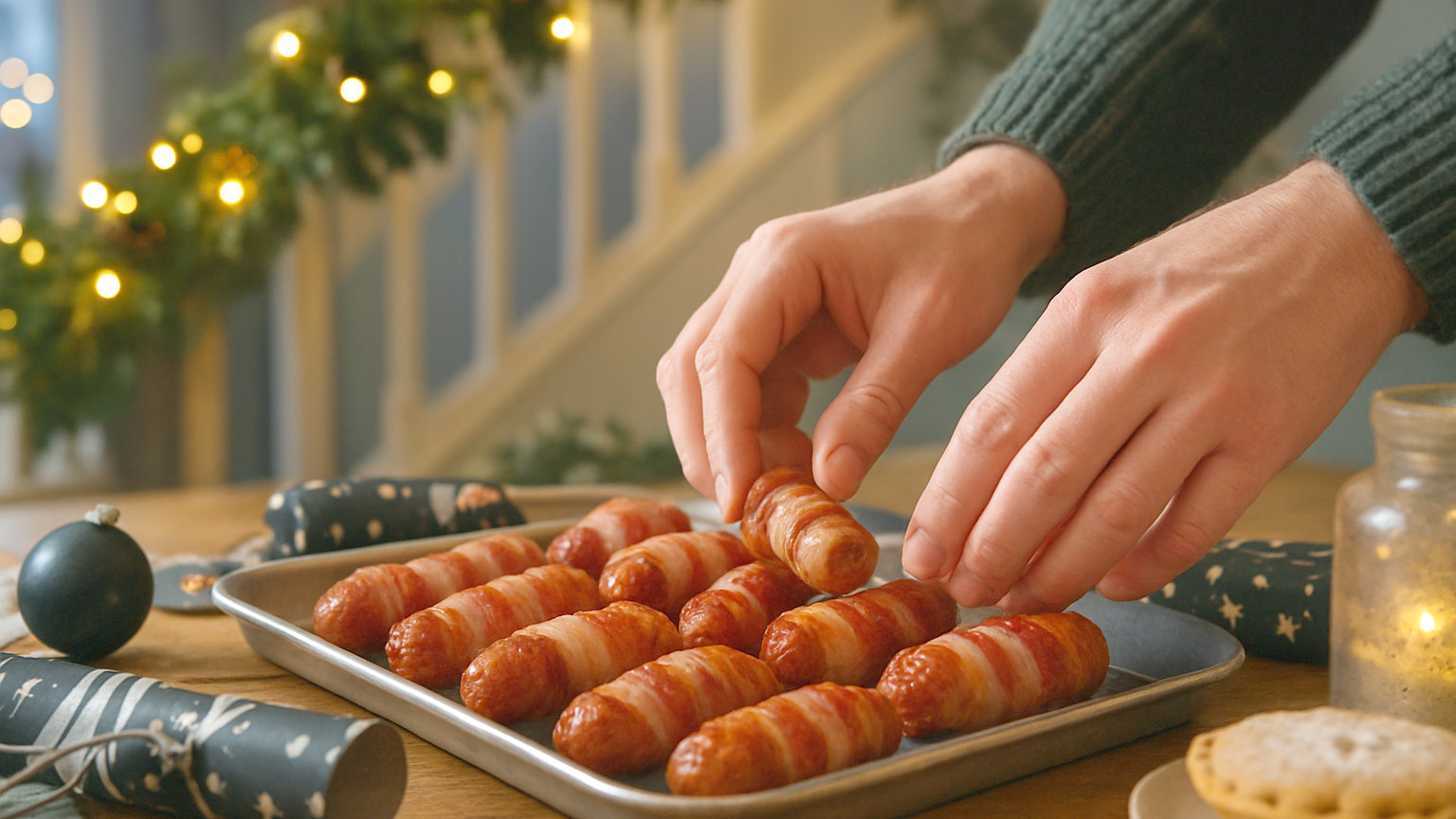
Pigs in blankets are the item most reliably finished on the Christmas table and the one people go looking for when the plates are cleared. They are also easy to get wrong in a specific way: the bacon comes out pale and flabby rather than crisp, and it unwinds from the sausage on the tray. Both problems have simple causes and both are fixed in the preparation rather than the cooking.
Which bacon should you use?
Streaky rather than back, because the fat content is what crisps. Back bacon is leaner, wraps awkwardly around a small sausage and dries out before it browns. Smoked or unsmoked is a matter of taste, though smoked gives more flavour against the sweetness of the sausage. Thin cut is better than thick, since thick rashers take too long to crisp and the sausage overcooks in the meantime.
Why does stretching the bacon matter?
It makes one rasher cover two sausages, which halves the bacon bill, and it makes the wrap tighter so it does not unwind. Run the back of a knife firmly along each rasher on a board, pressing away from you, and it will lengthen by half again. Then cut it in half and wrap each piece around a chipolata with the join underneath.
Which sausages work best?
Chipolatas, which are the right size and cook in the same time as the bacon. A good quality one with a high meat content holds together better than a cheap one, which shrinks and leaves the bacon loose. Cocktail sausages are too small and dry out. If you can only get standard sausages, twist each one in the middle and cut them in half.
Lay them join side down on the tray. The weight of the sausage holds the bacon closed while it cooks and seals it in place within a few minutes.
How do you get them crisp?
Space them out on a tray with room around each one, because crowded pigs in blankets steam rather than roast. Cook at a high temperature, around 200C, for 25 to 30 minutes, turning once. Use a metal tray rather than a ceramic dish. Do not cover them. If they are going in during the turkey rest alongside the potatoes, they will need the same high heat and the same amount of space.
Can they be made in advance?
Yes, and this is one of the best uses of the freezer in December. Wrap them, open freeze them on a tray until solid, then bag them. Cook from frozen with an extra five to ten minutes. Made and refrigerated rather than frozen, they keep for two days. Doing this in November removes a fiddly twenty minute job from Christmas morning entirely.
What variations are worth trying?
A brush of maple syrup or honey in the last five minutes, which caramelises and is very good. A sage leaf tucked under the bacon. A twist of black pepper. Wrapping dates or prunes instead of sausages, which is an older British recipe entirely. What to avoid is anything that adds moisture early, since a wet coating will stop the bacon crisping.
How many should you make?
Two to three per person as a working figure, and more if your household treats them as the main event, which many do. They are the item most likely to run short, they cost very little, and any left over are excellent cold the next day or chopped into a bubble and squeak. Making a few extra is one of the safest bets on the whole table.
Can you cook them on the same tray as everything else?
Better not to. They render a considerable amount of fat, which pools and stops potatoes crisping, and they need turning at a different point. A separate tray is worth the oven space.
If space is genuinely short, an air fryer handles a full batch in about twenty minutes and takes them out of the oven queue entirely.


