
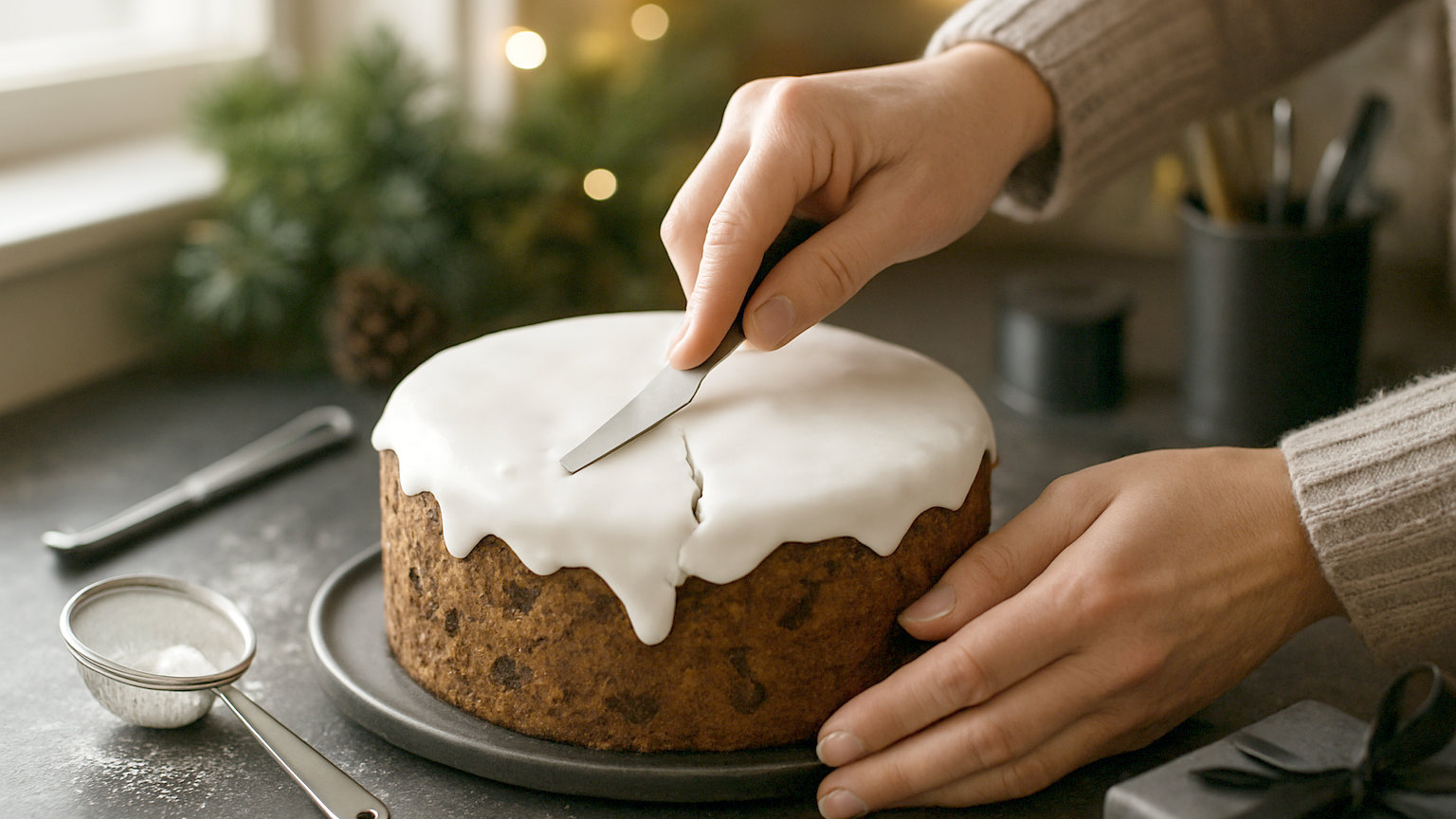
Almost every Christmas baking disaster has a rescue, and a surprising proportion of them come down to the same three causes: an oven that is not the temperature it claims, ingredients used cold from the fridge, and something being rushed that needed resting. Knowing the pattern is more useful than any individual fix, because it prevents the next one as well.
Why has the cake sunk in the middle?
Usually because the oven door was opened too early, or because there was too much raising agent, or because it came out before the centre was set. A skewer into the middle should come out clean, and a fruit cake will take considerably longer than the recipe suggests if the oven runs cool. If it has sunk, cut out the middle and fill the crater with marzipan before icing, which nobody will ever detect.
Why is the fruit cake dry?
Because it was baked too hot or too long, which is the usual cause, or because the fruit was not soaked and drew moisture out of the batter. A dry cake is fixable: pierce it all over with a skewer and feed it generously with brandy or orange juice over a week, wrapping it tightly between feeds. It will not be perfect and it will be perfectly good.
Why has all the fruit sunk to the bottom?
Because the batter was too loose to hold it, or the fruit was too wet from soaking. Draining soaked fruit properly and tossing it in a spoonful of the measured flour before folding it in both help. Once baked there is no fix, but a cake with the fruit at the bottom tastes exactly the same and can be served cut into squares rather than wedges.
Buy an oven thermometer. Domestic ovens are routinely twenty degrees out from the dial, and that single fact explains a very large share of Christmas baking failures.
Why does the pastry shrink down the sides?
Because it was stretched into the tin rather than laid in, and because it did not rest. Gluten developed during rolling pulls back when heated. Roll slightly larger than needed, ease it in without pulling, and chill the lined tin for twenty to thirty minutes before baking. That chill fixes shrinking, reduces leaking and firms the pastry so it lifts out cleanly.
Why has the buttercream split?
Almost always a temperature difference between the butter and whatever was added to it. If it looks curdled, warm the outside of the bowl briefly with a cloth and keep beating, and it will usually come back. If it is too soft, chill it for twenty minutes and beat again. Very little goes permanently wrong with buttercream that beating and patience will not correct.
Why is the royal icing yellowing?
Because almond oil from the marzipan has seeped through, which happens when the icing goes on before the marzipan has dried. Leave marzipan three or four days before icing. If it has already stained, a further thin coat once the surface is completely dry will usually cover it, and a wide ribbon around the side hides a good deal.
What is the most common cause of all?
The oven. Domestic ovens routinely run ten to twenty degrees away from the dial, they have hot spots, and a fan oven behaves differently again. A cheap oven thermometer costs very little and turns baking from a gamble into a process. Everything else on this page is worth knowing; that one thing prevents more failures than the rest combined.
When is something genuinely beyond rescue?
When it is burnt through rather than on the surface, and when anything containing raw egg has been left out too long. Everything else has a second life. A collapsed cake becomes a trifle base. Broken biscuits become a cheesecake crust. Failed fudge becomes a sauce. Very little needs to go in the bin, and the trifle is frequently better than the cake would have been.


