December is among the windiest months of the British year and most outdoor decorating is planned as though it were not. The result is a familiar sight on the twenty-seventh: an inflatable on its side in next door garden, a light run torn loose at one end, and a lit reindeer face down on the lawn. Choosing for the weather rather than for the catalogue photograph avoids nearly all of it.
Which items hold up?
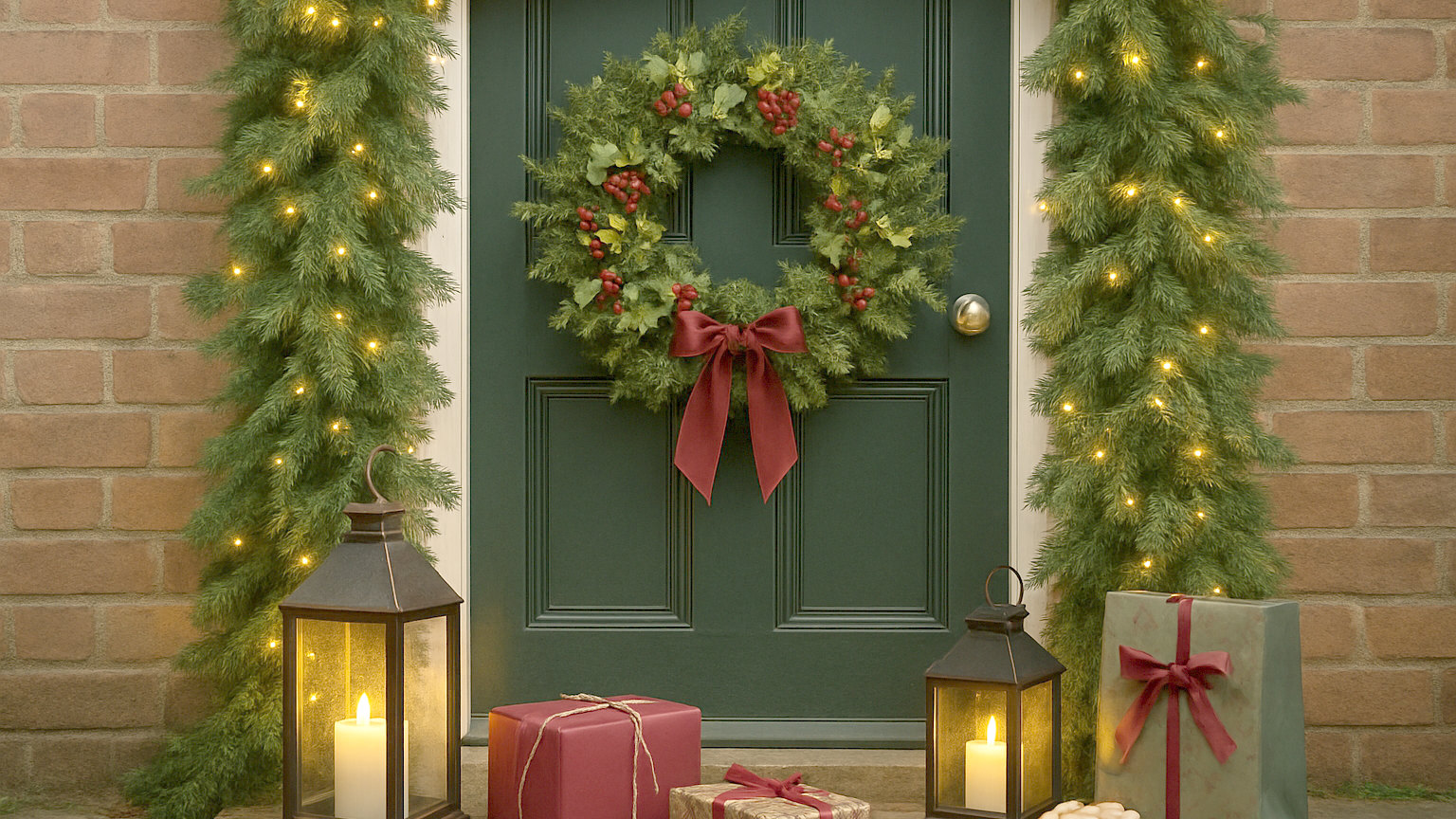
Anything low, heavy and rigid. Lights fixed directly to a wall or a fence. Pots, provided they are heavy and not top heavy. Metal framed figures, which are rigid and let wind pass through rather than catching it. Wreaths and garlands on a door, which are sheltered. Ground level spike lights. Anything that presents little surface area to the wind will generally survive whatever December produces.
Which items do not?
Inflatables, which are essentially sails and which tear at the seams once they start flexing. Tall lightweight figures. Anything flat and broad fixed to a fence. Freestanding items in pots that are lighter than the thing they hold. Netting lights over a hedge, which lift and bag. Anything held up by adhesive alone, which fails in cold and wet regardless of what the packaging claims.
How should things be anchored?
Into ground rather than into a border that turns to mud, using every stake and tether supplied and then some more. Add guy lines to a fence post, a railing or a heavy planter. On hard standing, use sandbags or heavy pots rather than trying to weight something with a few bricks. Anchor at more points than seems necessary, because wind loads are not steady and one loose corner starts the failure.
Take things down before a forecast gale rather than after it. Twenty minutes of work saves a decoration that cannot be repaired once the seams have gone.
What about cables in wind?
Never leave a cable pulled tight, since a branch or a fixing moving in wind will eventually pull it free or split the insulation. Cables should hang in gentle loops with slack at every fixing. Check every run after a storm, at ground level and in daylight, before switching anything back on. A cable damaged in a gale is a genuine electrical risk rather than a cosmetic problem.
Who is liable if something blows away?
You are, broadly, if something you put up damages a neighbour property or a passing car. That is a reasonable argument for anchoring properly and for taking things down when a warning is issued. It is also worth checking that anything large and heavy is not positioned where it could fall onto a path, a road or a parked vehicle if the fixings failed.
How do you plan for the weather?
Put the display up in a way that allows the vulnerable parts to be removed quickly. If the inflatable takes twenty minutes to deflate and store, it will be left up through a gale. If it takes five, it will not. Keep the storage bag somewhere accessible rather than at the back of a shed, which is the practical difference between a decoration that survives and one that does not.
What should you check after a storm?
Every fixing, every cable along its length, every anchor point, and whether anything has shifted position. Do it in daylight, with everything switched off at the socket, before it goes back on. A fixing that held through one gale with a small amount of movement will usually fail in the next one, so anything that has moved wants redoing rather than pushing back.
How do you know when to act?
Weather warnings are issued days ahead and are worth paying attention to in December rather than treating as background noise. A yellow warning for wind is enough reason to deflate anything inflatable and bring in anything freestanding.
Gusts matter more than the average wind speed, and a sheltered garden can still funnel wind unpredictably between buildings, so local experience of where things blow over is worth more than a forecast number.