
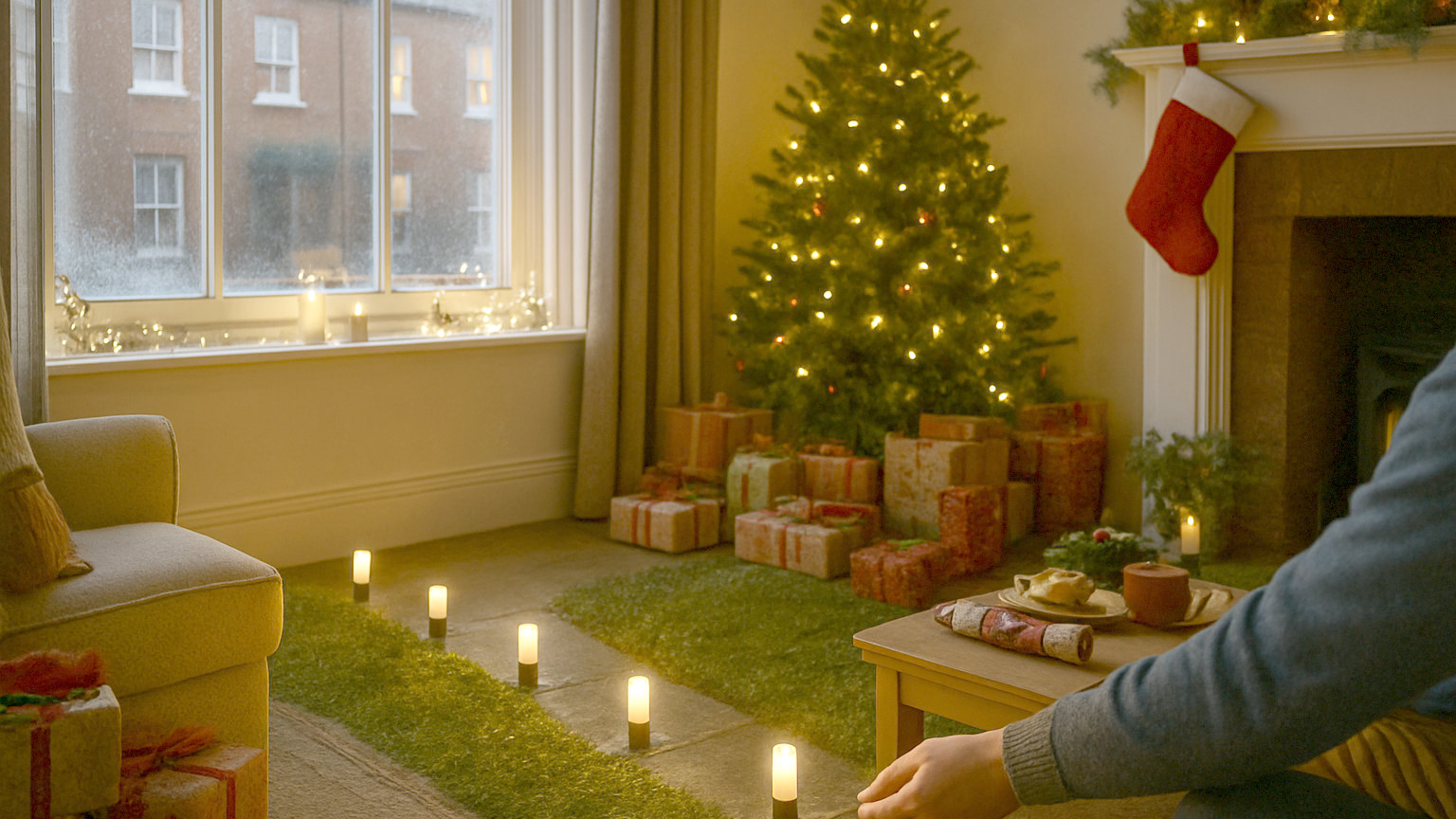
Path lighting is the most useful outdoor Christmas decoration, because it does an actual job as well as looking good. December brings a great many visitors to a door that is normally used by two people who already know where the uneven slab is, and it does so in the dark and frequently on ice. A lit path is a courtesy as much as a decoration.
How should it be spaced?
Evenly, and further apart than most people assume. Lights every 1.5 to 2 metres, alternating sides, give a sense of the route without turning the garden into a runway. Marking the edges matters more than lighting the surface, since the eye follows a line. Concentrate the lights at the points that actually need them: steps, a change of level, a turn, and the last stretch to the door.
Why does solar disappoint in December?
Because a British December gives a solar panel almost nothing to work with. Short days, low sun and persistent cloud mean many solar sets manage only an hour or two of dim output on a winter evening, which is precisely when they are needed. They are much better suited to summer garden lighting. If you use them, position the panel where it catches whatever direct light there is and keep it clean.
What are the alternatives?
A low voltage garden lighting kit, which runs from a transformer plugged into an outdoor socket and gives consistent output all evening. Mains spike lights rated for outdoor use. Battery lanterns along the edge of a path, which need no cable at all and can be brought in and recharged. Rechargeable lanterns are the simplest option for anybody without an outdoor socket.
Every cable on a path must be routed where nobody will walk on it or trip over it. A cable across a path in the dark is a worse hazard than the darkness it was meant to solve.
How do you avoid dazzling people?
Aim light downwards and outwards rather than upwards into faces, and keep the brightness low. A path lit by dim markers is easier to walk than one lit by a few bright sources, because bright points destroy night vision and leave everything between them darker than before. Shielded fittings that throw light onto the ground are considerably better than bare bulbs.
What about the driveway?
The same principle with more caution about cables, since anything crossing a driveway will be driven over. Run cables around the edge rather than across, protected in a proper conduit if they must cross. Do not place spike lights where a car door opens or where somebody will step out of a vehicle in the dark. Reflective markers work alongside lights and need no power at all.
What does the electrical safety require?
Every fitting and every connector rated for outdoor use with an appropriate IP rating, an RCD protecting the circuit, outdoor rated extension leads with connections kept off the ground and out of standing water. Anything involving a new external socket or fixed wiring is a job for a qualified electrician rather than a domestic one.
Can it stay up after Christmas?
Path lighting is one of the few outdoor decorations that can, because it reads as garden lighting rather than as Christmas decoration once the seasonal elements come down. Leaving the path lit through January and February is genuinely useful in the darkest months, and it means the installation is doing something for a quarter of the year rather than a fortnight.
What about ice and snow?
Lighting a path helps but it does not make it safe, and a lit sheet of ice is still a sheet of ice. Grit or salt the path before visitors arrive, particularly the section by the door where water runs off a roof and refreezes.
Check that nothing you have installed makes the surface worse, since a cable, a stake base or a low decoration under a dusting of snow becomes an invisible trip hazard.


