
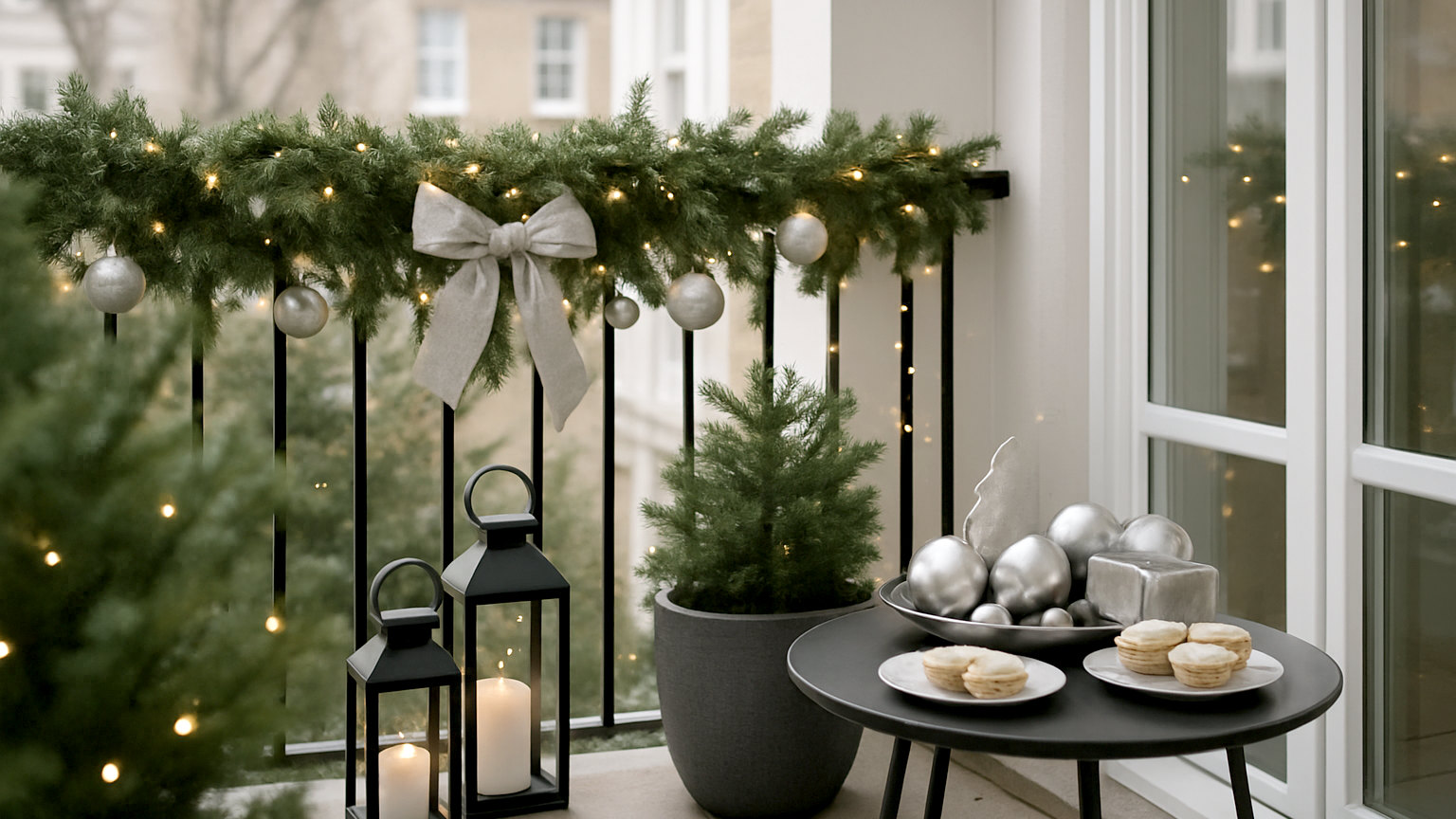
A balcony is the only outdoor space many households have, and it comes with three constraints that a garden does not: rules about what can be attached to the building, exposure to considerably more wind than ground level, and somebody living directly underneath. Working within those three produces a good result, and ignoring any of them produces a difficult conversation.
What does the lease usually say?
Most leases and tenancy agreements restrict what can be fixed to the exterior of a building, and many restrict what can be visible from outside. Fire regulations may also apply, particularly to anything in a walkway, on an escape route or attached to a communal area. Check before you buy rather than after, since the usual outcome of getting it wrong is being asked to take it all down.
What can normally be done without permission?
Anything freestanding and anything attached to your own railings with ties rather than fixings. Pots, a small tree, lights cable tied to a railing, a wreath on your own door. Anything on the inside of your windows. That covers almost everything worth doing, and none of it drills into or permanently marks the building.
What survives the wind?
Very little that is not tied down, and a balcony several floors up sees noticeably more wind than the street. Lights secured with cable ties at short intervals. Heavy pots with low centres of gravity. Anything rigid. What does not survive is anything light, anything tall, anything inflatable and any pot that is lighter than the plant in it, all of which end up on somebody car.
Nothing should be able to fall or blow off the balcony. An object dropped from height is a serious hazard and you are responsible for it.
Why does dripping matter?
Because watering pots on a balcony sends water straight onto the balcony or the washing below, which is one of the most common sources of neighbour disputes in flats. Use pots with saucers, water sparingly, and check what is underneath before you start. The same applies to anything that will shed needles, petals or foliage over the edge.
How do you handle the electrics?
Battery or USB sets are by far the simplest, since they need nothing run through a door or a window. If you use mains lights, the set must be rated for outdoor use, protected by an RCD, and the cable must not run under a door or a window that closes on it. Never run a cable through a gap in a window frame that will be shut on it.
What works in a small space?
A run of lights along the railing, which is the single most effective thing and needs nothing but cable ties. A pair of pots either side of the door with a small conifer or some branches in each. A wreath on the door itself. A lantern. That is a complete scheme and it takes half an hour, and all of it can be seen from inside as well as outside.
What about the view from below?
Worth thinking about, since a balcony display is seen mainly by other people rather than by you. Lights along the underside of the railing read well from the street. Anything at floor level of the balcony is invisible from below. If the building has a shared aspect, matching what neighbours do, or at least not competing with it, tends to make for an easier December.
What about the view from inside?
A balcony display is looked at from the room behind it for far more hours than it is looked at from the street, so it is worth checking how it reads through the glass in the evening. Lights facing outwards can leave the balcony itself dark from inside.
A second small set angled back towards the doors, or a lantern on the floor of the balcony, gives you something to look at from the sofa without changing what the street sees.


