A dried orange garland costs the price of a bag of oranges and a ball of twine, keeps for several years, and fills a room with a smell that no candle reproduces. It is also close to impossible to get wrong, since the only variables are how thick the slices are and how long they spend in the oven. It is the single best value decoration on this whole site.
How thick should the slices be?
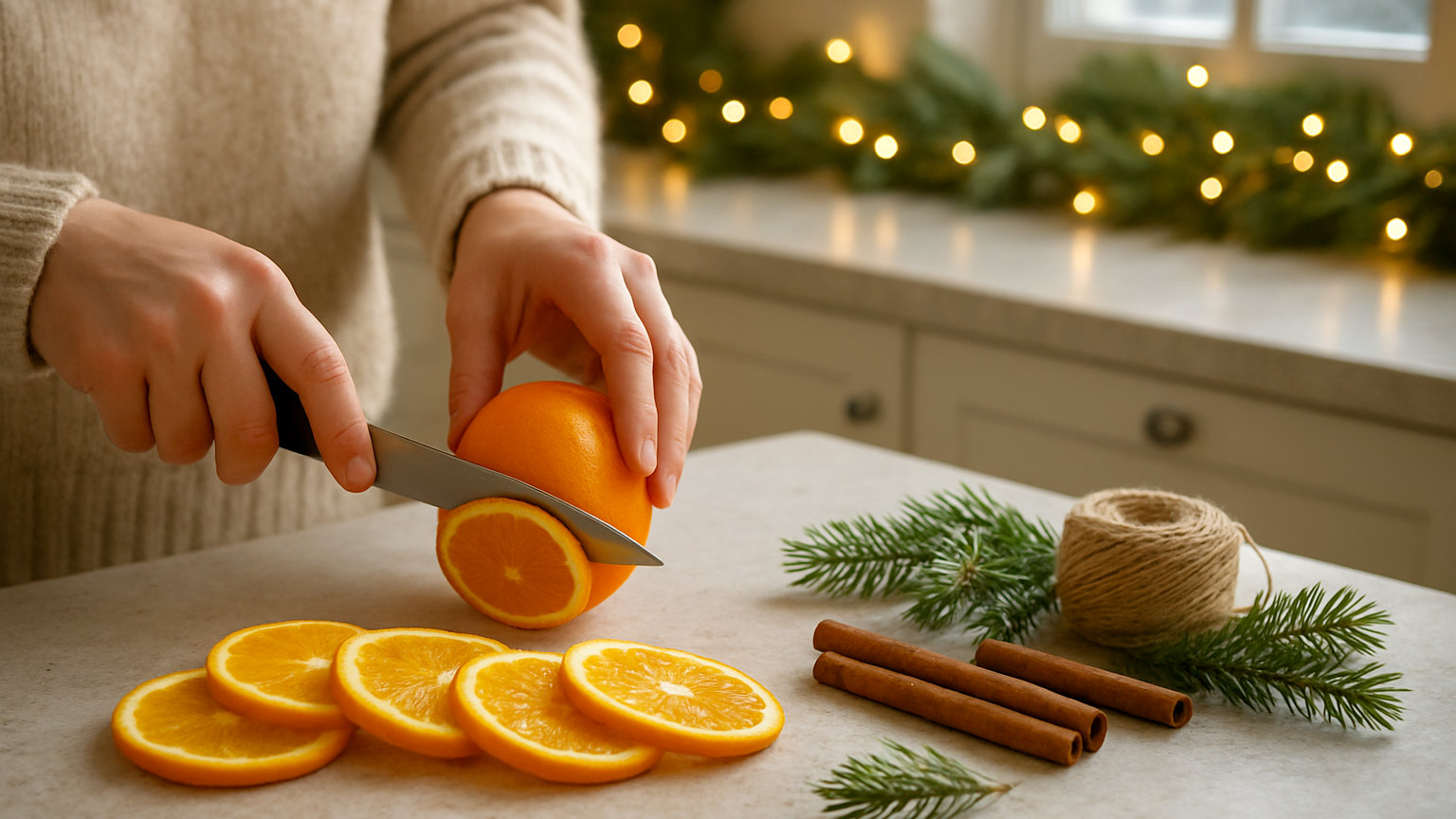
About half a centimetre, and consistency matters more than the exact figure. Thinner slices dry faster but become fragile and tear when threaded. Thicker ones take considerably longer and can stay damp in the middle, which leads to mould weeks later. A sharp knife or a mandoline gives even slices; a blunt knife crushes the fruit and squeezes the juice out.
How long do they take to dry?
Three to four hours in an oven at its lowest setting, usually around 90C to 110C, turning once or twice. They should be dry to the touch and slightly translucent, with no soft or sticky patches. A dehydrator does the same job overnight at a lower temperature and gives better colour. Air drying on a radiator works but takes several days and the results are less reliable.
How do you stop them going brown?
Blot each slice thoroughly on kitchen paper before it goes in, since surface juice caramelises and darkens. Keep the temperature as low as your oven allows, because heat rather than time is what browns them. Prop the oven door open slightly with a wooden spoon so moisture escapes rather than steaming the fruit. Turning them prevents one side sticking and discolouring.
Thread them while they are still slightly warm. A fully cooled slice is brittle and the needle will crack it; a warm one has just enough give.
How do you thread them?
With a large blunt needle and baker twine or garden string, going through the pith near the edge rather than through the middle, which is where they tear. Push the needle through carefully rather than forcing it. Leave a little slack between slices so the garland hangs naturally, and tie a knot on either side of each slice if you want them evenly spaced rather than sliding together.
What else can go on it?
Cinnamon sticks tied in small bundles. Star anise, which is beautiful and brittle. Bay leaves, threaded flat. Dried apple slices, done the same way. Pine cones on wire. Wooden beads, which give spacing and contrast. Alternating orange with one other element gives a rhythm and stops it reading as a row of identical discs.
Where does it work best?
A mantelpiece, a bannister, across a window, along a shelf, or around a tree as an alternative to tinsel. It also makes an excellent gift wrap decoration cut into short lengths, and single slices work as tree decorations or place card holders. Because it is dry and light it needs almost no support, which makes it far easier to hang than a fresh garland.
How should it be stored?
Coiled loosely in a box with tissue between the layers, somewhere dry, and not in a damp shed or a garage. Kept properly it will last several years, gradually deepening in colour. If it picks up moisture and softens, half an hour in a low oven dries it out again. Do not store it in a sealed plastic bag, which traps any remaining moisture and causes mould.
When should you make it?
Any time from October, since the finished garland keeps for years and the job is a pleasant one for an evening rather than something to squeeze into December. Oranges are cheap and plentiful through the autumn.
Making it early also means the house smells of it for longer, which for many people is the actual reason to make one rather than buy a candle.
It is also one of the few Christmas jobs that can be done entirely out of season, which makes it a useful thing to have on the list for a quiet weekend rather than a busy December evening.