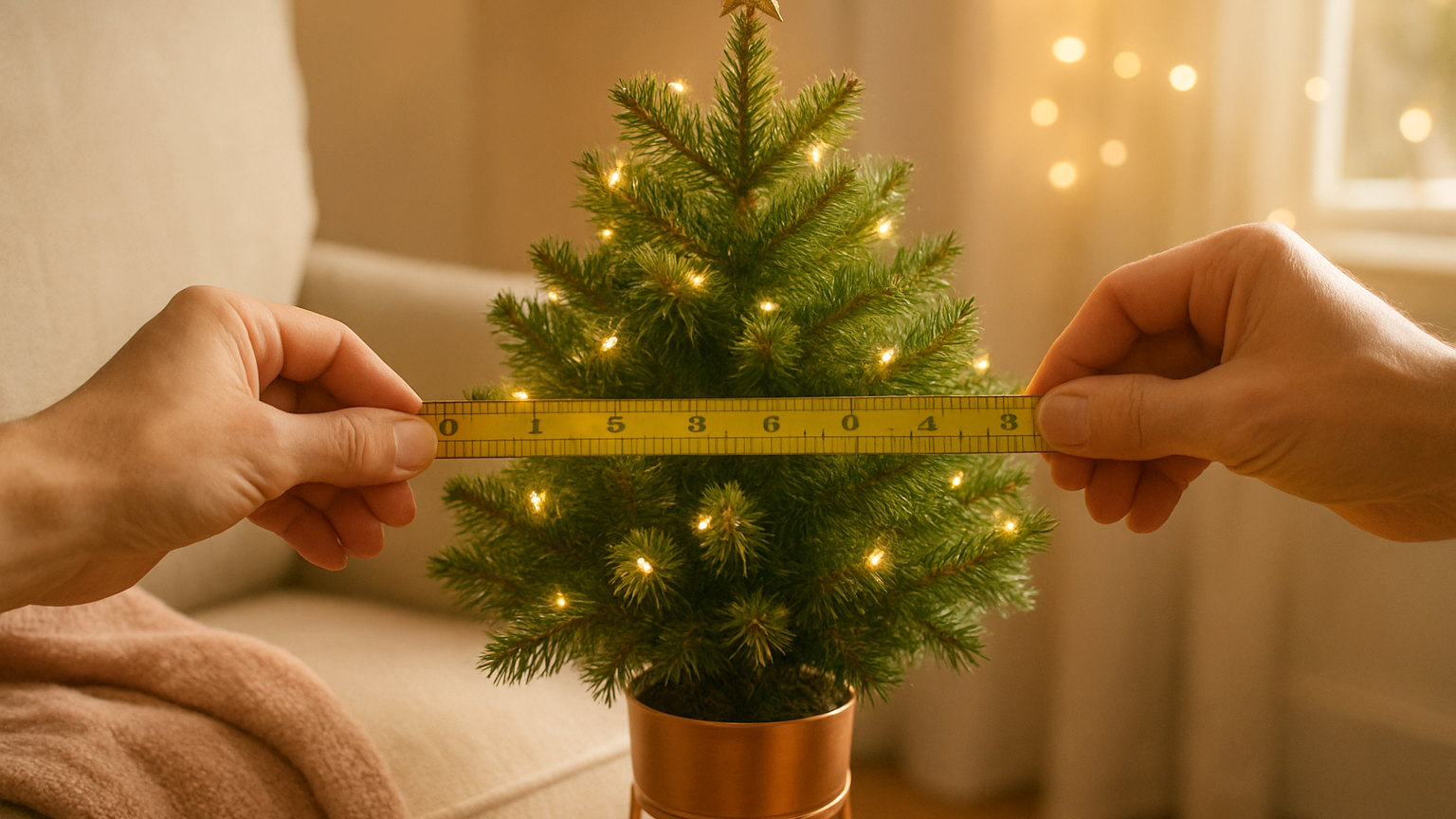
Every Christmas tree looks smaller in a field, a car park or a garden centre than it does in a living room, because it is being judged against an open sky rather than against a ceiling. This is why so many households end up sawing the top off in the hallway. Five minutes with a tape measure before you leave the house removes the problem entirely.
What should you measure?
Ceiling height in the spot where the tree will go, since ceilings vary within a house and a bay window or a sloping ceiling changes the answer. Then the floor space available, measured as a circle rather than a square, because a tree is round. Note anything the tree will have to fit past on the way in, particularly a doorway, a turn in a hallway or a bannister.
How much do you allow for the stand and topper?
Around 30cm in total is a safe working figure. A water stand lifts the tree between 10cm and 20cm off the floor, and a star or angel adds another 15cm or so on top. So a room with a 240cm ceiling comfortably takes a tree of around 210cm, which is roughly seven feet. Buying to the ceiling height rather than to the ceiling height minus the extras is the classic error.
Why does width matter more than height?
Because a tree that is 20cm too tall can be trimmed at the base, and one that is too wide cannot be fixed at all. Width is also what determines whether the room still works: a tree that blocks a doorway, a radiator or a route to the sofa will be resented by the middle of December. A six foot Nordmann can easily be a metre and a half across at the base.
Measure the room, write the number on your hand, and take a tape measure with you. Judging a tree by eye in an open space is unreliable for everybody.
How do you judge a tree outdoors?
Stand it upright rather than looking at it lying down, since a tree on its side is impossible to read. Ask the seller to hold it up and step back several paces. Compare it against your own height rather than against the trees around it. Most sellers label trees by height in feet, and those labels are usually accurate to within a few inches, so trust the label over your eye.
What if the room is small?
Look for a slim or pencil variety, or a Fraser fir, which is naturally narrower than a Nordmann. A tree in a pot raised on a small table takes up less floor space and reads as taller. A half tree against a wall, or a tree hung on the wall, are both genuine options in a very small flat. Nobody has ever regretted a slightly smaller tree that the room could accommodate.
What if the ceiling is very high?
A tall thin tree will look lost in a large room, so proportion matters more than maximum height. A tree that reaches about two thirds to three quarters of the ceiling height generally looks right. Very tall trees also become genuinely difficult to decorate and to water safely, and anything over about eight feet needs a proper stepladder rather than a chair.
What can you do if it is too big?
Trim the base rather than the top, since cutting the leader ruins the shape and the topper has nowhere to sit. Take it off in small increments and re-measure, remembering that you also need a fresh cut for water uptake. Lower branches can be removed entirely and used for a garland or a mantelpiece, which is a better use for them than the green bin.
Where in the room should it go?
Somewhere it can be seen from the doorway and from where people sit, away from radiators and out of the route between the door and the sofa. A corner uses the least floor space and lets you skip decorating the back.
A window is the traditional position and looks good from the street, but check that the curtains still close and that the tree is not sitting directly over a radiator, which most windows in British houses are.