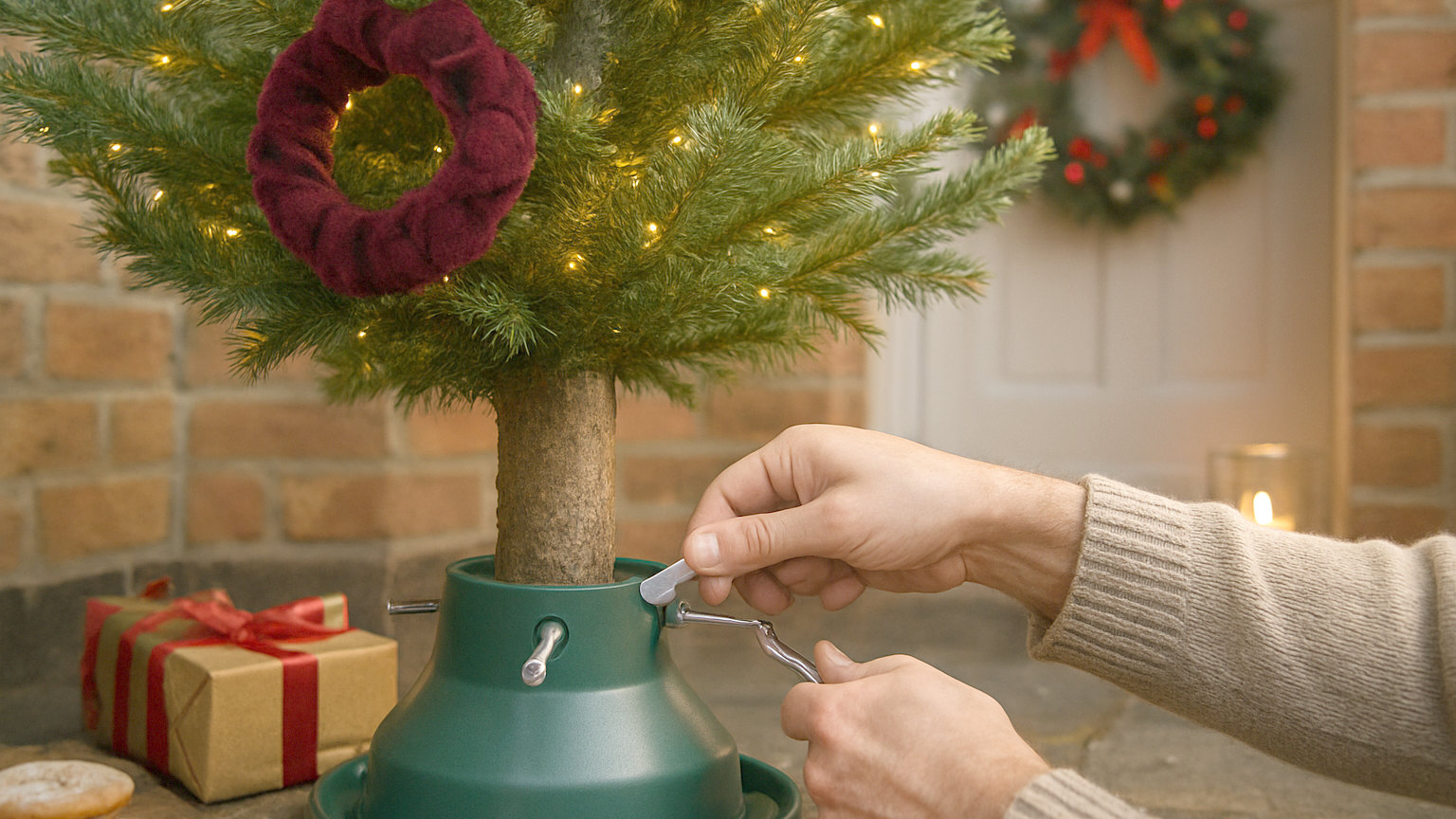
A leaning Christmas tree is one of the small annual frustrations that has a genuinely simple solution, and the solution is that it is a two person job. One person holds and adjusts, one person stands back and directs, and the whole thing takes four minutes rather than the forty it takes when somebody tries to do both alone from underneath the branches.
Why do you have to check from two directions?
Because a tree can be perfectly vertical when viewed from the front and leaning noticeably when viewed from the side, and the person crouched at the base cannot see either. Look from the doorway, then move ninety degrees and look again. Adjust for one direction at a time rather than trying to correct both at once, which is how a tree ends up chasing itself around the stand.
How should the bolts be tightened?
Evenly and in opposite pairs, in the same way as wheel nuts. Tighten each one lightly first so the trunk is held but can still move, get the tree upright, then go round again bringing them all up firm. Tightening one fully before touching the others pushes the trunk over and guarantees a lean. Most stands have four bolts and all four should end up carrying similar pressure.
What if the trunk is not straight?
Very few are, and this is the part people miss. The aim is not a vertical trunk, it is a tree that looks straight, which are different things when the trunk has a bend in it. Set it so the upper two thirds look right, since that is what the eye reads, and accept that the base may be at an angle inside the stand.
Get the tree straight before the lights go on, not after. Adjusting a stand under a fully decorated tree is how baubles get broken.
What if the stand will not hold it?
Check the trunk actually fits: a base that is too wide will sit on top of the bolts rather than between them, and a base that is too narrow leaves the tree loose however tight the bolts are. Shaving the sides of the base with a saw or a knife to fit the stand is normal practice. Never shave so much that the cut surface for water uptake is reduced.
Does the base need trimming first?
Yes, and for a separate reason. Saw two to three centimetres off the bottom, straight across, immediately before the tree goes in, so it can draw water. Do this at the same time as any shaping for the stand. A flat, square cut also sits better in the stand than the ragged one the tree arrived with.
When should you check it again?
The following morning, and again after a few days. A freshly installed tree settles as the branches drop and relax, and the trunk can shift slightly in the stand as the wood takes up water. A tree that was perfect on the Saturday afternoon frequently has a small lean by Sunday, and correcting it early is far easier than after everything is hung.
How do you make it stable in a busy house?
A stand with a wide base rather than a narrow one, and a full reservoir, which adds useful weight low down. In a house with small children or animals, a discreet line of fishing wire from the upper trunk to a small hook in the wall or the window frame costs nothing and removes the possibility of the whole thing coming down. It is invisible from two feet away.
What if the floor is uneven?
Very few floors are level, and an old house with sloping boards will defeat even a well set stand. Pack under one side of the stand with folded card or thin plywood rather than trying to correct the lean with the bolts, which simply puts the trunk under strain.
Check the packing is stable before the reservoir is filled, since a stand carrying two litres of water and a tree is considerably heavier than an empty one and will settle onto anything soft.