The set of lights that half works next December was usually broken in the loft rather than on the tree. Bundling a string into a ball puts tight bends in the cable, and repeated bending in the same place fractures the conductor inside the insulation, where you cannot see it. The tangle is annoying; the internal break is what actually ends the set.
Why does bundling break them?
Because the copper conductor inside a thin cable is not designed to be bent sharply and repeatedly at the same point. Each tight fold work hardens the metal slightly, and after a few seasons it fractures. The insulation stays intact so the damage is invisible, and the symptom is a section that works intermittently or not at all. There is no domestic repair for it.
What should you wind them onto?
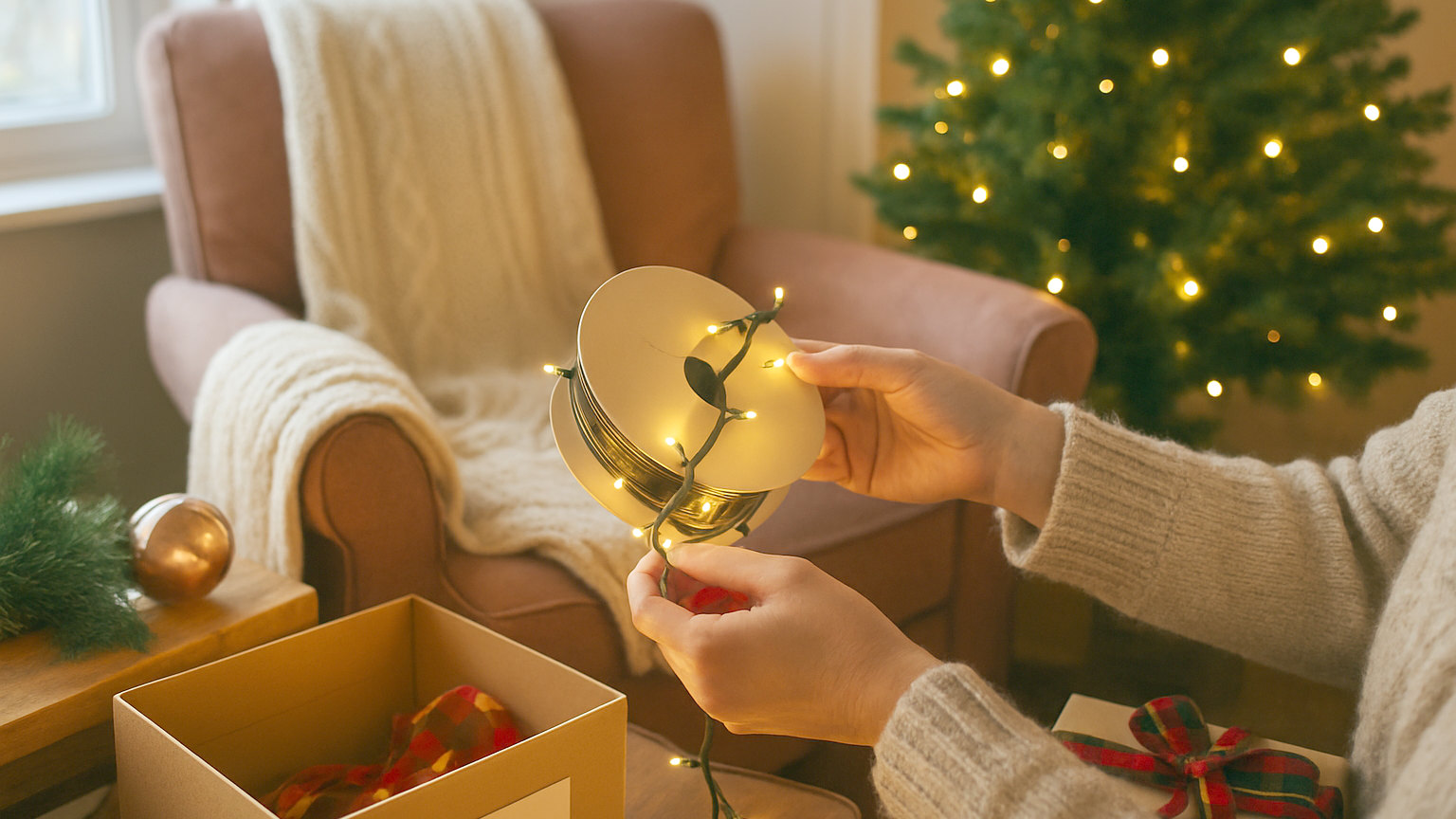
Anything that holds a gentle curve. A plastic cable reel, which costs a few pounds. A rectangle of stiff cardboard with a notch cut at each end to hold the ends. An offcut of drainpipe or a cardboard tube. A wooden clothes peg for very short sets. The principle is the same in every case: a wide radius rather than a tight fold, and the ends secured so nothing works loose.
How should sets be separated?
One set per reel, and one reel per bag or compartment, so that no two sets can tangle with each other. Freezer bags work perfectly well. If you have several sets doing different jobs, keep them apart rather than in one large box, because the box that has to be emptied to find the right set is the box that gets tipped out and tangled.
Test every set before it goes into storage, and write the result on the label. Finding out in January is a small job; finding out in December is a shopping trip.
What should you write on the label?
What the set is for, how long the cable is, whether it worked when it went away, whether it is rated for outdoor use, and the wattage. Those five facts answer every question you will have next December and take thirty seconds to write. Tape the label to the reel rather than to the bag, since bags get swapped and reels do not.
Where should they be stored?
Somewhere dry and not subject to extremes. A loft is acceptable for lights, which tolerate temperature swings better than wax or plastic figures do, but a damp shed or garage is not, since moisture in a connector is a genuine safety issue when the set is next used. Keep them off the floor and away from anything that might be chewed by mice.
What about the packaging?
Keep it, or at least keep the useful part of it. The box contains the spare fuses, the spare bulbs, the bulb puller and the only printed record of the wattage and IP rating. If the box is bulky, cut out the panel with the specification on it and tape it to the reel, and put the spares in a small bag taped alongside.
What should you throw away in January?
Any set with cracked, brittle or taped cable, a damaged plug, loose pins or visible bare wire. Any set that has been used outdoors without being rated for it. Any set old enough to have a two pin plug and an adaptor. Storing a set you already know is faulty simply means discovering it again next year, and the January sales are the cheapest moment to replace it.
How should outdoor sets be stored differently?
Dried completely before they go away, which means bringing them inside for a day rather than coiling them straight off a wet wall in January. Moisture trapped in a connector over eleven months is the main cause of an outdoor set failing.
Store them separately from the indoor sets and label them clearly as outdoor rated, since the one mistake worth guarding against is an indoor set being used outside because the boxes got mixed up.