
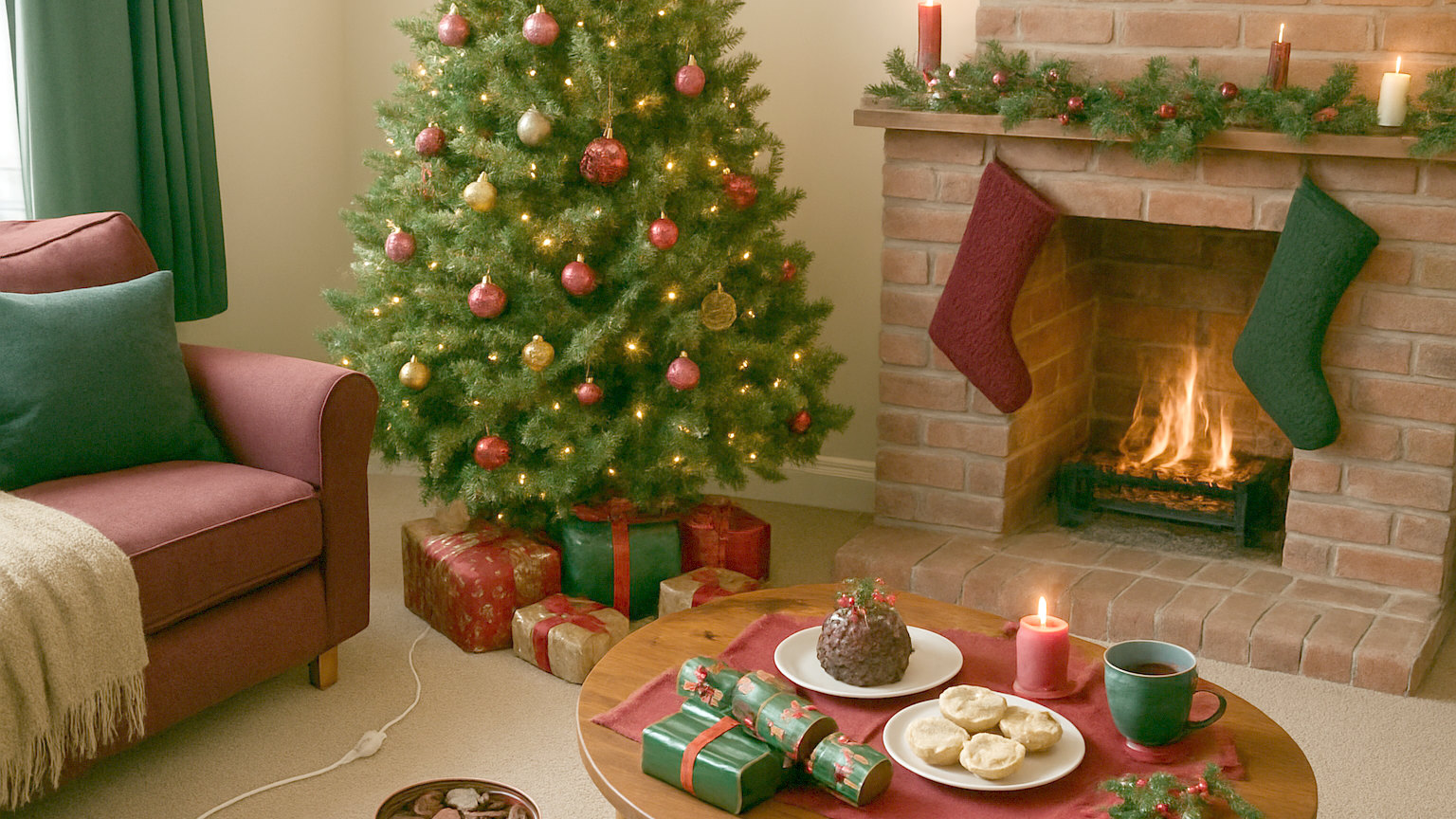
A carefully lit tree undone by a white cable running diagonally across a carpet is one of the more common sights in December, and it is entirely avoidable with five minutes of planning before anything is switched on. The constraint is that some of the obvious solutions are unsafe, so it is worth knowing which routes are acceptable and which are not.
Where can cables safely be routed?
Along a skirting board, held with adhesive cable clips, which is the neatest solution and leaves almost no trace. Behind furniture. Along the back edge of a shelf. Under the lip of a mantelpiece. Through the branches of the tree itself for the last stretch. Inside a proper cable cover or floor strip where a run genuinely has to cross open floor.
What should never be done with them?
Never run a cable under a carpet or a rug, which is the most common unsafe shortcut. A cable underfoot is compressed and abraded, the damage is invisible, and heat cannot escape. Never run one under a door that closes on it. Never staple or nail through a cable. Never join two leads with tape. Never leave a cable stretched taut across a doorway at ankle height.
How do you plan the run before you start?
Decide where the socket is before deciding where the tree goes, which is the reverse of what most people do. Then work out whether the lights start at the top or the bottom of the tree so the plug end finishes near the socket. Lay everything out and check the length reaches before winding anything, since running out is what forces the improvised diagonal run across the room.
Never run a cable under a carpet or a rug. It is the one shortcut that is genuinely dangerous rather than merely untidy.
Does cable colour help?
More than people expect. Green cable disappears into a real or artificial tree entirely. White cable disappears against a white wall or skirting and is glaringly obvious on a dark carpet. Black is best along a dark skirting or behind furniture. Buying the right cable colour for where the set is going is a decision worth making at the point of purchase, since it cannot be fixed afterwards.
What removes the problem entirely?
Battery and USB sets, which have no mains cable at all and are the right answer for anything on a mantelpiece, a bannister, a shelf, a window or a wreath. A battery pack tucked behind an object is far easier to hide than a lead running to a socket. For a tree the quantity of lights makes mains the sensible choice, but for everything else battery removes the question.
What about extension leads?
Position the lead rather than hiding it, which usually means behind furniture with the socket block accessible. Do not daisy chain multiple leads. Do not exceed the stated rating on the lead. Unwind a reel completely before use, since a coiled reel under load can overheat. And leave the switch reachable, because a lead you have to move a sofa to reach will get left switched on.
How do you manage the excess?
Coil the spare loosely in a figure of eight and secure it with a velcro tie behind the tree or the furniture, rather than winding it tightly, which damages the cable in the same way that bundling does in storage. Do not leave a coiled excess sitting under something that generates heat, and do not tuck it inside a cardboard box or a fabric tree skirt.
What should you do about the socket itself?
Leave it accessible, since a socket behind a fully decorated tree cannot be reached to unplug at bedtime, and a set that cannot easily be switched off will be left on. Position the tree with the socket in mind rather than the other way round.
A remote controlled socket adaptor solves it neatly for a few pounds, and means the tree can be switched off from a chair rather than by crawling under the branches.


