
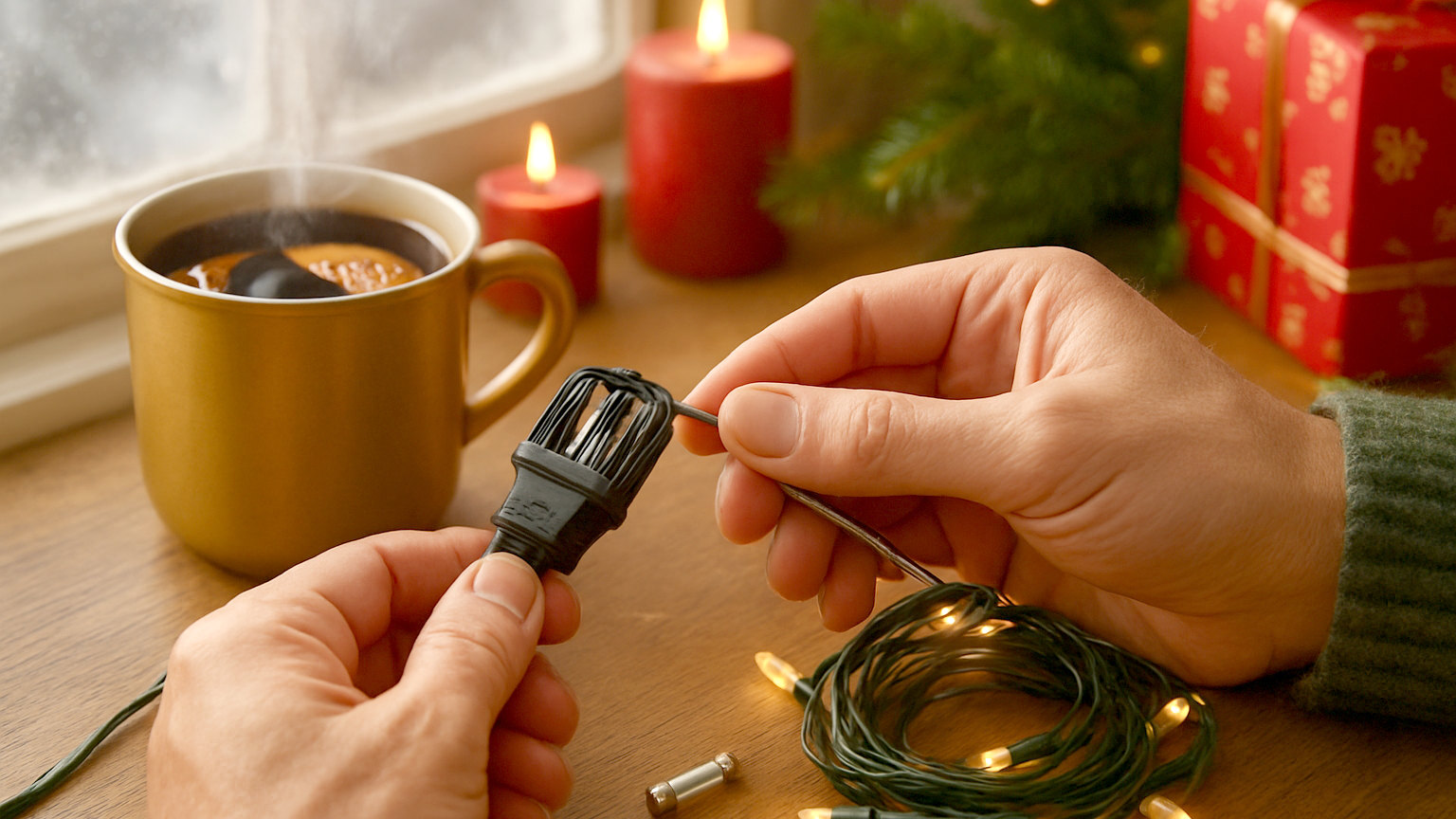
Most sets of Christmas lights that come out of the loft dead are not dead. They have a blown fuse in the plug, a loose bulb, or they are plugged into a socket that is switched off, and all three take under five minutes to establish. Throwing away a working set every year is both expensive and unnecessary, and the checks below cover the large majority of failures.
What should you check first?
The socket, by plugging something else into it. Then the switch on the plug, the timer if there is one, and whether a remote or a battery pack has flat batteries. These sound too obvious to mention and they account for a genuine share of failures every December. Only once the supply is confirmed is it worth looking at the lights themselves.
Why is the fuse usually the answer?
Because Christmas light plugs contain a small fuse, often a 3A or lower, and it is designed to fail rather than let the set overheat. It blows from surges, from being switched on and off repeatedly, or simply from age. Unplug the set, open the fuse compartment with a small screwdriver, and replace the fuse with one of the same rating. Never fit a higher rated fuse, since the rating is a safety limit rather than a suggestion.
How do you find a failed bulb?
On older non LED sets wired in series, one failed bulb can take out a whole section. Look for a bulb that is visibly blackened or sitting loose in its holder, and press each one gently to check it is seated. Most sets came with spare bulbs and a bulb puller in the packaging, which is the reason to keep the box. Modern LED sets are usually wired so that one failure does not kill the run.
Unplug the set before touching any bulb, holder or fuse. This applies even when nothing is lit, since part of a set can be live while another part is dark.
What if half the set works?
That points to a break in one section rather than a supply problem, which on a series wired set usually means a bulb or a holder somewhere at the start of the dark stretch. Work along from the last lit bulb. On a sealed LED set, a dark section generally means a broken wire inside the insulation, which is not economically repairable and is the point at which the set should be replaced.
When should a set be thrown away?
When the cable is cracked, brittle, taped, chewed by an animal or damaged in any way. When the plug is cracked or the pins are loose. When bare wire is visible anywhere. When it has been outside and is not rated for outdoor use. And when it is old enough to predate current safety standards, which for anything with a two pin European plug and an adaptor is worth taking seriously.
How should sets be stored to avoid this?
Wound onto a reel or a piece of stiff cardboard rather than bundled, which is what causes the internal wire breaks that finish a set off. Somewhere dry and not subject to extremes of temperature, so a loft is acceptable but a damp shed is not. Keep the packaging with the spare fuses and bulbs, and put a note in the box saying whether the set worked when it went away.
What should you do about outdoor sets?
Check the IP rating on the packaging before assuming a set can go outside, and never use an indoor set outdoors regardless of how sheltered the spot looks. Outdoor runs should be protected by an RCD. Any repair beyond changing a fuse or a bulb on an outdoor set is not a domestic job, and anything involving fixed wiring or a permanent external socket needs a qualified electrician.
What should you keep with the set?
The packaging, which contains the spare fuses, the spare bulbs and the bulb puller, and which is the only place the wattage and IP rating are written down. Cut the useful panel off the box and tape it to the reel if the box itself is bulky.
A note of what the set is for, whether it worked last year and how long the cable is saves ten minutes every December and takes thirty seconds to write.


