Most home Christmas trees are under lit, which is why they look flat once the daylight goes. The usual approach is to buy one set, wind it round the outside and hope, and the result is a ring of lights on the surface with a dark void behind it. Both the quantity and the placement are worth thinking about, and the placement matters more.
What is the rule of thumb?
Around 100 lights per foot of tree height as a minimum, so a six foot tree wants at least 600. For a full, dense look, many people go to 150 or even 200 per foot. That sounds like a great deal and it is roughly what a well lit tree in a shop window carries. If your tree has 200 lights on it and looks disappointing, the number is the reason.
Why does depth matter more than quantity?
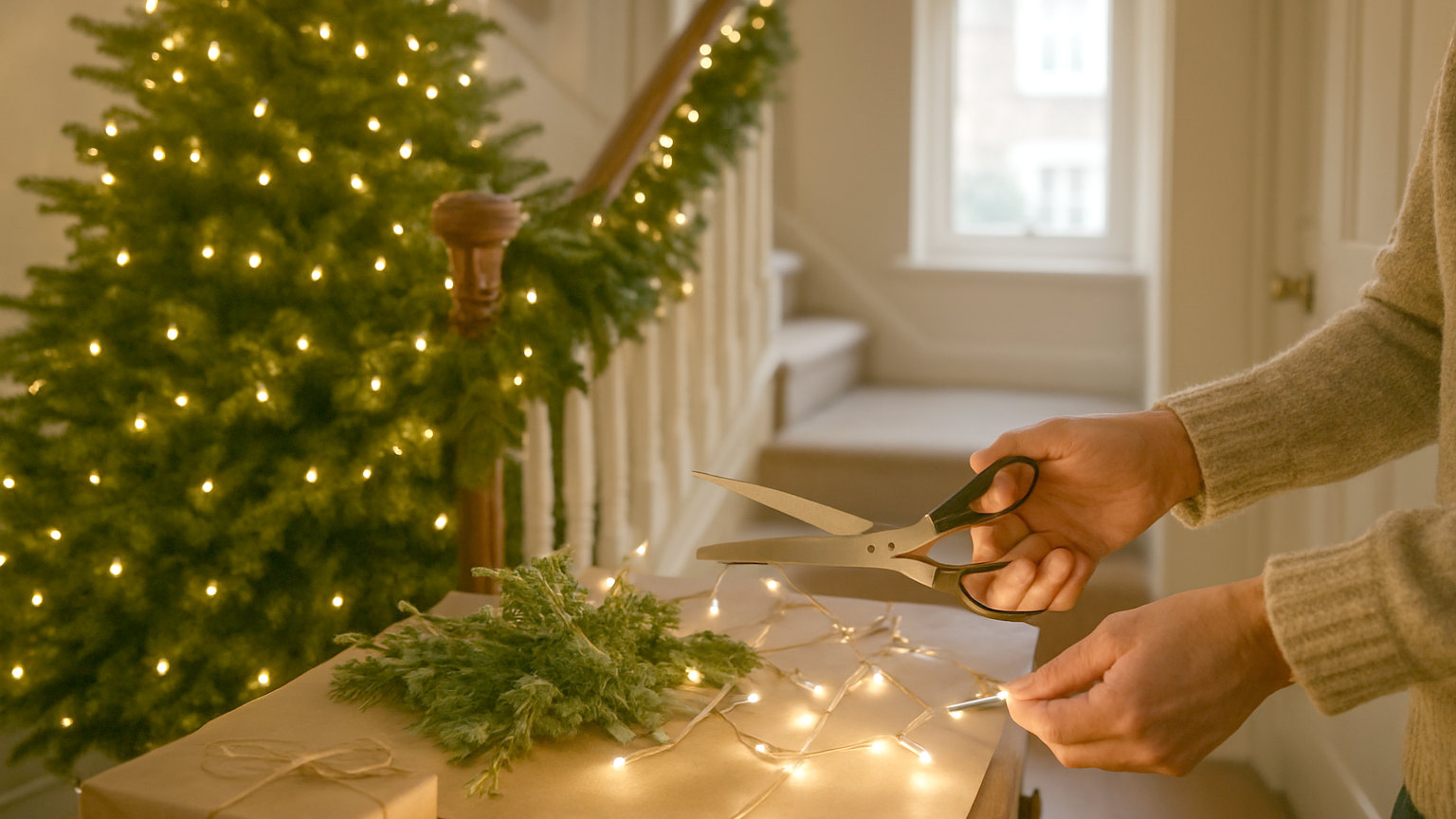
Because lights wound only around the outside illuminate the surface and leave the interior black, which makes the tree look two dimensional. Working the string in towards the trunk and back out again along each branch puts light inside the tree, so it glows from within. The same 600 lights placed with depth look dramatically better than 600 placed on the perimeter.
How do you plan the run?
Start at the plug end and work from the bottom of the tree upwards, or from the top down, but decide before you start so you know where the cable finishes. Working from the bottom means the plug ends up near the socket, which is usually what you want. Check the total cable length against the tree height before you begin, since running out two thirds of the way up is the standard frustration.
Test every set before it goes on the tree. Finding a dead section after an hour of winding is the reason people give up on real trees.
Should you use one long set or several shorter ones?
Several shorter sets are considerably easier to manage, easier to replace when one fails, and let you light sections of the tree independently. Check the packaging for how many sets can be safely connected end to end, since that limit exists for a reason and exceeding it can overload the first set in the chain. Where sets cannot be linked, plan for more than one socket.
What about the lights going on first?
Lights before anything else, always. Garlands and ribbon next, then baubles, then the topper. Adding lights after the baubles means lifting and disturbing everything already hung, and it usually results in the lights sitting on top of the decorations rather than behind them. This order is the one genuinely fixed rule of tree decorating.
Do you need lights on the back?
If the tree is in a corner or against a wall, no, and skipping the back saves a set. If it stands in the middle of a room or is visible from a window outside, then yes. It is worth deciding this before you buy, since it changes the quantity by roughly a third and there is no point lighting a face nobody will see.
How much do they cost to run?
Very little, if they are LED. A typical LED string draws only a few watts, so several sets running for six hours a day through December amount to a very small number of kilowatt hours in total. Older filament sets draw considerably more. To work it out for your own, multiply the wattage on the packaging by the hours used, divide by 1000, and multiply by your unit rate.
What about a pre lit tree?
It removes the whole job, which is a genuine advantage, and most come lit at a sensible density. The disadvantage is that when a section fails you cannot simply replace a set, and on a sealed tree that can mean losing the lighting entirely.
If you buy one, check whether the light sections are individually replaceable before you commit, since that single detail determines whether the tree lasts five years or fifteen.