A window is the only surface in the house seen from both sides at once, which is what makes it awkward. An arrangement that looks right from the sofa can read as a jumble from the pavement, and one designed for the street can shine straight into the room all evening. Deciding which audience matters more is the first decision, and most people never make it consciously.
What reads well from the street?
Simple, symmetrical shapes with clear outlines. A candle arch, which is why the Scandinavian ones are so effective. A single star. A row of evenly spaced lights along the top of the frame. What does not read well is a tangle of string lights draped without pattern, which from a distance is simply a bright patch. From outside, shape matters far more than quantity.
What about curtains and blinds?
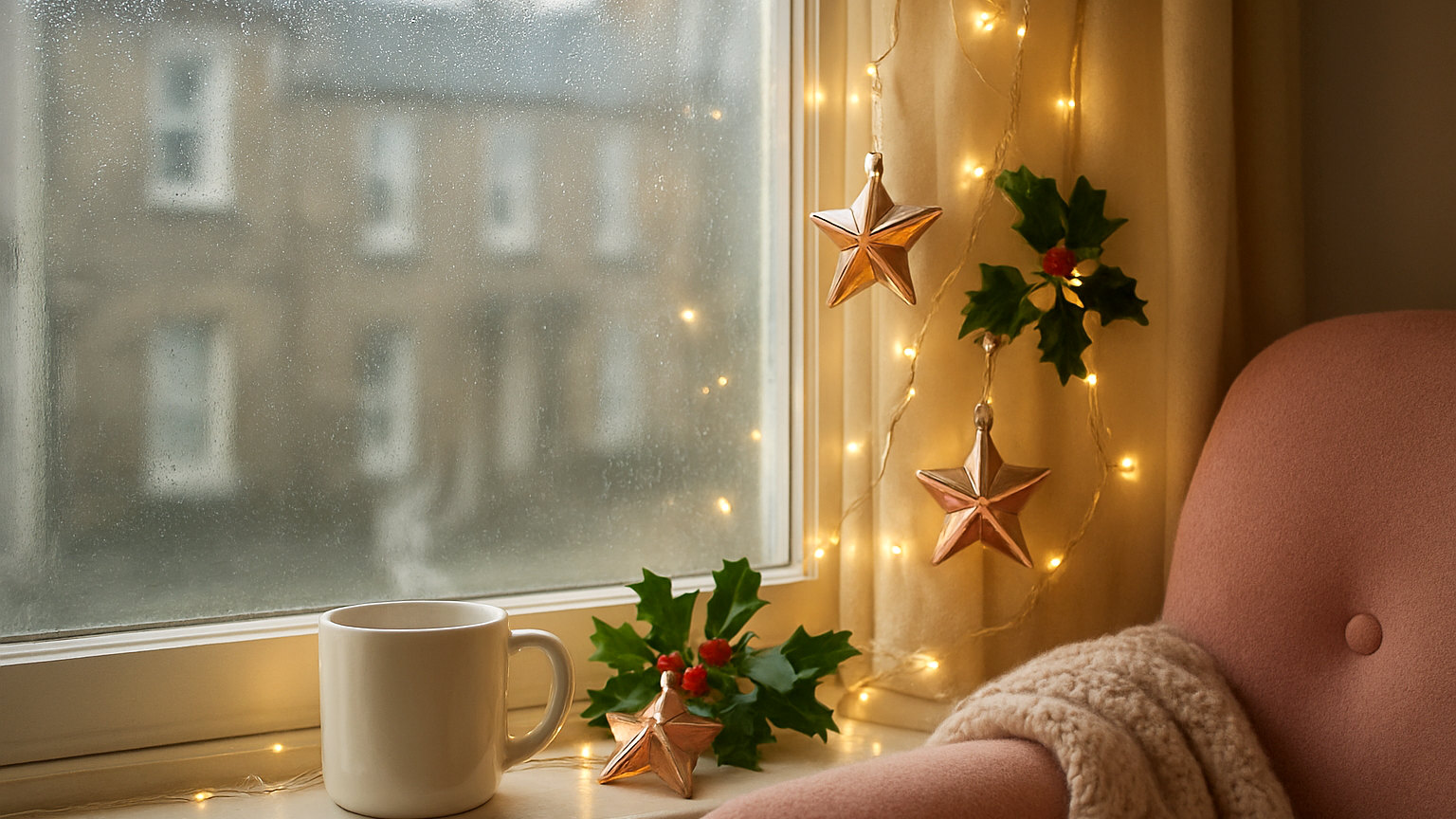
They are the practical constraint everybody discovers on the first evening. Anything sitting on the sill has to be behind the curtain when it closes, which means it is invisible from inside all evening, or in front of it, which means the curtain cannot close. A candle arch on the sill with the curtains drawn behind it is the usual compromise and it works well.
Why does condensation matter?
Because British windows run with it in December, and anything sitting in a puddle on a sill is a problem. Battery packs, mains connectors and paper decorations all suffer. Keep electrical parts off the glass and off the sill surface where water collects, wipe the sill regularly, and stand anything electrical on a small block or a coaster rather than directly on the wet surface.
Battery powered sets are the right default for a window. There is no cable to run across a room and nothing plugged in beside a surface that will be wet by morning.
Which lights suit a window?
Battery or USB sets, for the reason above. Warm white for a traditional look from the street, cool white if the scheme is silver and blue. A set with a timer, so the window comes on at dusk without anybody remembering. Curtain or net lights, which hang as a sheet and give an even effect, though they are best behind a net or a blind rather than against bare glass.
What about silhouettes and stickers?
Paper or card silhouettes taped to the glass and backlit are extremely effective from the street and cost almost nothing. Children can make them. Window stickers and spray snow both work in daylight, when lights do not, which is a genuine consideration since a window is on display for eight hours of daylight and only a few hours of dark.
How do you avoid lighting the room?
Point everything outwards and keep it low in the window, so the light falls away from the room rather than into it. A bright set at eye level facing inwards is genuinely uncomfortable to sit with for an evening. If the display is primarily for the street, closing the curtain behind it solves the problem completely and improves the view from outside.
What suits a flat with no outdoor space?
The window becomes the whole of the outdoor display, which is a good reason to do it properly. A lit shape facing outwards, a wreath hung on the inside of the glass, and a small tree visible from the street between the curtains together read as a decorated home from the pavement without anything being fixed to the building.
What about upstairs windows?
They are seen from further away and read best with one simple lit shape rather than anything detailed. A single star or a plain light frame in a bedroom window does more from the pavement than a complicated arrangement nobody can resolve at that distance.
Anything upstairs also needs to be safe to reach without leaning out, which rules out fixing things to the outside of an upper window entirely. Everything should be done from inside the room.