
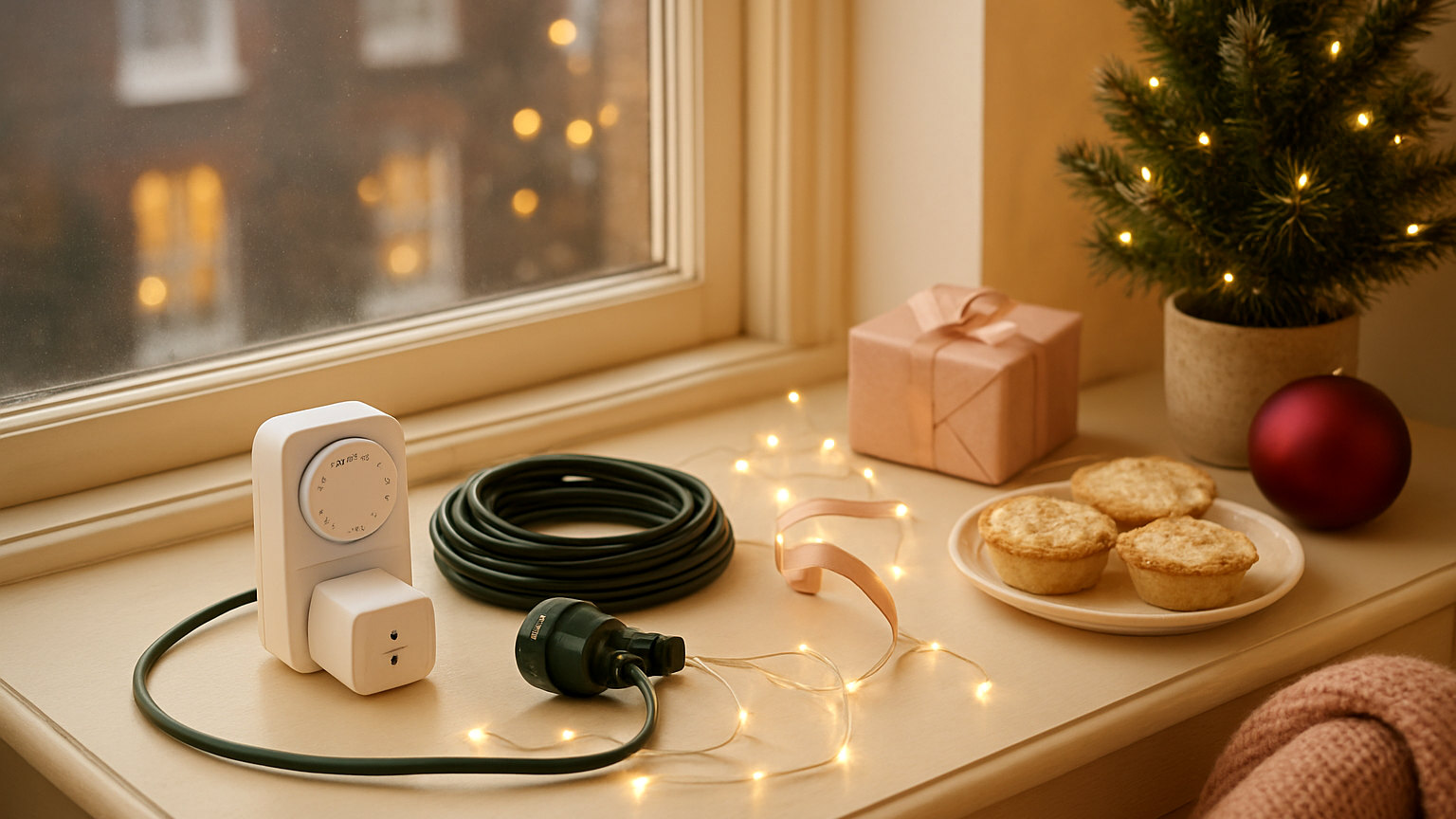
A plug in timer costs a few pounds and does three useful things at once: it cuts the running cost by halving the hours, it removes the nightly job of switching everything on and off, and it means the lights are never running while the house is asleep, which is the single most repeated piece of safety advice about Christmas lighting.
What is a mechanical timer?
The simplest option: a dial with segments you push down for the hours you want power. It plugs into the socket, the lights plug into it, and it repeats the same pattern every day. It needs no app, no network and no configuration, it costs very little, and it keeps working for years. For most households this is all that is required.
What does a smart plug add?
Control from a phone, schedules that vary by day, and in most cases the ability to switch things on and off by voice. The genuinely useful features are being able to turn the tree off from the sofa without crawling under the branches, and being able to check from elsewhere that the lights are off. It needs a network connection to work.
Which suits outdoors?
Only a timer or plug specifically rated for outdoor use, with an appropriate IP rating and a weatherproof housing. An indoor timer in an outdoor socket is a genuine hazard regardless of how sheltered the position looks. The alternative, and frequently the better one, is to keep the timer indoors and run an outdoor rated extension from it.
Check the timer rating against what you are plugging into it. Most are rated well below a wall socket, and an inflatable blower or a heater will exceed it easily.
What should the schedule be?
On around dusk, which in December is mid afternoon, and off at bedtime rather than at midnight. That is roughly six or seven hours a day against the sixteen or more that lights left running would use, which cuts both the cost and the wear on the sets by around two thirds. A second shorter slot early in the morning suits a household that is up before it is light.
Does it save much money?
Proportionally to the hours, which for LED lights is a small sum and for a large display with inflatables or projectors is a real one. The saving scales with what you are running, so a household with a single tree will notice very little and a household with a substantial outdoor display will notice a great deal.
What are the practical mistakes?
Putting the timer somewhere unreachable behind the tree, so it cannot be adjusted. Forgetting that a mechanical timer needs the current time set correctly on the dial. Plugging an extension into a timer and then overloading the extension. And assuming a timer switched off has isolated the circuit, which it has not, so anything being worked on should be unplugged at the socket.
What else can they be used for?
A lamp on a timer while you are away, which is a considerably better use than decorative lights for suggesting a house is occupied, since a lamp is designed for continuous operation and a light set is not. The same timer then does the job for the rest of the year, which is a reasonable argument for buying a decent one.
What should you not put on a timer?
Anything that needs to be watched while it runs, and anything with a heating element. A timer switching a heater or a blower on in an empty house is a genuinely poor idea whatever the packaging suggests.
The same applies to anything you would not be comfortable leaving running unattended, since a timer removes the person from the room rather than removing the risk.
Which should you buy?
A mechanical timer for anything indoors that only needs to come on and off at the same time each day, which covers the tree and most of the house for a couple of pounds.
A smart plug where you want to switch things from elsewhere in the house or check them while away, and an outdoor rated unit for anything outside. Most households need one of the first and one of the third.


