
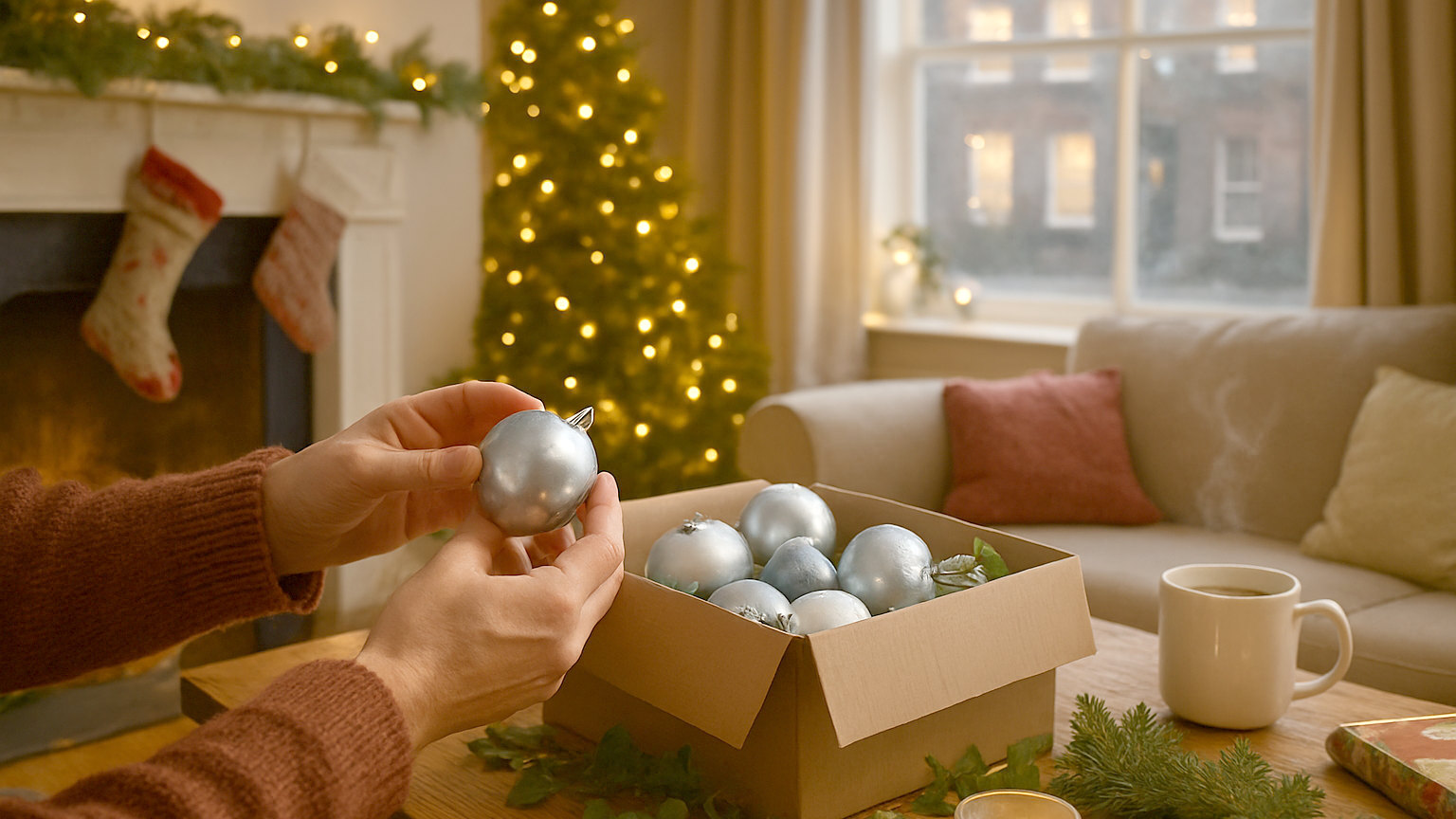
The cheapest time to buy Christmas decorations is the last week of December and the first fortnight of January, when everything is reduced by half or more and the stock has not yet been picked over by a full season. Buying in the week before Christmas is the most expensive possible approach, and it is what most households do.
Why are the January sales the answer?
Because decorations are seasonal stock that shops do not want to store for eleven months, so the reductions are genuine and steep rather than nominal. Everything keeps indefinitely. The only cost is remembering where you put it, which a single labelled box solves. Buying next year decorations in January is the single most effective thing in this article.
What about charity shops?
Excellent, and consistently underrated. Charity shops receive a great deal of Christmas stock in January when people clear out, and put it out again in November. Glass baubles, wooden decorations and vintage pieces all turn up for very little, and the older glass ones are frequently better made than anything currently sold at the same price. Check each one for chips and for an intact cap.
Where do you find things nobody else has?
Florist and garden trade suppliers, some of which sell to the public and stock the same ranges as the expensive shops. Museum and gallery shops. Independent gift shops in the January sales. Local craft fairs. Marketplace listings and local selling groups, where people sell complete sets they no longer want. Any of these produce a tree that does not look like everybody else.
Buy for next year in January and keep it in one labelled box. Half price, full choice, and nothing bought in a hurry.
What should you check for quality?
On glass baubles, that the cap is firmly attached and the neck is intact, since a loose cap is the most common fault. That the paint or glitter is not already shedding in the box. On plastic, that the finish is not already scratched. On anything with a hanging loop, that the loop is tied rather than glued. And that a set is complete, since a box of twelve is frequently a box of nine.
Why is a set of twenty-four usually a mistake?
Because twenty-four identical baubles produce a tree that looks bought rather than assembled, and because it uses up a whole year budget on one texture and one finish. Two sets of six in different finishes at the same price produce something far more interesting. Buying a smaller number of better pieces each year builds a collection; buying one large set replaces one.
What is worth spending money on?
Lights, where the difference between cheap and good is obvious in the colour and the failure rate. The tree topper, since it is the one everybody looks at. Two or three special pieces a year that you actually like. Everything else, including the plain filler baubles that make a tree look full, can be bought at the cheapest price you can find.
What can you make instead?
A surprising proportion of it. Dried orange slices, salt dough shapes, paper stars, cinnamon bundles, pine cones and felt shapes all cost almost nothing and last for years. A tree can be filled out very effectively with ribbon loops, which cost a fraction of what the equivalent volume in baubles would. Foliage from the garden covers most of the rest of the house.
What is worth buying second hand?
Almost everything except lights. Glass baubles, wooden decorations, artificial garlands, tree collars and even artificial trees turn up in good condition on local selling groups in January and again in November for a fraction of retail.
Lights are the exception, since you cannot assess internal cable damage from a photograph and a faulty set is a safety matter rather than a bargain.
The other reliable saving is simply buying less. A tree looks full because of light and ribbon as much as baubles, and both cost a fraction of what an equivalent volume of glass would.


