The decorations worth repairing are almost never the expensive ones. They are the salt dough star from a decade ago, the one from a holiday, the one that belonged to somebody. Most of what goes wrong with these is mechanical and fixable in five minutes, and knowing which repairs are worth attempting saves a surprising number of things from the bin each January.
What goes wrong most often?
The metal cap pulling off a glass bauble, which is by far the most common. Hanging loops perishing or coming untied. Glued elements dropping off. Paint chipping. Wire hooks bending open under weight. Fabric fraying. Almost all of these are failures of the attachment rather than of the decoration itself, which is why they are worth fixing.
How do you refit a bauble cap?
The cap is usually held by a springy metal insert that grips the inside of the glass neck. Squeeze the insert slightly wider with small pliers so it grips again, then push the cap back on. If the glass neck is intact but the grip has gone, a small amount of strong clear adhesive around the inside of the cap will hold it. Let it cure fully before hanging anything from it.
What if the glass neck has broken?
The bauble cannot be re-capped, but it does not have to be thrown away. Turn it upside down and use it in a bowl or a vase display, where the missing cap is invisible. Or fill it with lights inside a glass container. A broken neck on a plain bauble is usually not worth the effort, but on a sentimental one this keeps it in circulation.
Replace every perished hanging loop before it fails on the tree. Most breakages happen when a decade old thread gives way and a decoration falls onto a hard floor.
How do you replace a hanging loop?
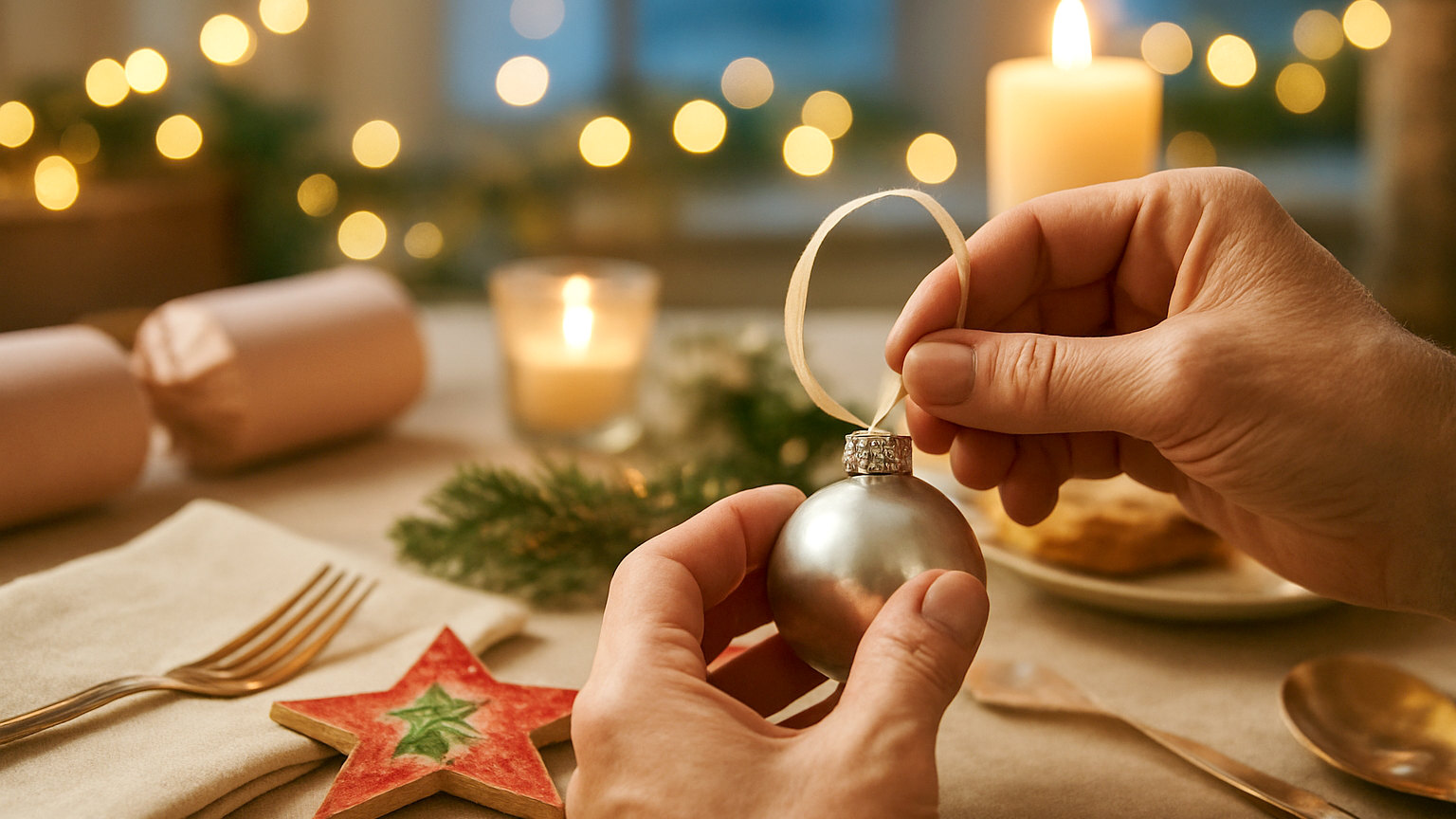
Thin ribbon, baker twine, fishing line or florist wire, threaded through and tied in a loop rather than knotted tight against the decoration. Fishing line is close to invisible and very strong, which suits anything heavy. Do this as a batch job in January when everything is out, rather than one at a time on the tree, and it takes twenty minutes for the whole collection.
Which glue should you use?
A clear strong adhesive for glass and ceramic, applied in small quantities. PVA for paper, card and salt dough. A hot glue gun for fabric, felt and anything with a gap to fill, though it shows more than the others. Avoid superglue on anything porous or painted, since it can blanch the surface and it is unforgiving of a misplaced join.
How do you rescue something a child made?
Gently, and accepting that it will show its age. Salt dough can be re-sealed with a coat of PVA or clear varnish, which stops it absorbing moisture and crumbling further. Chipped paint can be touched in or left. A photograph mounted on card can be re-mounted. If it is genuinely beyond repair, photograph it before it goes, which is worth more than the object by that point.
When should you let something go?
When it is a plain mass produced item you own six of. When a repair would take longer than the decoration is worth and it carries no history. And when it is a light set with damaged cable, which is a safety matter rather than a sentimental one. Deciding this in January, with everything laid out, is far easier than deciding in December with a tree waiting.
What should you check before packing everything away?
Every hanging loop, every glued joint and every light set, all at once, while it is out on a table in January. Repairs done then are unhurried, and anything needing a replacement can be bought in the sales rather than at full price in December.
Keep a small repair kit in the decorations box: a reel of fishing line, a tube of clear adhesive, some ribbon and a few spare hooks. It takes no space and it turns most repairs into a five minute job.