The glass bauble is one of the few Christmas traditions with a specific place of origin, and it is a small town in the Thuringian forest in Germany. The technique developed there in the nineteenth century, spread across the world within a few decades, and is still practised in the same town today, largely by hand and largely unchanged.
Where did they come from?
Lauscha, in Thuringia, a glassmaking town since the sixteenth century. Glassmakers there had long produced beads and glass eyes, and in the middle of the nineteenth century they began making decorated glass spheres for Christmas trees, which had previously been hung with fruit, nuts and candles. The story attaching the invention to one impoverished glassblower is charming and not well documented.
How did they spread?
Through export, and one retailer in particular. An American chain store began importing Lauscha baubles in the 1880s, initially reluctantly, and the trade grew to millions of pieces a year within two decades. The German industry supplied most of the world until the disruptions of the twentieth century, after which production spread to Poland, the Czech lands and eventually to machine manufacture elsewhere.
How is a hand blown bauble made?
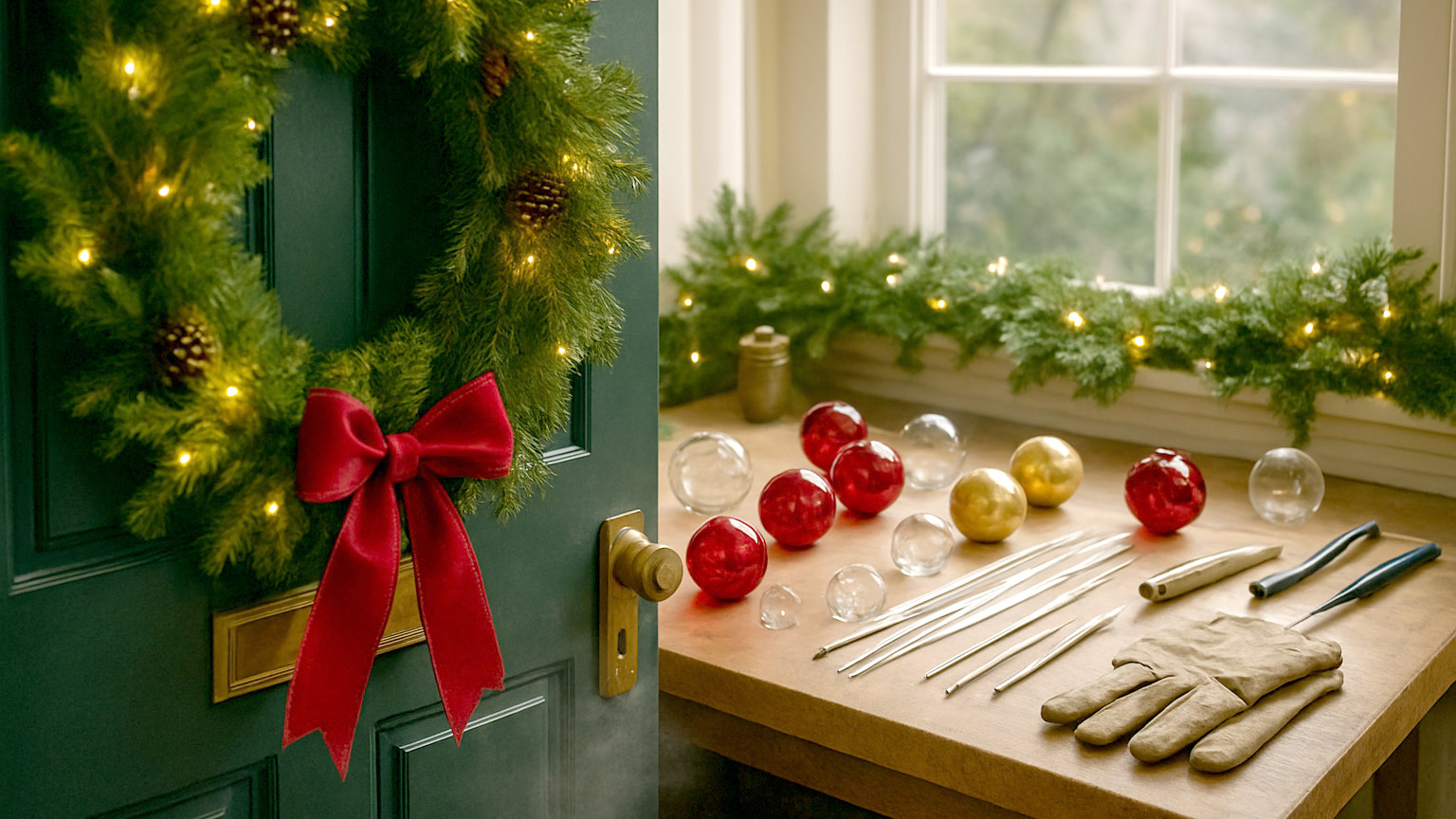
A length of glass tube is heated in a flame until it softens, then blown into a mould or free blown into a sphere, with the neck drawn out to form the opening. It is left to cool, then silvered, then coloured and decorated. A skilled maker produces a bauble in a couple of minutes, and the whole process is still done seated at a bench with a torch.
The silvering is what makes them shine. A solution is poured inside, swirled and left to deposit a mirror layer on the interior, which is why the colour appears to come from within the glass.
What is the silvering?
A chemical solution poured into the finished sphere and swirled so it deposits a thin reflective layer on the inside surface. Early versions used lead, later ones silver nitrate. That interior mirror is why a glass bauble has depth that a painted plastic one cannot reproduce, and why the colour appears to sit inside the glass rather than on it.
How do you tell a hand blown one?
Weight and thinness first: a mouth blown bauble is startlingly light and the glass is very thin. Look for a slight pontil mark or an irregularity at the neck where it was drawn off. Small variations between supposedly identical pieces. And a faint asymmetry, since no hand blown sphere is perfectly round. Machine made glass baubles are heavier, thicker and identical.
Are old ones worth anything?
Some are, particularly early figural shapes and pre war German pieces in good condition, and there is an active collectors market. Most are worth little in money and a great deal in other ways. Age is not the main factor: condition, rarity of shape and an intact original cap matter considerably more than the decade.
How should they be looked after?
Wrapped individually in tissue in a compartmented box, stored somewhere dry and stable rather than a loft that swings from freezing to thirty degrees. Handle by the cap rather than the body, since thin glass flexes. If a cap pulls off, the springy insert inside it can usually be widened slightly with pliers and pushed back on.
Where are they still made?
Lauscha itself, where several workshops still produce mouth blown and hand painted baubles and where the craft is treated as heritage as well as industry. Poland and the Czech Republic both have substantial hand blown production.
Machine made glass baubles are produced in far larger quantities elsewhere and are entirely serviceable. The distinction is worth knowing if you are paying a hand blown price.
What should you look for when buying?
An intact cap with a working spring insert, no chips around the neck, and no clouding inside, which indicates the silvering has degraded and cannot be repaired.
Hold it up to a light: a hand blown bauble will show slight variation in the thickness of the glass, which is a flaw in manufacturing terms and the main sign that a person made it.