The English speaking world has a gift bringer who rewards good children and, at most, leaves coal for the others. Across the Alps and much of northern Europe the arrangement is considerably more direct: Saint Nicholas travels with a companion whose job is the other children, and the companion is frequently horned, chained and genuinely frightening.
Who is Krampus?
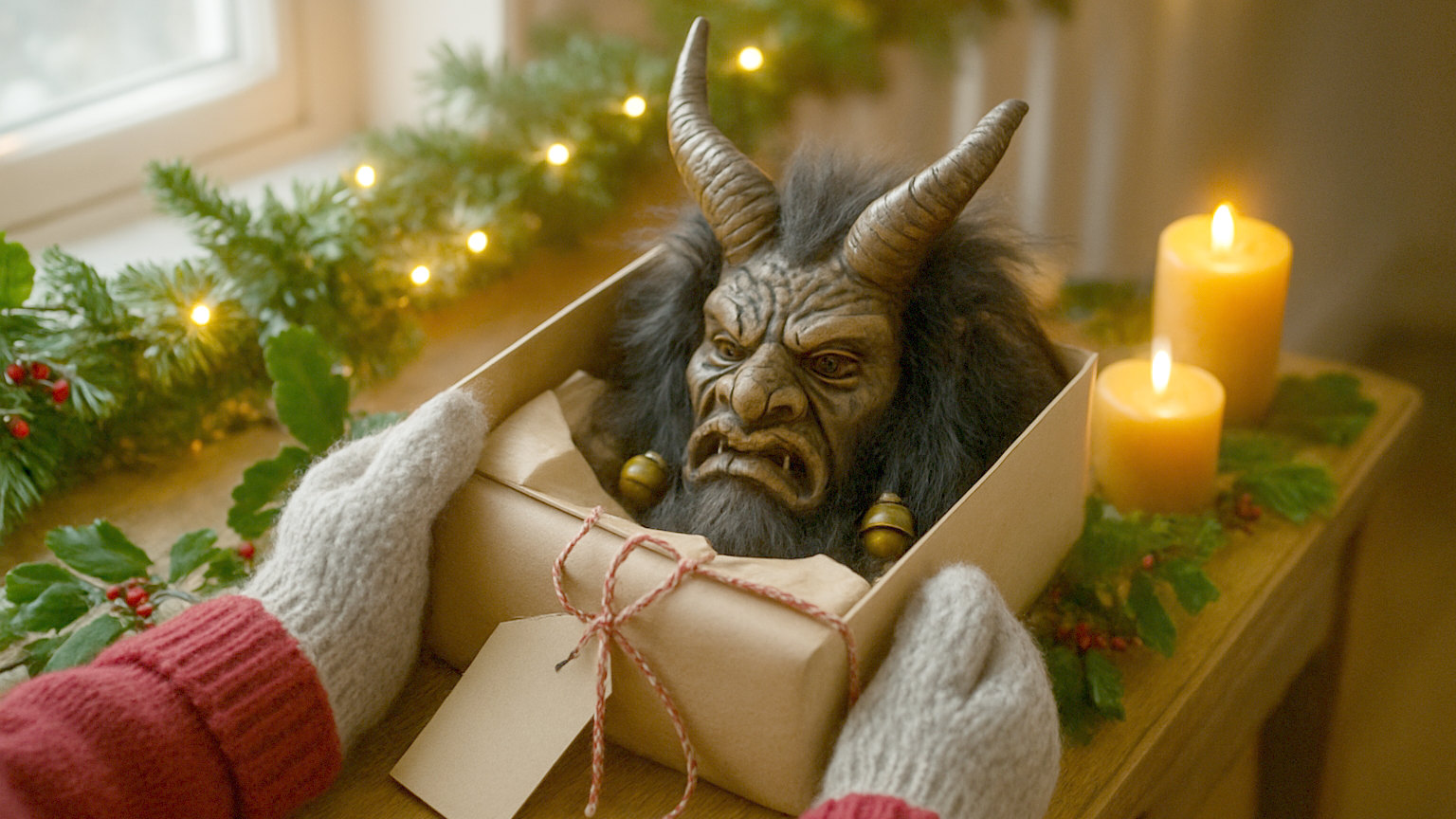
A horned figure from Alpine folklore, covered in fur, carrying birch switches and often chains, who accompanies Saint Nicholas on the evening of the fifth of December. Where Nicholas rewards, Krampus punishes, and in the stories he carries misbehaving children away in a basket. The tradition is strongest in Austria, Bavaria and parts of Hungary, Slovenia and Croatia.
What happens on Krampusnacht?
In many Alpine towns, a Krampuslauf, which is a parade of people in elaborate hand carved wooden masks and full fur costumes running through the streets on the fifth of December. They are loud, they carry bells and switches, and they will chase people. It is a genuine living tradition rather than a heritage performance and it draws substantial crowds.
Are there other companions?
Several, varying by region. Knecht Ruprecht in parts of Germany, a bearded figure carrying a sack and a stick. Belsnickel, a fur clad figure from the Palatinate, carried to Pennsylvania by German settlers. Pere Fouettard in eastern France and Wallonia. In the Netherlands, the companion of Sinterklaas has been the subject of significant public controversy and substantial change in recent years.
These figures are not a modern invention or a horror franchise. They are long standing regional traditions that predate the sanitised version by centuries.
What about the Nordic figures?
Iceland has the most elaborate cast. Thirteen Yule Lads arrive one at a time in the nights before Christmas, each with a specific mischief, from door slamming to stealing skyr. Their mother Gryla is an ogress who takes badly behaved children, and the Yule Cat eats anyone who has not received new clothes before Christmas, which is a strong incentive to give socks.
Who is Frau Perchta?
An Alpine figure associated with the twelve days after Christmas rather than with the run up, who inspects households and is said to reward the diligent and deal severely with the idle. She is considerably older than the Christian festival she is now attached to and belongs to a wider European tradition of midwinter figures who check on people.
Why do these figures exist?
Because midwinter traditions across Europe generally paired reward with threat, and because the season sits at the darkest point of the year in cultures where that mattered. The English speaking version, in which the gift bringer is entirely benign, is the unusual one rather than the norm, and it is largely a nineteenth century softening.
Where can you see them?
Alpine Austria and Bavaria in the first week of December, where the parades are advertised locally and are free to watch. Several are enormous. They are not suitable for young children, which the organisers say plainly, since the costumes are deliberately frightening and the participants will come into the crowd. Interest outside Europe has grown considerably in the last two decades.
Are they suitable for children?
The parades are not, and the organisers usually say so plainly. The costumes are deliberately frightening, the participants come into the crowd, and the noise is considerable.
The figures do appear in gentler forms in some household traditions, where a companion accompanies Saint Nicholas without the full parade, and that version is entirely manageable for a child.
Why has interest grown outside Europe?
Partly through film and television, which have used the figure repeatedly since the 2010s, and partly through a wider appetite for the older and stranger parts of the tradition.
That has produced Krampus events in Britain and North America, which are new rather than traditional, and which the Alpine communities view with a certain amount of amusement.