
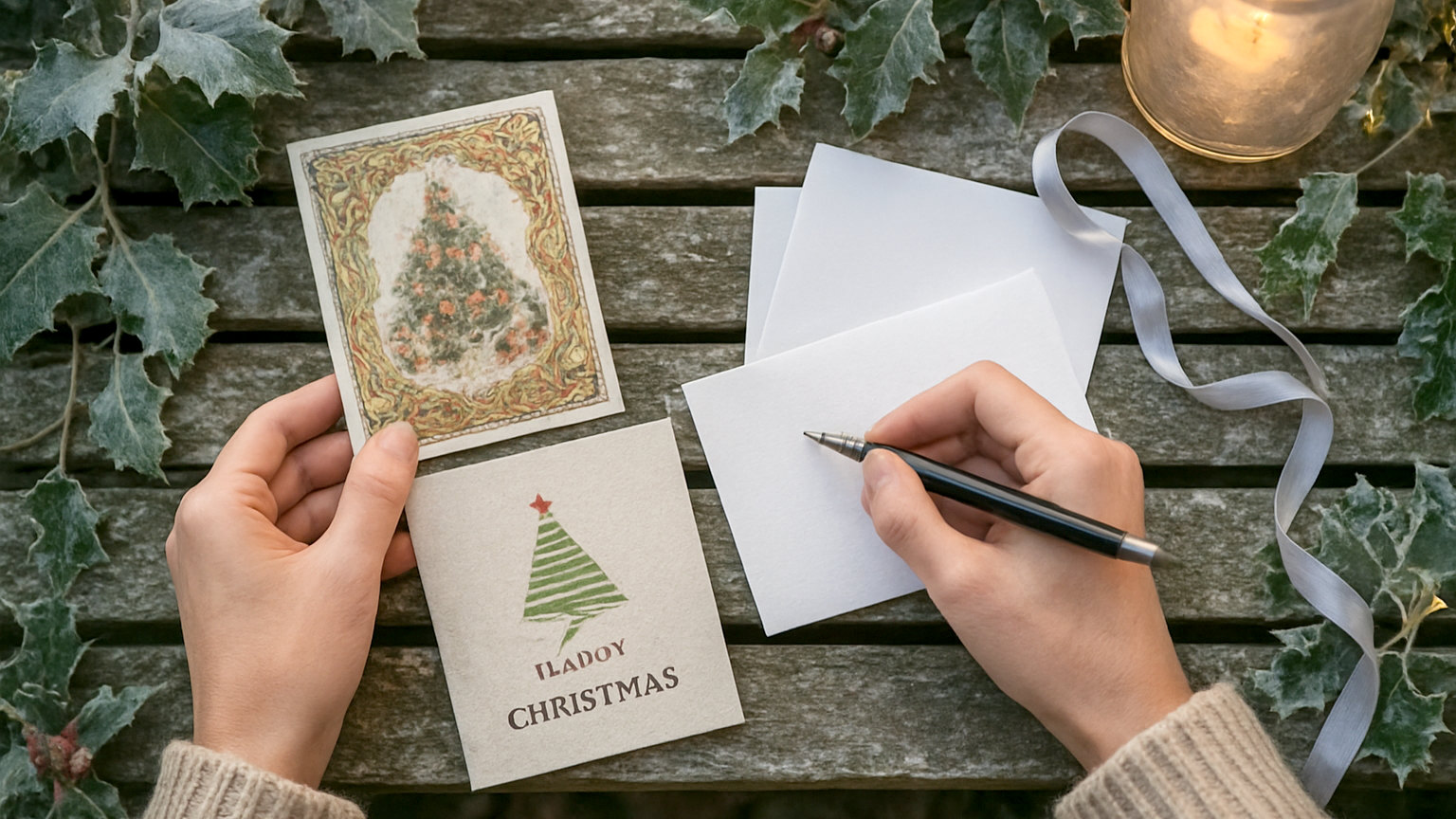
The Christmas card began as one man attempt to avoid writing a large number of individual letters, became a habit involving hundreds of millions of items a year, and is now in fairly steep decline. The whole arc runs from 1843 to the present and it tracks the cost of postage almost exactly, which tells you most of what you need to know about why people sent them.
Who sent the first one?
Henry Cole, a civil servant who had been involved in the introduction of the penny post, commissioned an illustrated card from the artist John Callcott Horsley in 1843. It showed a family at table with panels depicting charitable acts, and about a thousand were printed. They were expensive and the design attracted some criticism for showing a child being given wine.
What made it possible?
The penny post, introduced in 1840, which for the first time made sending something to a large number of people affordable. Before that, postage was paid by the recipient and priced by distance, which made unsolicited mail an imposition rather than a gift. A uniform cheap rate changed the economics entirely.
How did it become a mass habit?
Through cheaper printing and a further reduction in postal rates for cards in the 1870s, which brought the cost within reach of most households. Colour lithography made elaborate designs affordable. By the last decades of the century the Christmas card was an established industry with a vast range of designs, many of them nothing to do with Christmas at all.
Victorian card designs are considerably stranger than the modern version. Dead robins, giant insects and unsettling children all appear regularly and nobody has entirely explained why.
What were the Victorian designs like?
Frequently bizarre. Alongside the expected snow scenes and robins there are cards showing dead birds, anthropomorphic frogs, enormous insects, and imagery that reads as macabre to a modern eye. Explanations vary from a different attitude to mortality to simple novelty in a crowded market, and none of them is entirely satisfying.
Why the robin?
Because Victorian postmen wore red uniforms and were nicknamed robins, so a robin on a card was a small joke about the postman delivering it. The bird then became attached to Christmas independently of the joke, and it now appears on cards sent by people who have never heard the explanation.
Why is the habit declining?
Postage costs, which have risen substantially in real terms, and the availability of free instant alternatives. Sending fifty cards is now a considerable expense, and a great many people who once sent a full list have reduced it to close family or stopped entirely. Charity cards remain popular, though the proportion actually reaching the charity varies enormously and is worth checking on the box.
Is it worth keeping up?
For a reduced list, many people find it is. A card is one of the few remaining reasons to write to somebody you rarely see, and for older relatives who do not use messaging it is frequently the only contact of the year. Sending ten carefully rather than fifty dutifully is where most households have landed, which is probably the sensible position.
When should you post them?
Earlier than most people do. The Royal Mail last posting dates for second and first class fall well before Christmas and are published in the autumn, and overseas deadlines are earlier still, frequently in the first days of December.
A card arriving after the decorations have come down has largely missed its purpose, so working backwards from the deadline rather than forwards from when you get round to it is the practical approach.
What do you do with them afterwards?
Cut them into gift tags for next year, which is the traditional use and takes ten minutes. Several charities also run card recycling collections in January.
Cards with glitter or foil cannot go in household recycling, which covers a substantial proportion of what arrives, so the scrunch test applies to cards as much as to wrapping paper.


