
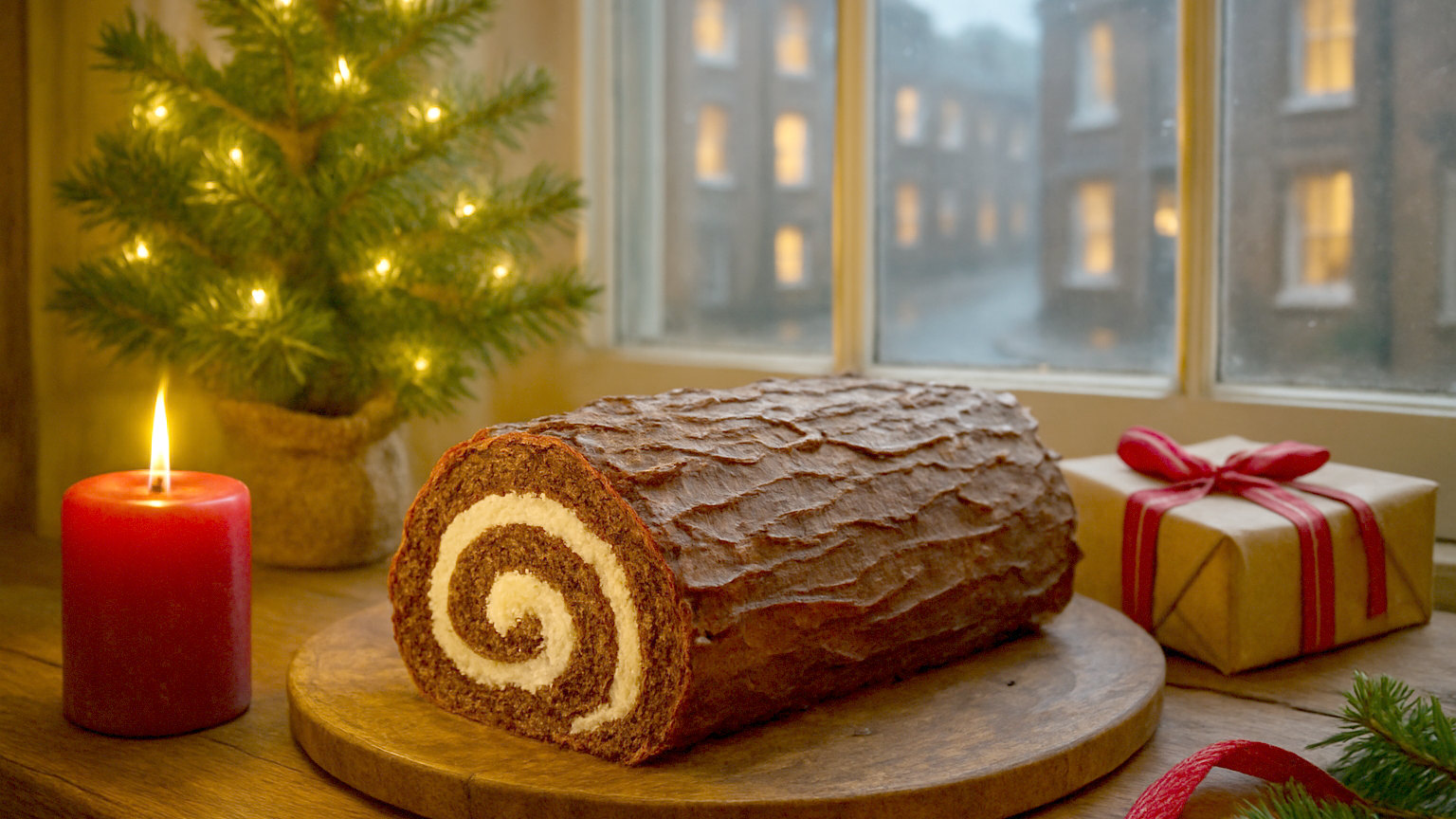
The Yule log is among the small number of Christmas customs that is genuinely ancient rather than Victorian, and it has ended up as a chocolate Swiss roll. The journey from a midwinter fire ritual observed across northern Europe to a supermarket dessert is a fairly complete illustration of what happens to traditions when the conditions that supported them disappear.
What was the custom?
A large log, sometimes a whole section of trunk, brought into the house on Christmas Eve with some ceremony and set burning on the open hearth. It was intended to burn through the twelve days of Christmas, or at least through Christmas Eve and Christmas Day, and a piece was kept back to light the following year fire.
What rules were attached to it?
A great many, varying by region. It should be found or given rather than bought. It should be lit with the saved fragment of last year log. It must not go out before its time, which was regarded as a bad omen for the household. The ashes were kept and variously scattered on fields, used as a charm against fire, or added to a well.
How old is it?
Older than the Christian festival it attached itself to. Midwinter fire customs are recorded across Germanic and Nordic Europe and belong to the same family of traditions as bringing evergreens indoors. The word Yule itself predates Christmas in English and Norse and referred to the midwinter feast rather than to the nativity.
The log required an open hearth large enough to take a tree trunk. When those disappeared from ordinary houses, the custom had nowhere to happen and it went with them.
Why did it disappear?
Because the fireplace changed. A custom requiring a hearth large enough to burn a section of trunk for several days cannot survive in a house with a small grate, and it certainly cannot survive central heating. The decline maps almost exactly onto the disappearance of the open hall fire from ordinary homes through the eighteenth and nineteenth centuries.
How did it become a cake?
In nineteenth century France, where the buche de Noel appeared as a dessert shaped and decorated to resemble the log, at exactly the point when the actual custom was fading. It is a memorial rather than a descendant. The British yule log cake is an import of the same idea, and most people eating one have no idea it refers to anything.
Does it survive anywhere?
In pockets, and in revived form. Some households with wood burners keep a version of it, and several communities have revived it as a public event. In parts of the Balkans and southern Europe related customs persisted considerably longer. As a domestic tradition in Britain it is effectively gone outside of deliberate revivals.
Can you do a version of it?
If you have a fire, yes, and it takes nothing but the decision. Choose a log, bring it in on Christmas Eve, light it that evening, and keep a piece back for next year. It costs nothing, it gives the evening a small ceremony, and it is one of the few things you can do at Christmas that somebody in the same landscape was doing a thousand years ago.
What is a yule log in other countries?
The custom appears across northern and central Europe under different names, and in parts of the Balkans a related tradition of bringing in and burning an oak branch on Christmas Eve survives as a substantial public occasion.
In several places the ashes or a fragment of the wood retained their protective reputation long after the burning itself had become symbolic rather than practical.
What is left of the word Yule?
A good deal more than the custom. It survives in Yuletide, in the log, in the Scandinavian jul and in a scattering of dialect usage, and it is one of the oldest words attached to the season in English.
It refers to the midwinter feast rather than to the nativity, which is why it appears in contexts that have nothing religious about them at all.


