
Small presents are where Christmas money is wasted most efficiently. Eight items at five pounds each is forty pounds per stocking, and in most households at least half of that is in a drawer or a bin by February. The fix is not to spend less but to apply the same test to a five pound item as to a fifty pound one: would this be used in an ordinary week in March.
What makes a five pound present worth having?
It has to be the good version of something small rather than a small version of something good. A proper pen, a solid keyring, a decent pack of cards, real chocolate rather than novelty chocolate, seeds from a serious supplier, a pair of warm socks in merino instead of a pair of novelty socks in thin cotton. Five pounds is enough to buy the honest version of many everyday objects, and the honest version is what gets used.
Which cheap fillers reliably get used?
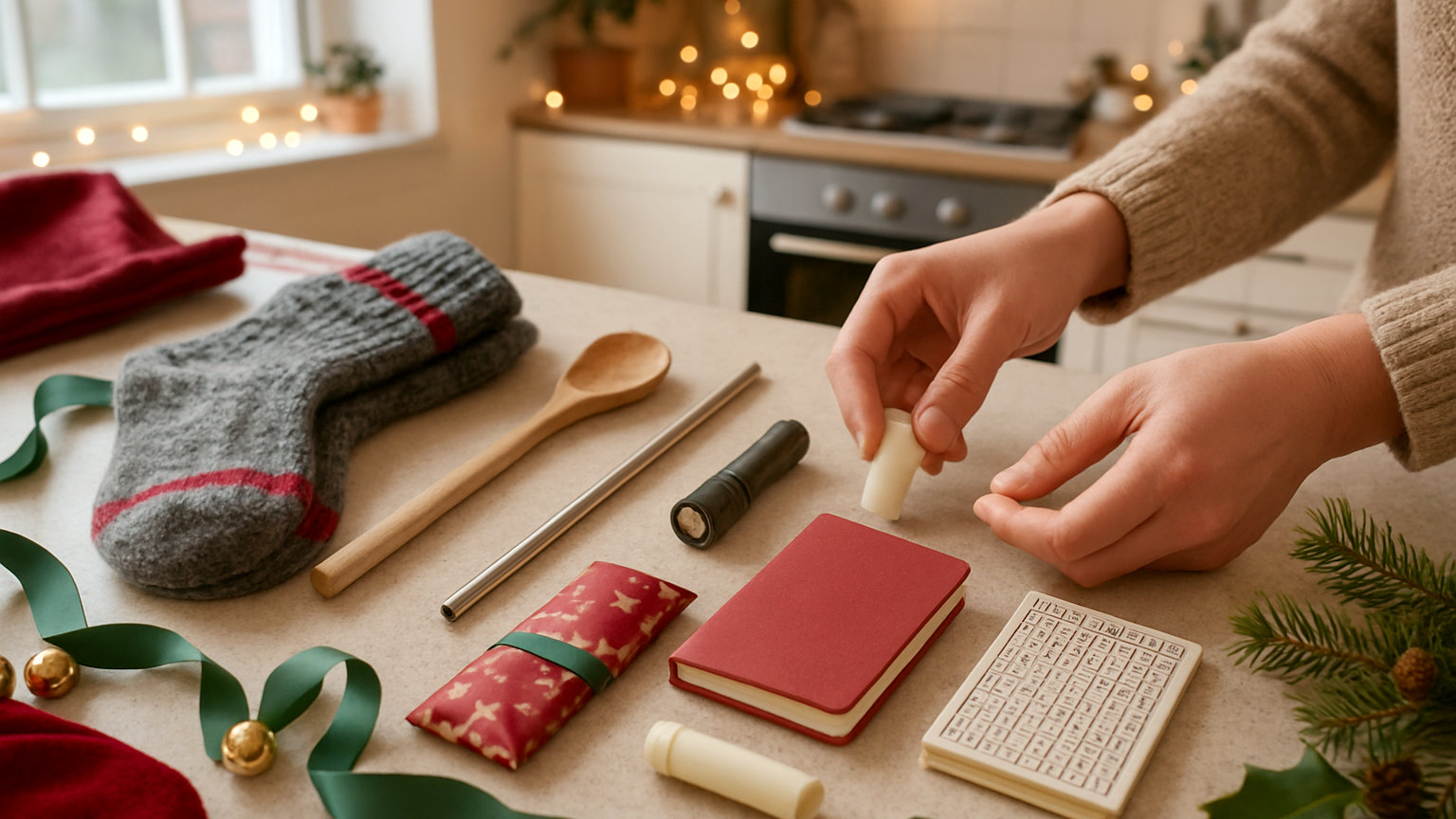
Consumables lead: chocolate, sweets, good coffee sachets, hot chocolate, spices, a small jar of something. Practical items follow: batteries, lip balm, hand cream, hair ties, phone cable, a torch, a tape measure, a nail brush. Then small entertainment: a puzzle book, a pack of cards, a paperback from a second hand shop, dice. All of these disappear into ordinary life rather than sitting on a shelf being decorative.
Which are landfill by January?
Anything whose entire purpose is to be amusing once. Miniature versions of appliances. Novelty desk items. Cheap headphones and cheap chargers, which fail quickly and are irritating rather than free. Branded merchandise for something they liked eighteen months ago. Sets of five tiny things sold together, which are five disappointments in one packet. If you cannot picture the object still existing at Easter, it is not a present, it is packaging.
How do you buy eight fillers without overspending?
Buy across the year rather than in December. Anything that will keep can be bought in January sales, on holiday, or whenever you happen to see the right thing, and stored in one box. This spreads the cost across twelve months instead of one, and it removes the December problem of buying whatever is in front of you because time has run out. Keep the box somewhere you will remember, since the classic failure is finding it in February.
Set the box up in January and add to it whenever you see something good. One box, one rule, and the whole stocking problem disappears from December entirely.
Do fillers need to be new?
Not at all, and for books in particular second hand is often better, since five pounds buys a good hardback rather than a thin paperback. Charity shops, second hand bookshops and market stalls all produce better fillers than a supermarket aisle at the same price. The one category where new matters is anything hygiene related or anything with a shelf life.
How many should each stocking have?
Six to eight small items plus the satsuma is enough for most stockings, with one slightly larger item to give the middle some shape. More than that and the stocking will not close, the unwrapping becomes a chore rather than a pleasure, and the last few items are opened without being looked at. Fewer, better and properly wrapped beats a bulging stocking every year.
Where are the best places to find them?
Hardware shops, garden centres, delicatessens, stationers and second hand bookshops all outperform the aisle of Christmas gift items in a supermarket, because they sell useful things at ordinary prices rather than novelties at gift prices. Museum and gallery shops are strong for small stationery and puzzles. Markets are good for food. The general rule is that anywhere selling things for their function will produce better fillers than anywhere selling things for the occasion, and usually for less money. It is also worth keeping an eye on the reduced shelves in the weeks after Christmas, when perfectly good items lose their seasonal packaging and their price at the same time.


