
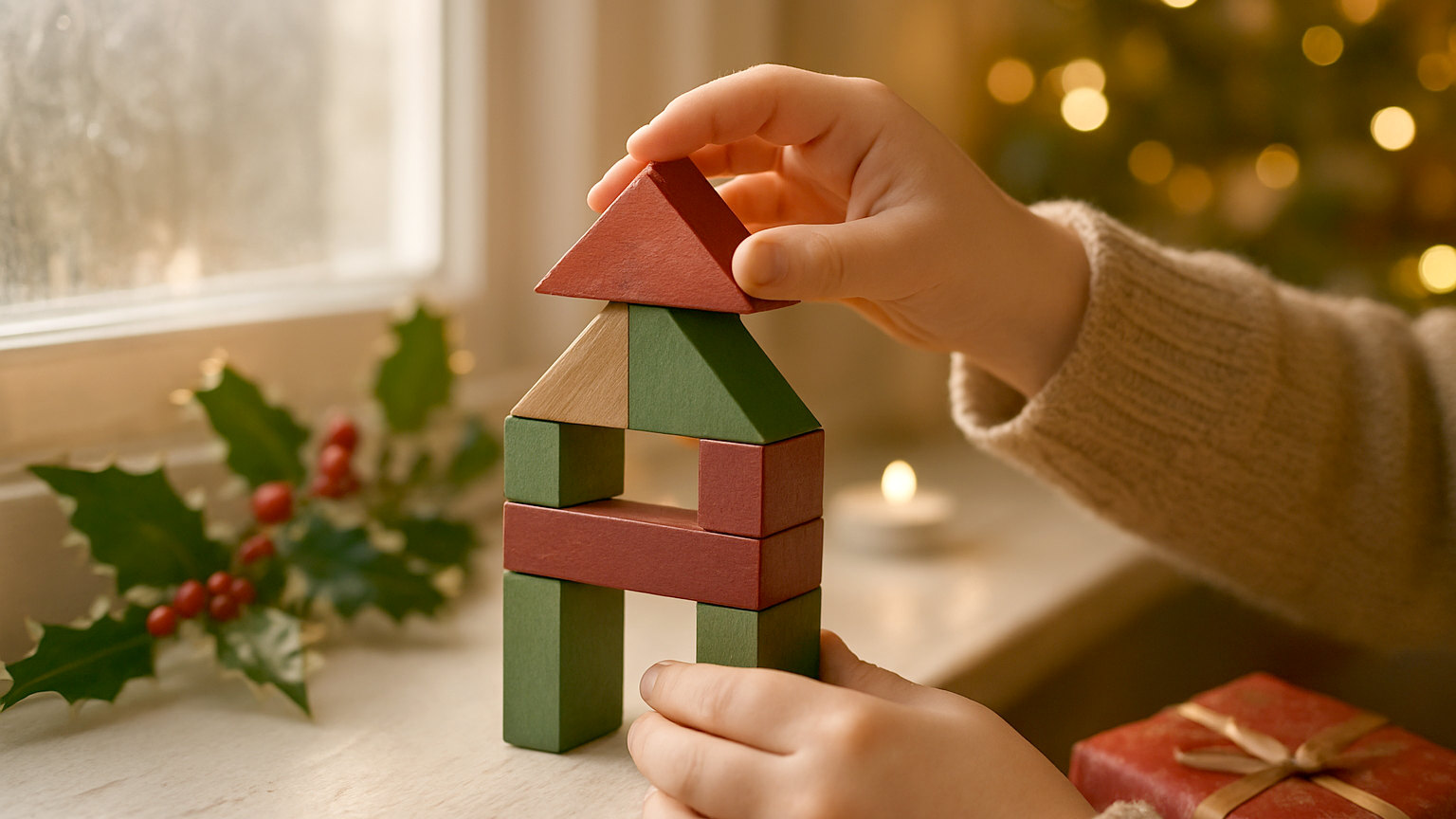
Most toys given at Christmas are abandoned within a few weeks, which is expensive, wasteful and entirely predictable. The ones that survive into spring share a small number of characteristics, and none of them are the characteristics that toy advertising emphasises. Knowing what to look for turns a pile of guesses into a couple of confident decisions.
What do the long-lasting toys have in common?
They can be played with in more than one way. A toy with a single function is finished as soon as the child has seen the function work, whereas a toy that can be arranged, combined, built with or used as a prop in an invented game has no natural end. Blocks, figures, vehicles, art materials, dressing up and construction sets all belong in this group. So does anything the child can add to over time, which is why systems outlast standalone items.
Why do the heavily advertised toys fade fastest?
Because the advertisement is doing the work that the toy cannot. A toy that performs an impressive trick sells well, and the trick is the whole experience. Once seen, there is nothing left to discover. Toys tied to a film or a series have an additional problem: the interest has an expiry date attached to the popularity of the thing it is based on, and children are ruthless about last year.
How can you judge a toy before buying it?
Ask three questions. What is the child doing while playing with it, as opposed to what the toy is doing. How many different ways could it be used. And would it still be interesting on the twentieth occasion. If the answer to the first is watching, and the answer to the second is one, the toy is a fifteen minute experience regardless of the price. Toys that require the child to do the imagining tend to outlast toys that do the imagining for them.
Does price predict how long a toy lasts?
Barely. Some of the most durable playthings are inexpensive, and some of the most expensive are single trick items. What price does predict is physical durability, which matters for anything that will be handled daily by a small child. A cheap version of a good design that breaks in February is a false economy, but an expensive version of a poor design is simply an expensive poor design.
Check what the toy needs before it works: batteries, an app, a subscription or a specific device. Each additional requirement is another reason it stops being used.
Which toys suit which ages?
Age labels on packaging are largely safety guidance rather than developmental advice, particularly the three and over warning, which refers to small parts. Buying above the stated age is common and usually fine for an older sibling situation, but buying below it is not, because the warning is about choking rather than difficulty. Beyond safety, the more useful guide is what the child is currently doing on their own initiative, because that is where their interest already sits.
When is it worth buying second hand?
Frequently. Wooden toys, construction bricks, train sets and puzzles all survive multiple childhoods and cost a fraction second hand, which allows a larger and better set for the same money. Check that sets are complete, wash everything on arrival, and avoid used items where safety depends on condition, such as car seats, helmets and anything electrical. Buying the bigger second hand set rather than the small new one is one of the few ways to increase play value while spending less.
What should you do with the toys that are not played with?
Deal with them in February rather than leaving them to accumulate, and involve the child in the decision where you can, since a toy given away with agreement causes no upset while one that disappears quietly does. Charity shops take most things in good condition, and nurseries, playgroups and refuges often want specific items. Rotating toys out of sight for a few months and reintroducing them also works surprisingly well, because a toy that returns after an absence is frequently played with as though it were new.


