
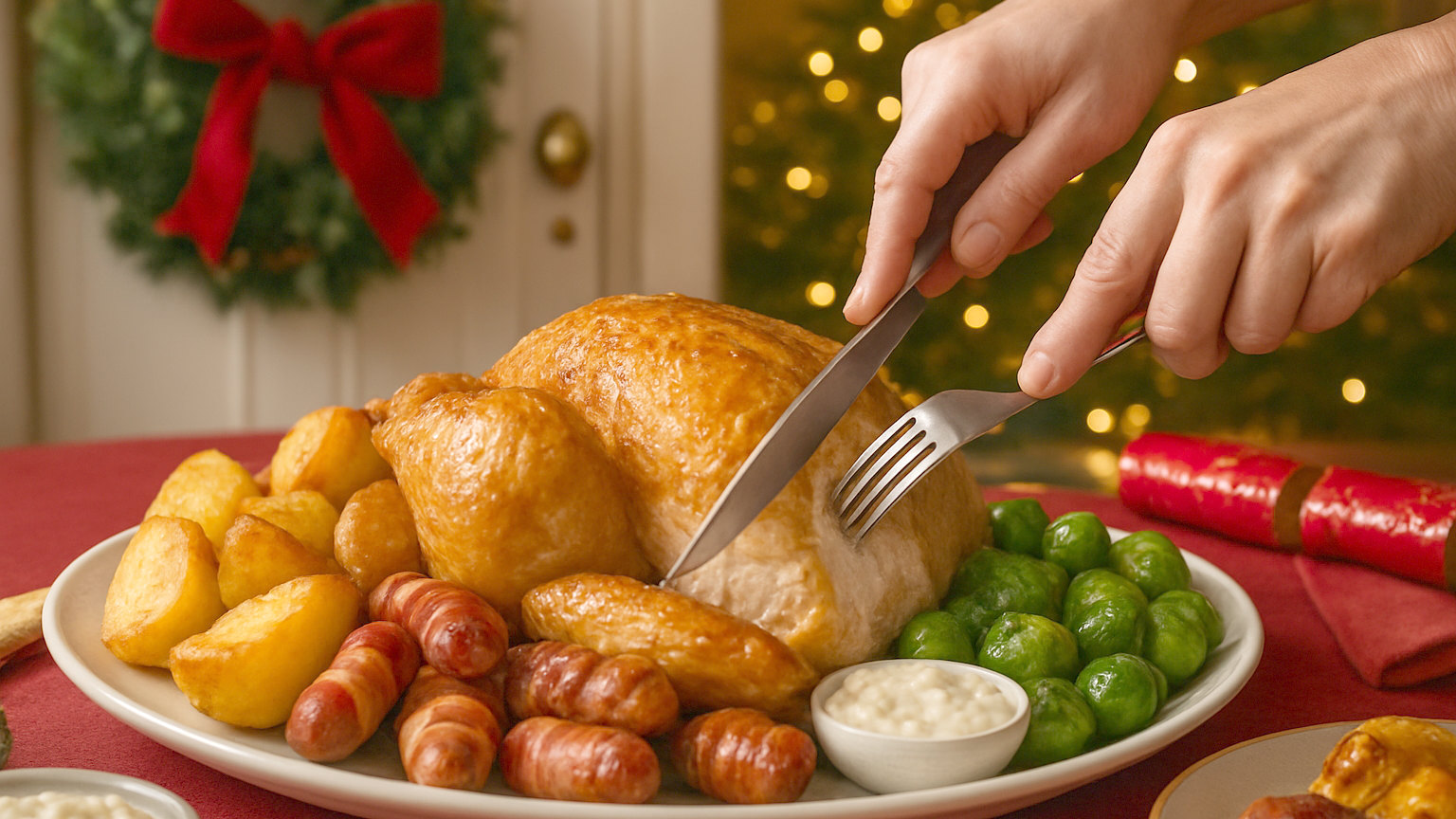
Christmas dinner scales down badly. The classic version assumes a crowd, a large oven and somebody who does not mind spending five hours in a kitchen, and applying it to a table of two produces a great deal of work, an enormous quantity of leftovers and a bird that will not fit the fridge afterwards. Cooking for a small number is a different problem, and it has better answers than a shrunken version of the same meal.
What should you cook instead of a turkey?
Duck breasts, which take fifteen minutes in a pan and are unmistakably a special occasion. A chicken, roasted properly with butter under the skin. A small joint of beef, cooked to a probe. Pork belly for crackling. A whole baked fish or a side of salmon. Any of these gives you a proper centrepiece without committing to a week of cold meat, and most of them take under an hour.
How do you keep the occasion without the scale?
Keep the elements that signal Christmas rather than the quantity. Roast potatoes, one or two good vegetables, a proper gravy, a bottle you would not open on an ordinary evening, and the table laid properly with crackers. It is the shape of the meal that carries the occasion rather than the number of dishes on it, and five items done well beat eleven done at speed.
What can you leave out entirely?
Most of it, honestly. Nobody eating a Christmas dinner for two needs four vegetables, two kinds of stuffing, bread sauce, cranberry sauce, pigs in blankets and a starter. Choose the three things your household actually looks forward to and drop the rest without apology. The items that survive that test vary enormously between families, which is a good indication of how much of the traditional spread is habit.
Cook the three things you actually look forward to and leave the rest out. A small table exposes very clearly which parts of the traditional dinner nobody eats.
How do you handle the trimmings?
Buy small quantities and make things that keep. Cranberry sauce lasts a fortnight, so one batch covers it. Bread sauce can be made in a small pan. Pigs in blankets come frozen in small bags. Stuffing is worth making properly even for two, since a small dish takes the same effort as a large one and the leftovers go into a sandwich. Buy vegetables loose rather than in bags sized for six.
What about pudding?
Individual puddings solve the problem of a full sized one feeding twelve, and small ones reheat in minutes. Alternatively skip the pudding entirely and have good cheese, a bar of decent chocolate or something from a bakery. A Christmas pudding kept from a previous year is very good and costs nothing, since a well fed one keeps for well over twelve months.
Is it worth cooking at all for one person?
Entirely a matter of preference, and both answers are legitimate. Some people find that cooking a proper meal for themselves is the point of the day. Others would rather have something they love that has nothing to do with Christmas at all, eaten in front of a film. Neither is a failure, and the assumption that a solitary Christmas must be sad is worth resisting.
How do you plan the timings?
Far more loosely than for a crowd, which is the real luxury of a small Christmas. With one small joint and two or three sides, the oven is not contested and the whole meal comes together in about ninety minutes. Write the timings down anyway if it helps, but the pressure that makes a large Christmas dinner stressful is simply absent, and it is worth noticing that rather than manufacturing it.
What should you buy less of?
Everything sold in a bag sized for a family of six, which is most of the vegetable aisle in December. Buy sprouts, carrots and parsnips loose, buy one small red cabbage rather than a whole one, and buy bread on the day rather than in advance.
Cheese is the other place a small household overbuys badly. Three good pieces at around 100g each is plenty for two people across several days, and it will be in better condition than a large board that sits in the fridge until January.


