
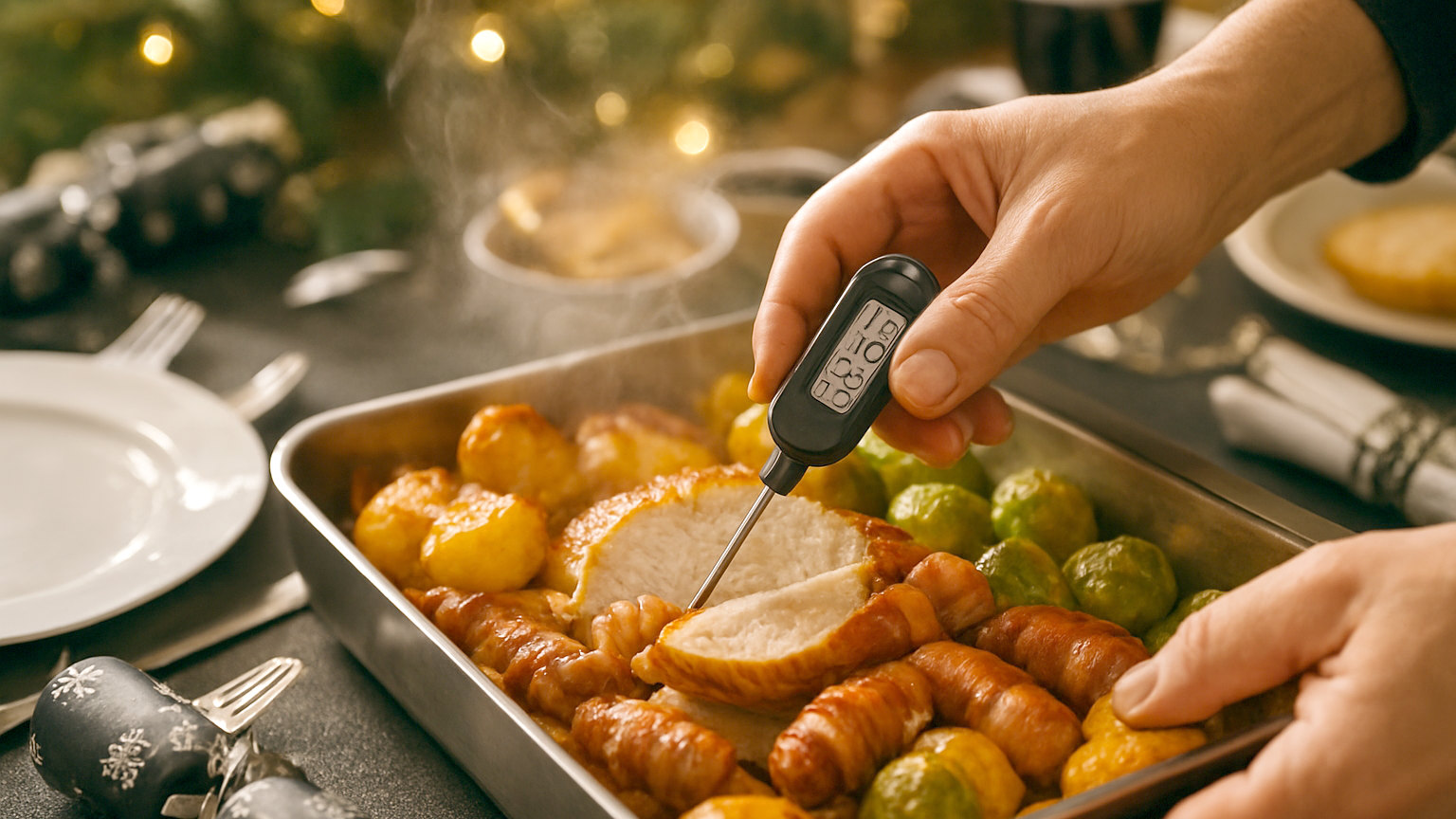
Christmas is the day of the year when cooked food sits out longest, in the warmest houses, in the largest quantities, and is then eaten for a week afterwards. The safety rules are short, they are not onerous, and they matter more on the twenty-fifth than at any other point in the calendar. None of what follows is a reason to worry; it is a reason to put things in the fridge sooner than feels necessary.
How quickly should food be cooled?
Within two hours of the end of cooking, and that two hours includes the time it spent on the table during the meal. The practical approach is to strip the bird and refrigerate everything as soon as the plates are cleared, rather than after the washing up, the presents and a film. A large joint cools faster cut into smaller pieces and spread out, which also makes it easier to store.
How hot does reheated food need to get?
Piping hot throughout, which in practice means steaming and, if you want a number, around 70C held for a couple of minutes at the centre. Stir anything liquid halfway through so there are no cold pockets, and if you are using a microwave, let the food stand for a minute or two afterwards so the heat evens out. Warm is not the same as reheated.
Can you reheat something twice?
No. Reheat once only, which means taking out what you intend to eat and leaving the rest in the fridge rather than warming the whole dish each time. This is the rule most commonly broken over Christmas week, because a large tray of something gets heated on Boxing Day, again on the twenty-seventh, and again after that. Portioning leftovers when you first put them away prevents it entirely.
Cool within two hours, refrigerate, reheat once until piping hot. Those three rules cover almost everything that can go wrong with Christmas leftovers.
What should never be reheated?
Anything that has been left out overnight, however cold the room was. Rice, unless it was cooled quickly and refrigerated immediately after cooking, since it carries a specific risk. Anything already reheated once. Shellfish that has been out on a table. And anything you are unsure about, since the value of the food involved is never worth the alternative.
How long does everything keep?
Cooked turkey and other meats, two to three days in the fridge. Cooked vegetables and stuffing, two days. Gravy, two days. Glazed ham, around five days because of the cure. Cheese, a week or more. Anything containing cream or eggs should be treated more cautiously. When in doubt, the freezer extends all of these considerably, provided things go in promptly rather than after four days in the fridge.
Is a warming drawer safe to leave things in?
For a short period during service, yes, provided it is genuinely hot rather than warm. What it must not be used for is holding food for several hours, since a lukewarm environment is precisely the condition in which bacteria multiply fastest. The same applies to a hostess trolley, a plate warmer or an oven left on low with the door ajar.
What about food that has been out on a buffet?
Two hours is the working limit for anything perishable sitting at room temperature, after which it should be thrown away rather than refrigerated. This is why putting out two thirds of a buffet and holding a third back is a safety measure as well as a presentation one. Anything untouched and still cold that has been out for under two hours can be refrigerated and used the next day.
What should you do with a large joint?
Carve or cut it down before refrigerating rather than putting the whole thing in the fridge intact. A large dense piece of meat takes many hours to cool through, and the centre stays warm long past the two hour window.
Spreading the meat out in shallow containers rather than piling it in a deep bowl makes a considerable difference to how fast it reaches fridge temperature.


