
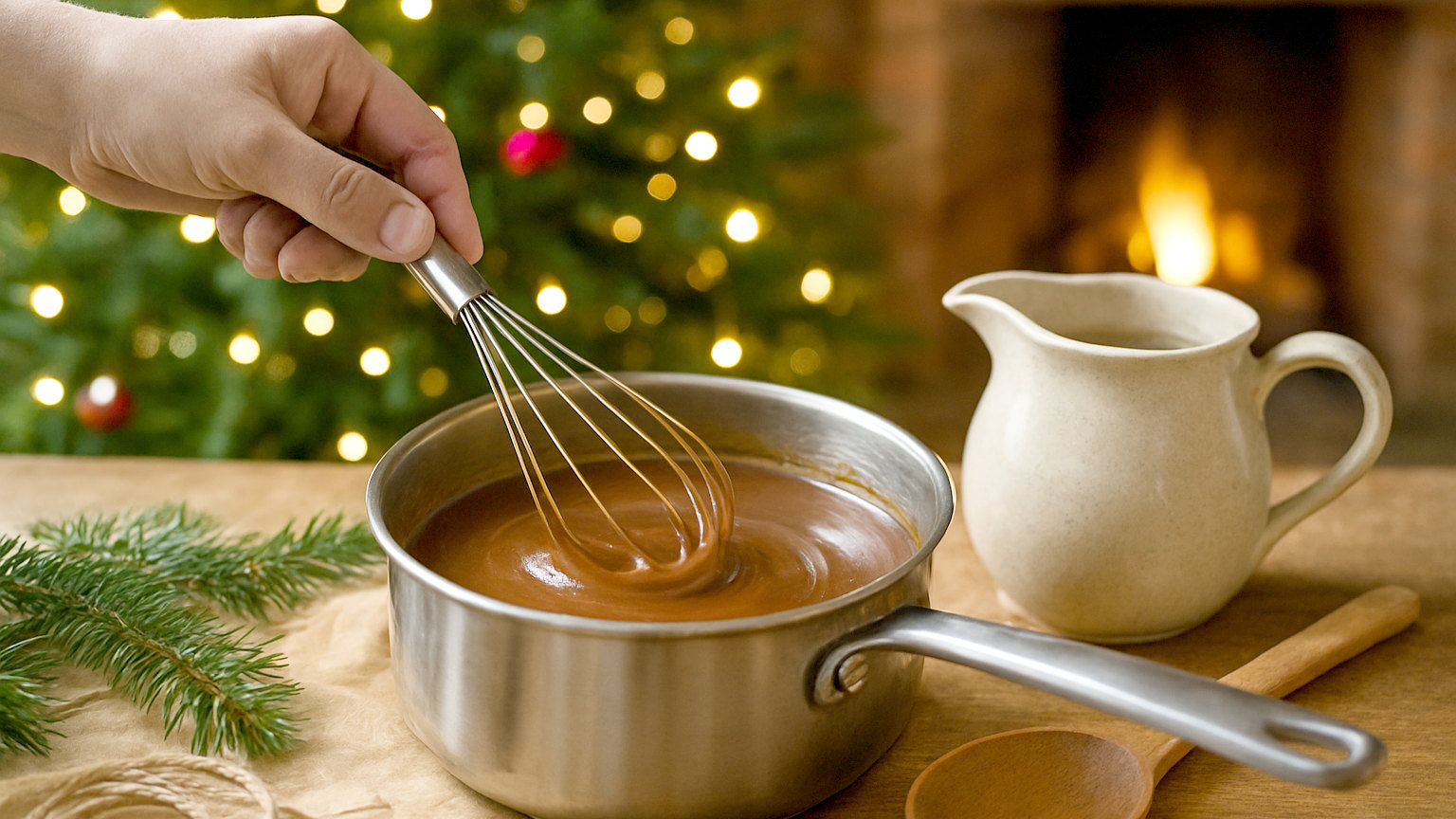
Gravy is the last thing made, in the busiest ten minutes of the day, by somebody who is simultaneously carving, draining vegetables and answering questions about where the serving spoons are. That is why it goes wrong, not because it is difficult. Almost all of the work can be done days earlier, which leaves nothing on the day except combining two things that are already made.
How do you build the base in advance?
Roast a few turkey wings or a chicken carcass with an onion, a carrot and a stick of celery until well browned, then cover with water and simmer for two or three hours. Strain it, cool it and keep it in the fridge or freezer. That stock is most of your gravy, and it can be made in November. On the day you are only adding the roasting juices and finishing the seasoning.
Why do lumps form?
Because flour meets liquid too quickly and the outside of each particle turns to paste before the inside is wet. The fix is to cook the flour into the fat first, making a roux, and then add liquid gradually while stirring, so each addition is fully incorporated before the next. Adding cold stock to a hot roux, rather than hot to hot, also helps considerably and is the opposite of what most people assume.
What do you do with the roasting tin?
Everything of value is in it. Pour off most of the fat but keep two or three tablespoons, put the tin over a low heat on the hob, and stir the flour into the fat and the browned residue. Cook it for a minute or two until it smells nutty rather than raw, then add a splash of wine, sherry or port and scrape the base hard. That scraping is where the flavour comes from.
Taste it before it goes to the table. Gravy is almost always improved by more salt, a splash of acidity and a little more time reducing, and none of those can be added once it is in the jug.
How do you fix gravy that has gone lumpy?
Pour it through a sieve, pressing with the back of a ladle. This works every time and takes thirty seconds, and nobody at the table will ever know. A stick blender is faster still if the pan is deep enough. Neither is a failure; both are what professional kitchens do routinely, and straining is worth doing even when the gravy looks smooth because it catches anything from the tin.
How thick should it be?
Thick enough to coat the back of a spoon and no thicker, since it will continue to thicken as it cools in the jug. If it is too thin, simmer it for a few minutes rather than adding more flour. If it is too thick, let it down with stock or the water from the vegetables, which carries flavour and would otherwise go down the sink. Adjust it at the last moment rather than early.
What lifts a dull gravy?
Salt first, since most home gravy is under seasoned. Then acidity: a splash of wine, sherry, port or even a little vinegar cuts through the richness of the meal. Then savoury depth from a spoonful of redcurrant jelly, a dash of soy or a teaspoon of marmite, none of which will be identifiable in the finished jug. Add these in small amounts and taste between each one.
Can you make it entirely without meat?
Yes, and a good vegetarian gravy is built the same way: brown onions and mushrooms hard, add flour, then a strong vegetable stock, and finish with red wine and soy for depth. It needs more browning and more seasoning than a meat gravy because there is no roasting tin doing the work. Make it in advance and reheat it, which is easier than finding hob space on the day.
When should it be made on the day?
During the turkey rest, which is the natural window. The bird is out of the oven and the tin is available, the potatoes are roasting and nothing else needs attention for twenty minutes. Make it then, pour it into a warmed jug and cover it, and it will still be hot when everything else is on the table. Leaving it until the carving has started is what creates the panic.


