
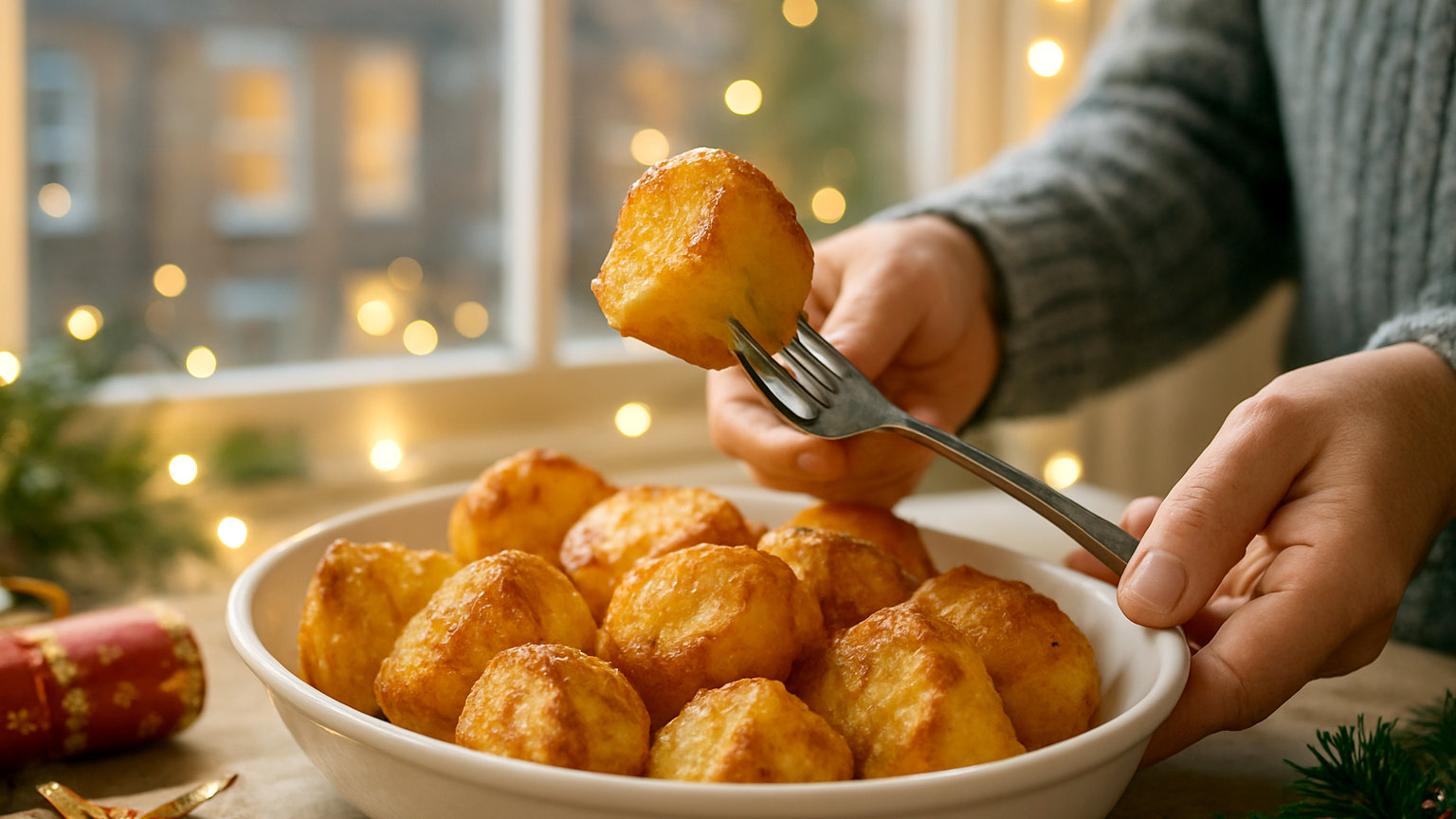
Crisp roast potatoes are not luck, and they are not a family secret. They come from three things: the right variety, a rough surface created before roasting, and fat that is genuinely hot when the potatoes go into it. Get all three right and the result is consistent every time. Get any one of them wrong and you produce the pale, slightly leathery potato that most people accept as normal.
Which variety should you buy?
A floury potato rather than a waxy one. Maris Piper and King Edward are the standard choices in Britain and both work extremely well. Desiree and Rooster are also good. What does not work is a salad or new potato, which holds together too firmly to produce a rough surface and stays dense inside. If a bag is labelled only as white or baking potatoes, it is usually floury enough to be worth trying.
Why does par-boiling matter?
Because it cooks the inside and, more importantly, softens the outer few millimetres so they can be broken up. Boil in salted water for around eight to ten minutes after the water returns to the boil, until the edge of a potato yields to a knife but the centre is still firm. Drain them thoroughly and let the steam escape for a minute, since surface water is the enemy of crispness and will cool the fat.
What does roughing them up actually do?
It creates surface area. Put the lid on the drained pan and shake it firmly several times so the outsides break into a rough starchy layer, or scuff each one with a fork. That ragged surface is what crisps, and it is the difference between a smooth potato that browns and a rough one that shatters when you bite it. This step takes ten seconds and is the one most often skipped.
The fat must be smoking hot before the potatoes go in. Put the tin with the fat in the oven for ten minutes first, and listen for the sizzle as each potato lands.
Which fat is best?
Goose fat and beef dripping give the best flavour and both have a high smoke point. Duck fat is close behind. A neutral oil with a high smoke point, such as sunflower or rapeseed, works perfectly well and is what many good cooks use. Olive oil is not ideal, since it burns at roasting temperatures. Use enough that each potato sits in a shallow film rather than swimming, and use a single layer with space between them.
What temperature and how long?
Around 200C, or 180C fan, for 45 minutes to an hour depending on size. Turn them once, roughly two thirds of the way through, rather than fussing at them, since every turn releases heat and disturbs the crust that is forming. If they are going in during the turkey rest, the oven can be pushed higher for the first fifteen minutes to compensate for the door having been open.
Can they be prepared ahead?
The par-boiling and roughing up can be done the day before. Spread them on a tray, cool completely, cover and refrigerate. Some cooks freeze them at this stage, which works well and means they go straight from freezer to hot fat. What cannot be done ahead is the roasting itself, since a reheated roast potato is a soft one and there is no reliable way around it.
Why did yours go soggy?
Almost always one of four things: the tin was overcrowded so they steamed rather than roasted, the fat was not hot enough when they went in, they were not dried properly after draining, or they were covered while resting. Steam is the common thread in all four. If they must wait, keep them in a single layer in a low oven uncovered rather than piled in a warm dish.
Can you cook them in an air fryer?
Very well, and on Christmas Day it is genuinely useful because it works independently of the oven queue. Par-boil and rough up as usual, toss in a little hot fat, and cook at around 200C for 25 to 35 minutes, shaking the basket twice.
The limitation is capacity. Most domestic air fryers will do enough for two or three people in one go, so for a full table it is better used for a second batch or for parsnips while the potatoes have the oven.


