
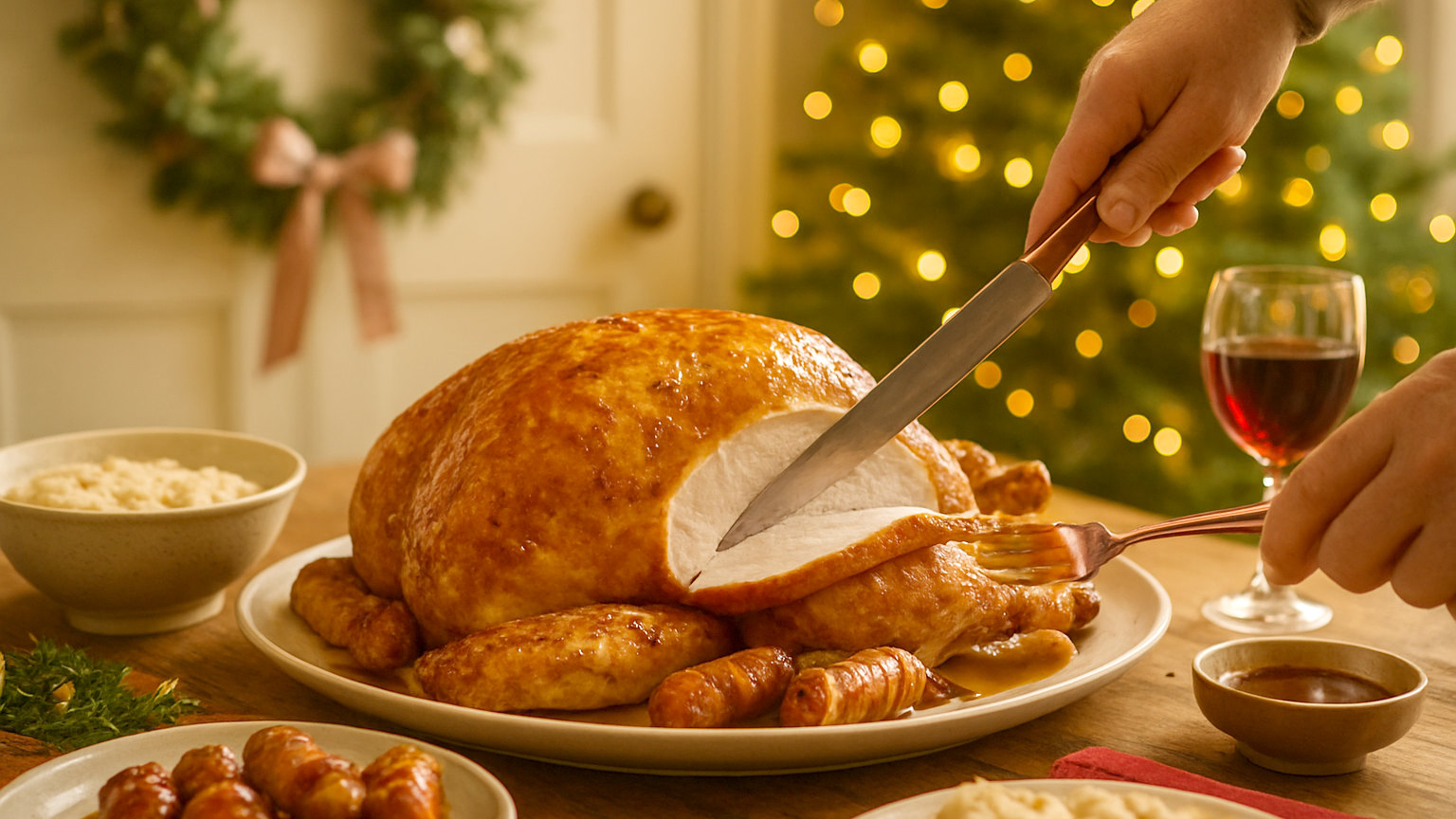
Carving a turkey looks difficult because most people attempt it the way it appears in illustrations, which is standing over an intact bird cutting thin slices off the breast while it sits on the bone. That is genuinely hard. Taking the meat off the carcass first and slicing it on a board is considerably easier, gives better slices and takes about four minutes. The technique is butchery rather than art.
Why must it rest first?
Because carving a bird straight from the oven pours the juices onto the board and leaves the meat dry. Thirty minutes minimum, and up to ninety for a large turkey, loosely covered in a warm place. The bird holds heat remarkably well, and the resting window is also when the oven is free for the potatoes. Carving too early is one of the few genuinely irreversible mistakes on the day.
Which knife should you use?
A long, thin, sharp blade rather than a heavy chef knife. A carving knife or a filleting knife both work. Sharpness matters far more than the type: a blunt knife tears the meat and requires pressure, which is how accidents happen. Steel the knife before you start. A carving fork is genuinely useful for holding the bird steady, and a board with a channel around the edge catches the juices for the gravy.
What is the order of work?
Remove the legs first by cutting through the skin between thigh and body, pushing the leg outwards until the joint pops, then cutting through it. Separate thigh from drumstick. Then run the knife down either side of the breastbone and follow the ribcage to release each breast whole. Slice each breast across the grain on the board. Finally, take the wings and pick off the oysters underneath, which are the best two pieces on the bird.
Slice the breast across the grain, not along it. Slicing lengthways gives long fibres and a stringy mouthful; across the grain gives short fibres and tender meat.
How do you keep it hot?
Warm the plates and the serving dish, which does most of the work, and carve onto the warm dish rather than onto a cold board. Cover the sliced meat with foil while you finish the rest. Pouring a few spoonfuls of hot gravy over the platter just before it goes to the table keeps the surface moist and stops the slices drying at the edges, which is what happens in the five minutes between carving and serving.
Should you carve at the table or in the kitchen?
In the kitchen, and bring the platter through. Carving at the table is a performance that requires a lot of space, good light and a steady audience, and it usually results in cold food while everybody watches. If the theatre matters, bring the whole bird through for people to see, then take it back and carve it properly where the board and the bin are.
What do you do with the carcass?
Strip it completely while it is still warm and easy, rather than putting it in the fridge to deal with later. Separate the good slices for sandwiches from the ragged pieces for cooking, and refrigerate both promptly. Break up the bones and either freeze them or make stock the same evening, which takes five minutes of work and produces several litres of the most useful thing in the fridge.
How much should you carve at once?
Only what is being eaten now. Sliced meat dries out considerably faster than meat left in a whole piece, so carve one breast for the table and leave the other intact in the fridge for the following day. It will be noticeably better on Boxing Day than pre sliced meat would have been, and it takes no extra effort to leave it alone.
What if the bird is unevenly cooked?
It is common, because the legs need longer than the breast. If the thigh probe reads below 75C but the breast is done, take the breast off whole, cover it, and return the legs to a hot oven for another twenty minutes.
This is easier than it sounds once the bird is already being taken apart, and it produces a better result than leaving the whole thing in and drying the breast out to rescue the legs.


