
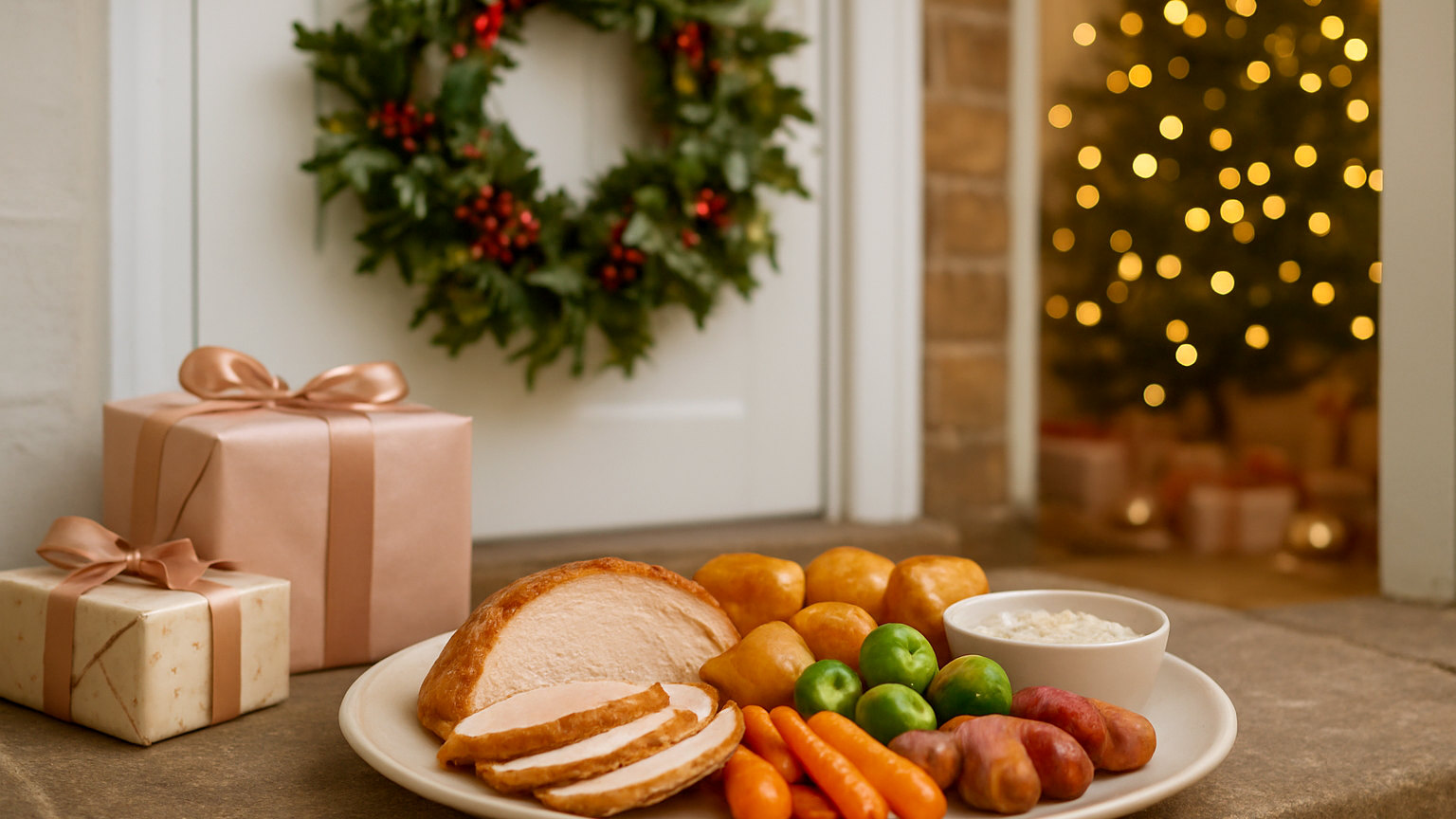
Almost every household buys too much food at Christmas, and the reason is understandable: nobody wants to run out on the one day of the year when the shops are shut. The result is an expensive amount of waste, most of it in vegetables and trimmings rather than in the bird. Working to actual quantities rather than to instinct usually saves a substantial sum and produces exactly the same meal.
How much turkey per person?
Around 500g of bone-in weight per person is the standard working figure for a meal with modest leftovers. If you want a serious quantity of cold turkey for Boxing Day and beyond, work to 700g or more per head. For a crown or a boneless joint, which have no bone or carcass in the weight, 250g to 350g per person is closer to right. Children under about ten can be counted as half an adult.
What about potatoes and vegetables?
Roast potatoes are the item most consistently underestimated: 250g of raw potato per person is generous for most tables and 300g is safer if roast potatoes are the point of the meal for your family. Each individual vegetable wants around 80g to 100g per person, which sounds small and is correct when there are four or five of them. The total vegetable weight is what matters rather than the amount of any one.
How many pigs in blankets and trimmings?
Two to three pigs in blankets per person, more if they are the thing everyone reaches for, which in many households they are. Stuffing at around 75g per person. One or two tablespoons each of bread sauce and cranberry sauce, both of which are bought in far greater quantity than anybody eats. Gravy at roughly 100ml per person, which is more than most people make.
Count the actual number of adults and children sitting down, then write the list from that number. Shopping from a feeling about how many people are coming is how the waste happens.
Where does most of the waste happen?
In vegetables, cheese and bread rather than in meat. Sprouts, carrots and parsnips are bought in bags sized for a household twice as large, cheese boards are assembled to look generous rather than to be eaten, and bread bought for sandwiches goes stale. Turkey is rarely the problem, since cold turkey has enough uses to see out a week if it is refrigerated promptly and kept properly.
How much do you add for leftovers?
Decide deliberately rather than by accident. If Boxing Day is a cold table and turkey sandwiches are part of the plan, add roughly 40 percent to the bird and nothing to the vegetables, since nobody eats leftover sprouts. If you want a curry or a pie later in the week, the same extra bird covers it. Buying extra of everything on the theory that leftovers are useful is where most of the waste originates.
Does it change for a mixed table?
Yes, and it is worth doing the arithmetic properly. Small children eat considerably less than the portions above, teenagers eat more than adults, and anybody who has grazed on party food since eleven in the morning will eat less than you expect at four. If several guests are vegetarian, reduce the bird accordingly rather than buying the same size and hoping, and increase the potatoes and trimmings, which everybody eats.
When should you order?
Butchers take turkey orders from October and the good birds go early, so late November is comfortable and mid December is a gamble. Order to the weight you calculated rather than to the nearest round number offered, since a butcher will match a size closely. Vegetables can be bought in the final few days and will be better for it, and anything frozen can be bought whenever it is convenient.
What about the drinks and the cheese board?
Half a bottle of wine per drinking adult for the meal itself is the usual working figure, and soft drinks should be bought in far greater quantity than feels necessary, since everybody draws on them.
For cheese, 100g per person is generous at the end of a large meal and most boards are assembled at twice that. Three good cheeses beat six mediocre ones, and the leftovers are more useful than any other part of the spread.


