
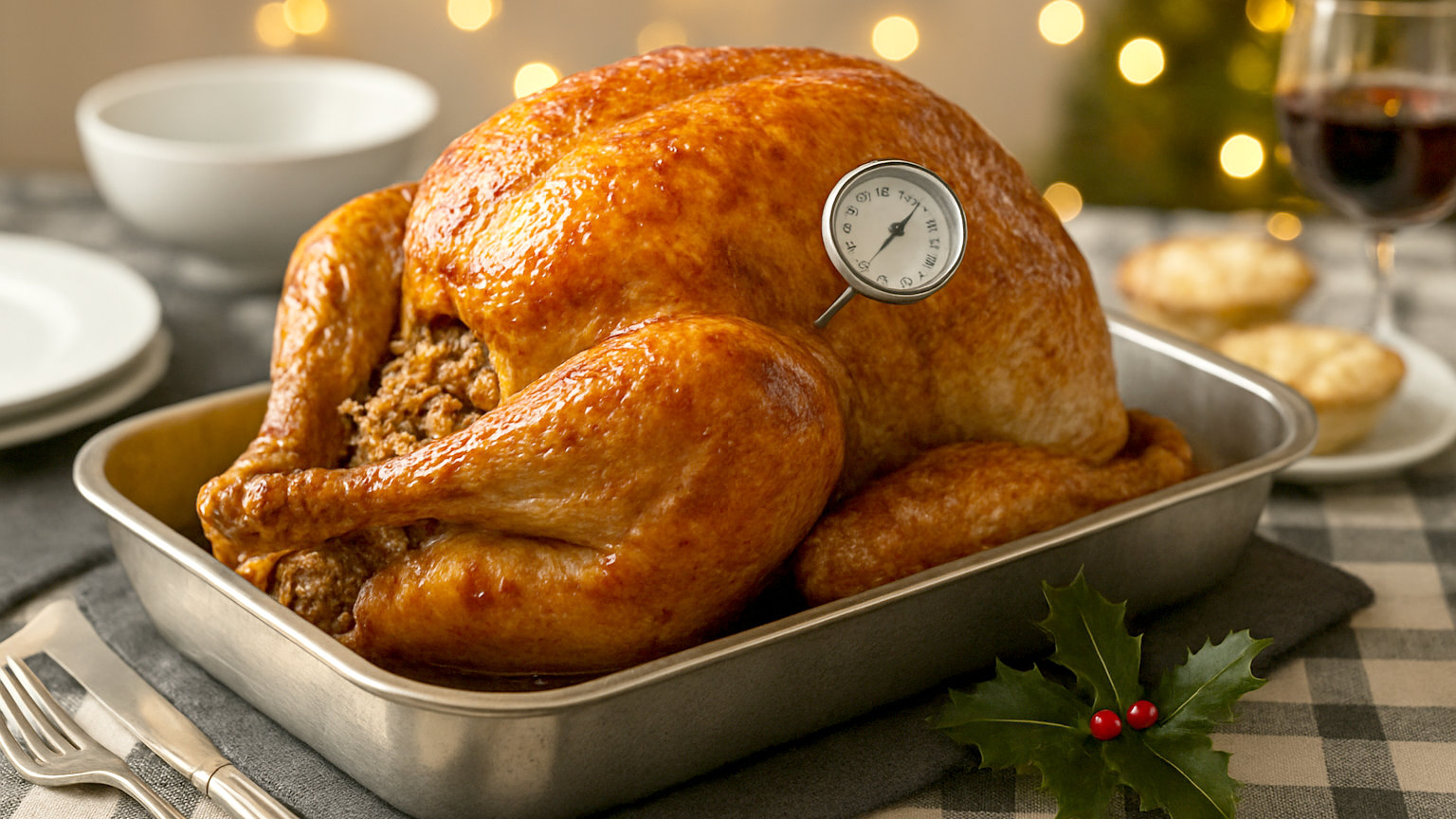
Turkey cooking times are published as though they were exact, and they are not. The shape of the bird, whether it went in cold from the fridge, whether the cavity is stuffed and how accurate your oven actually is all move the finish line by half an hour in either direction. A published time gets you close. A probe tells you when it is done.
How do you work out a starting time?
Weigh the bird after stuffing it, if you are stuffing it at all, and work from that figure at an oven temperature of around 180C, or 160C in a fan oven. The commonly used guidance in Britain is roughly 45 minutes per kilogram plus 20 minutes for birds under about 4.5kg, 40 minutes per kilogram between 4.5kg and 6.5kg, and around 35 minutes per kilogram above that. Treat the result as the point at which to start checking rather than the point at which to stop cooking.
How do you know when it is genuinely done?
A digital probe in the thickest part of the thigh, not touching bone, reading 75C. That is the number that matters and it is the only reliable test. The traditional checks are less dependable: juices running clear is a reasonable secondary sign but can mislead, and the leg wobbling freely tells you about the joint rather than about the temperature at the centre. A probe costs very little and removes the entire question.
Does stuffing the bird change the time?
Yes, significantly, which is why many cooks have stopped doing it. Stuffing inside the cavity slows heat reaching the centre, so the bird takes longer and the breast is dry by the time the stuffing is safe. If you do stuff it, the stuffing itself must reach 75C, which is a separate probe reading. Cooking the stuffing in a separate dish solves both problems and browns better, which is why it is the more common approach now.
A probe thermometer reading 75C in the thickest part of the thigh is the only reliable test. Every published time is an estimate around it.
How long does a frozen turkey take to defrost?
Longer than almost anybody allows for. In a fridge at around 4C, expect something in the region of 10 to 12 hours per kilogram, which puts a large bird at three or four days. Defrosting at room temperature is not recommended. Whichever method you use, the bird must be completely thawed before it goes in, and the way to check is that the cavity is free of ice and the legs move easily at the joint.
Should you cover it with foil?
Covering loosely for most of the cooking protects the breast, and removing the foil for the last thirty to forty minutes gives you the colour. Basting is optional and less important than people think, since the skin does most of the work of keeping moisture in and every opening of the door costs heat. If the skin is browning too quickly, put the foil back on rather than turning the oven down.
How long should it rest?
At least 30 minutes and up to 90 for a large bird, loosely covered in a warm place. Resting is not a courtesy to the meat, it is part of the cooking: the temperature continues to rise for a while and the juices redistribute rather than running out onto the board. A turkey holds heat remarkably well, and the resting window is exactly when the oven is needed for the potatoes.
What if it is not ready when you planned to eat?
This is common and entirely manageable. If it is underdone, carve the legs off and return them to the oven, since they take longest and the breast will be fine. If it finished early, the long rest is a gift rather than a problem. The only genuine error is serving it because the clock says so, which is why the probe rather than the timetable should have the final say.
What size bird do you need?
Around 500g of bone-in turkey per person is the usual working figure, rising towards 700g or more per head if you want a serious quantity of leftovers, which most households do. For a small gathering a crown is easier to handle and cooks considerably faster, though it gives you nothing for stock. Ordering from a butcher in November rather than late December gets you a better bird and a firm collection date.


