
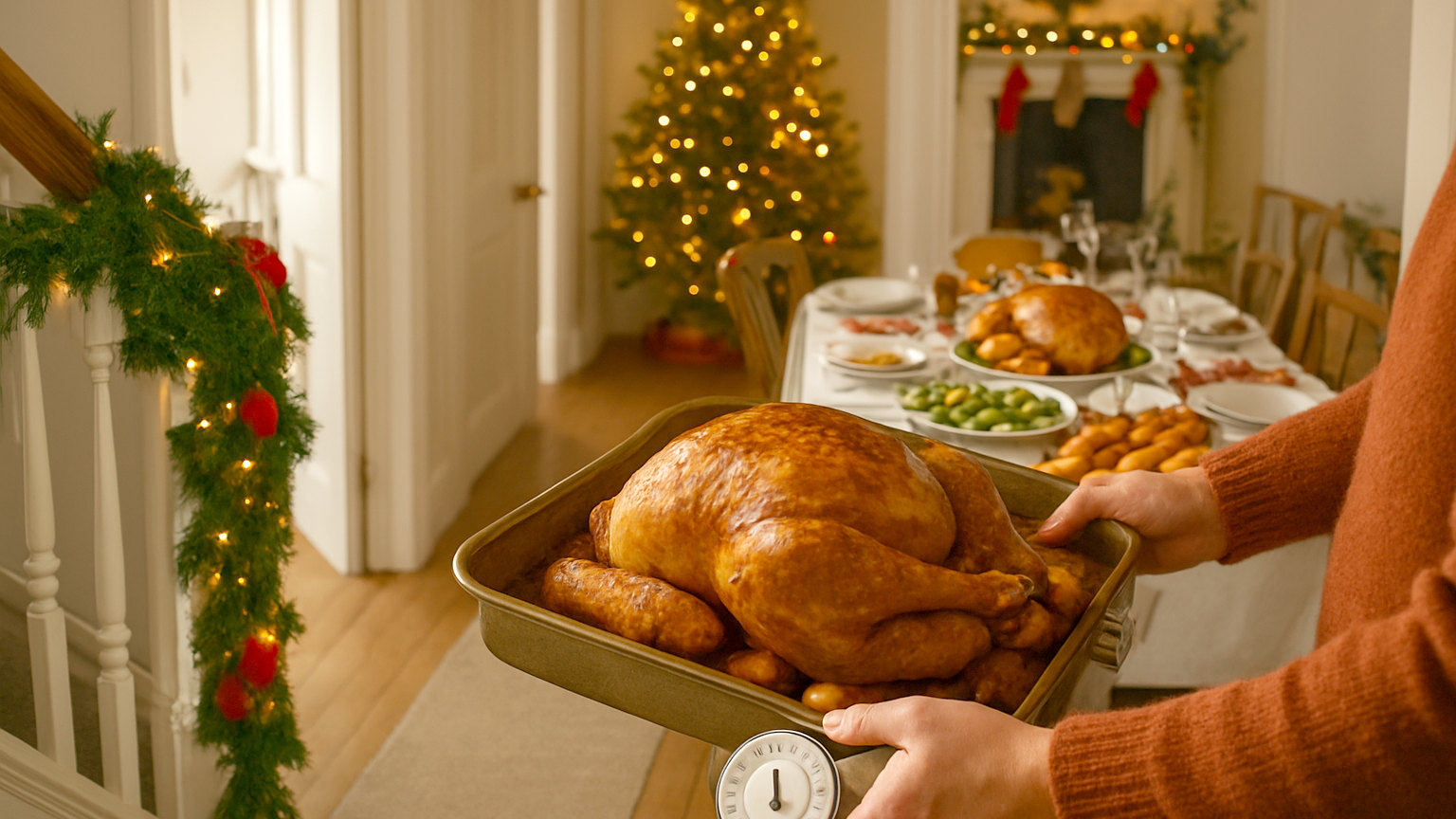
Christmas dinner is not a difficult meal to cook. Every individual component is something most people manage without thinking during the rest of the year. What makes it hard is that eight things have to be ready simultaneously in one oven, and that is a scheduling problem rather than a cooking one. A written plan solves it almost completely, and the writing takes twenty minutes on Christmas Eve.
How do you build the schedule?
Backwards, from the time you want to sit down. Write that time at the bottom of a sheet of paper, then work upwards: carving and gravy in the final fifteen minutes, potatoes and trimmings before that, the bird resting before that, the bird in the oven before that. Every item gets a line with a clock time against it. Do not calculate forwards from when you start, because forwards planning is how the meal ends up ready at half past four.
What does the oven queue actually look like?
The turkey occupies the oven for most of the morning, then comes out to rest for at least half an hour. That resting window is the whole opportunity, and it is when the potatoes, parsnips and anything else needing high heat go in together at a higher temperature. Understanding that the rest is not dead time but the busiest part of the plan is the single most useful realisation about cooking this meal in one oven.
What can be done the day before?
More than most people attempt. Peel and par-boil the potatoes and keep them in the fridge. Peel every vegetable. Make the bread sauce, the cranberry sauce and the stuffing. Wrap the pigs in blankets. Make the gravy base from wings or a stock cube and a good stock, and finish it with the roasting juices on the day. Lay the table. Between them these remove roughly two hours from Christmas morning.
Write the plan on paper and stick it to a cupboard door. Everybody can then see what is happening without asking, which is worth as much as the timings themselves.
What can be reheated without suffering?
Bread sauce, gravy, red cabbage, stuffing and anything braised all reheat well and can be done on the hob or in a microwave while the oven is busy. Roast potatoes do not reheat well and should be timed properly. Vegetables are better steamed or boiled at the last moment than kept warm, since twenty minutes in a warming drawer turns sprouts grey and soft.
How do you use the hob and other appliances?
Deliberately, as a second oven. A slow cooker will hold red cabbage or braised onions all morning. A microwave handles the bread sauce. An air fryer, if you have one, will do a batch of parsnips or pigs in blankets independently of the oven, which relieves the worst of the pressure in the final half hour. Steaming vegetables in a stack over one pan saves both space and washing up.
Who should be doing what?
Write names against tasks on the same sheet, because the alternative is one person cooking while four people ask whether they can help. Carving, gravy, drinks, laying the table, clearing as it goes and washing up as it goes are all jobs that can be handed over entirely. A plan with names on it turns a room of willing bystanders into a kitchen that runs itself.
What is the most common timing mistake?
Not allowing enough resting time for the bird, which then forces everything else forward and leaves the potatoes underdone. The second most common is starting the vegetables far too early. Both come from the same instinct, which is to get things done rather than to get them ready at a time. Trust the plan and leave things until their line on the sheet, even when the kitchen feels quiet.
When should the plan be written?
Christmas Eve, once the shopping is in and the actual weight of the bird is known. Writing it earlier means guessing at the weight, and writing it on the morning means doing arithmetic in a busy kitchen. Keep last year plan and adjust it rather than starting again, since the second year of doing this is considerably easier than the first and the third is barely any work at all.


