
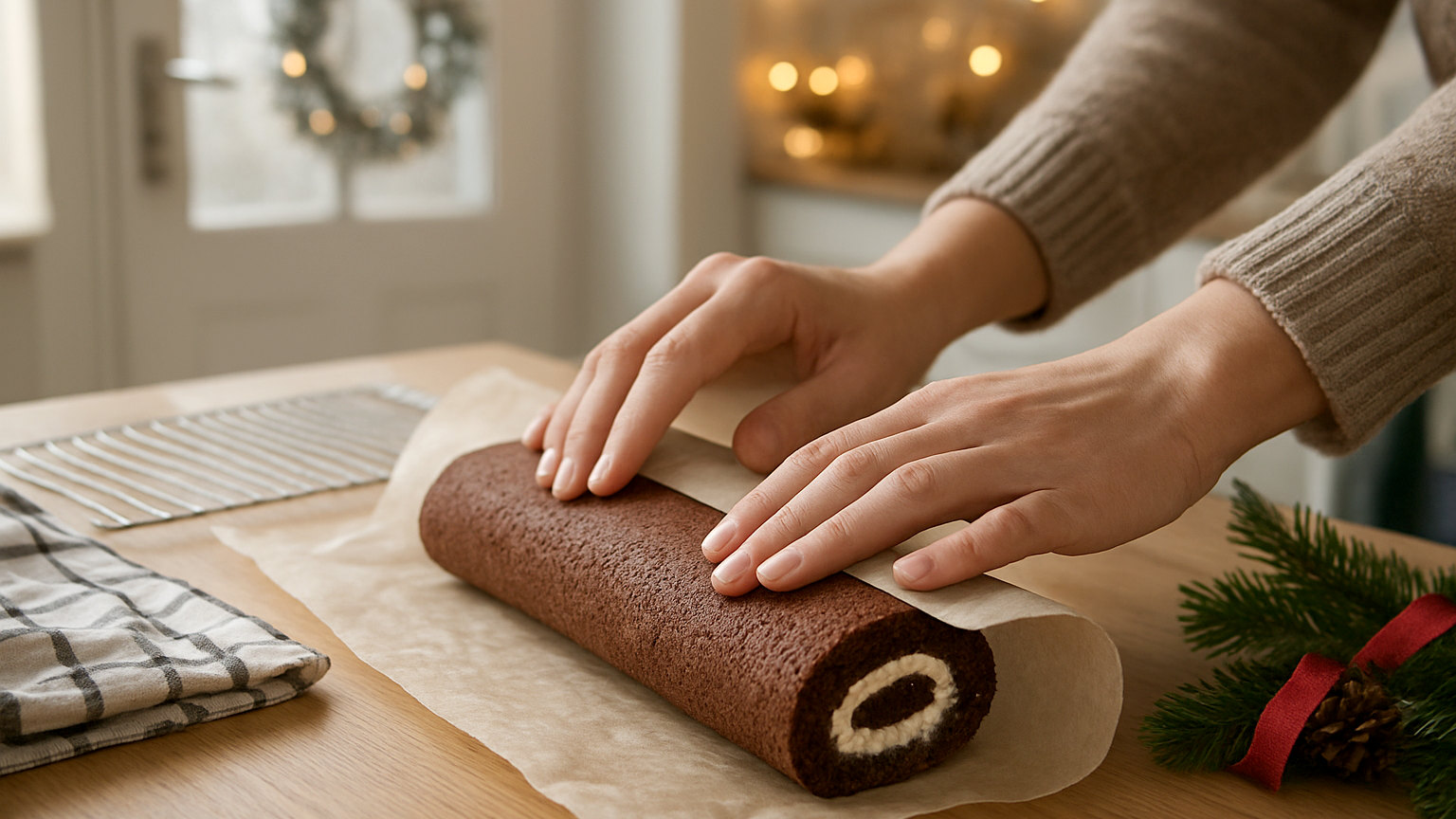
A yule log is a swiss roll wearing a costume, and it cracks for one reason: the sponge was cold when it was rolled. Everything else about it is straightforward. Get the rolling right and the rest is decoration, which is forgiving by design, since the finished thing is supposed to look like a piece of tree bark rather than like a neat cake.
Why does it crack?
Because a cooled sponge has set into a flat shape and the fibres will not bend without breaking. A hot sponge is still flexible, and rolling it while warm trains it into the curve. When you later unroll it to fill it, it will happily roll back the same way. Cracking is not a sign of a bad recipe or a heavy hand; it is a sign that the cake sat on a rack for twenty minutes first.
How do you roll it correctly?
The moment it comes out of the oven, turn it out onto a sheet of baking parchment dusted with caster sugar, peel off the paper it was baked on, and trim the crisp edges. Then roll it up with the fresh parchment inside, starting from a short edge, and leave it rolled until completely cool. Unroll gently, spread the filling, and roll it back without the paper.
How long should the sponge bake?
Only until it is just set and springs back when touched, usually eight to twelve minutes in a hot oven at around 200C. A whisked sponge for rolling is thin and cooks fast, and even two extra minutes dries it out enough to make it brittle. Under baking slightly is far safer than over baking, since a slightly damp sponge will still roll and a dry one will not.
Roll it hot, straight out of the oven, and let it cool in the rolled shape. This one step prevents almost every crack.
What should go inside?
Whipped cream is traditional and light, and it suits the richness of the chocolate outside. Chocolate buttercream is more stable and travels better. A layer of cherry jam or chestnut puree under the cream adds interest. Keep the filling thin, because a thick layer forces the roll open and is the second most common cause of a split. Chill it briefly before rolling if the filling is very soft.
How do you finish the outside?
Chocolate ganache, made from equal weights of dark chocolate and hot cream stirred until smooth, is the easiest and best. Spread it over the whole log while it is still slightly soft, then drag a fork along the length to create bark. Cut a short piece off one end at an angle and stick it to the side as a branch. Dust with icing sugar for snow.
What if it cracks anyway?
It does not matter, and this is the great advantage of this particular cake. Push the pieces back together, cover the whole thing in ganache and drag the fork over it. A crack under a bark texture is invisible. If it has broken badly, cut it into two shorter logs, or press the whole lot into a bowl with the cream as a trifle, which nobody will complain about.
How far ahead can it be made?
A day, if it is filled with buttercream and kept in a cool room, or two if it is refrigerated. A cream filled log should be made on the day or the evening before and kept in the fridge. The sponge alone, rolled in its parchment, can be made a day early and filled later. It also freezes well undecorated, which is the most useful option if you are cooking for a crowd.
What else can you do with the same sponge?
The identical method makes a summer swiss roll with jam and cream, so it is a technique worth having rather than a once a year recipe. The rolling rule is the same in both cases.
A coffee or chestnut buttercream, or a filling of cream and poached pears, turns the same log into something less obviously Christmas, which is useful if you are making one for a gathering in early December.


