
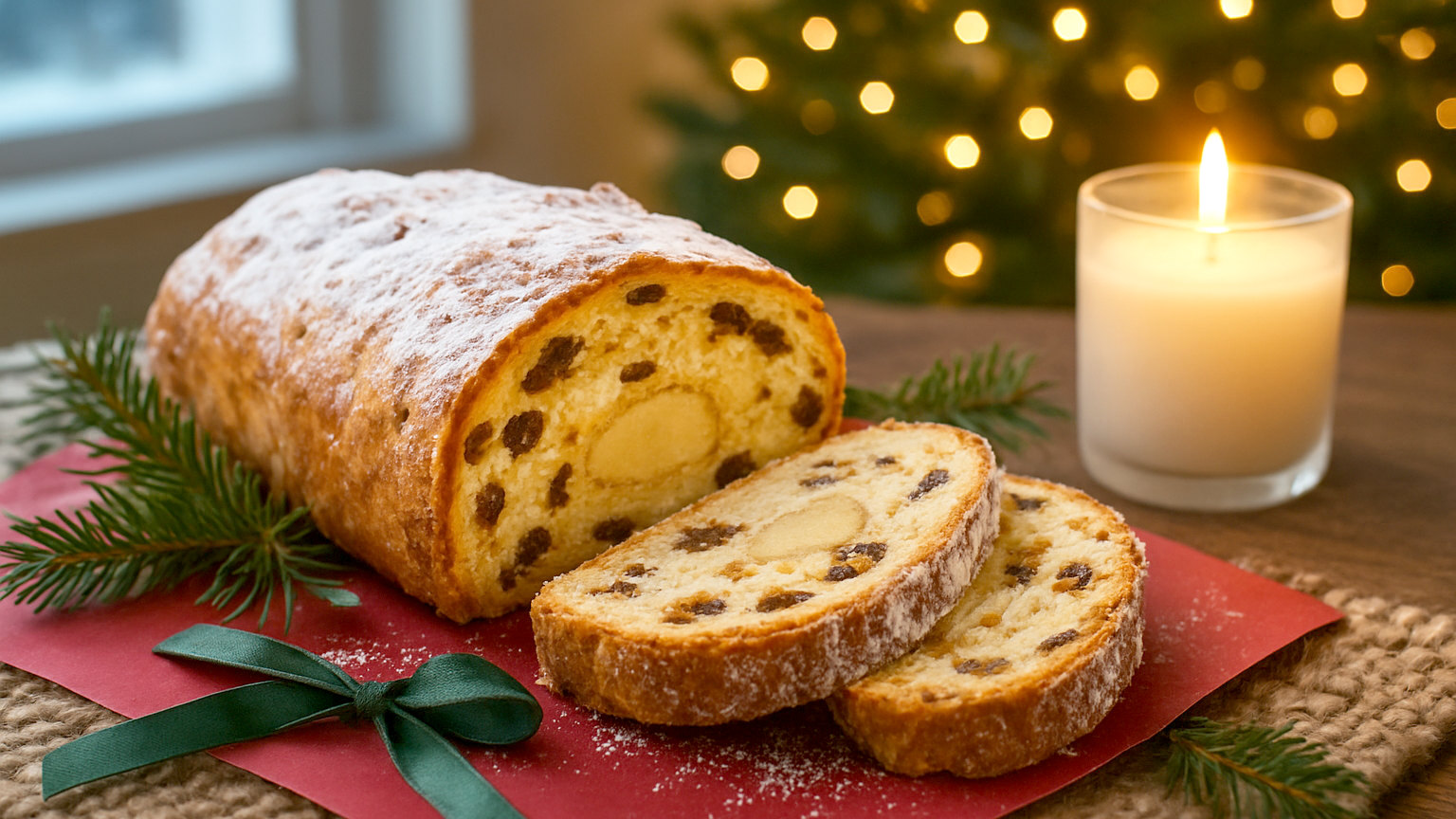
Stollen is a bread rather than a cake, which is the fact that explains everything else about it. It is made with yeast, it needs kneading and proving, and it behaves like an enriched dough throughout. People who approach it as a cake are surprised by how long it takes and how sticky it is at the start, and people who approach it as bread find it entirely familiar.
What goes into the dough?
Strong white flour, yeast, milk, a great deal of butter, sugar, eggs and warm spices, with dried fruit and candied peel soaked in rum or brandy stirred through. The butter content is what makes it rich and also what makes it slow to rise, so it needs longer proving than a plain loaf. Some recipes use a pre-ferment, which improves the flavour and is worth the extra few hours if you have them.
Why is the fruit soaked in advance?
Because dry fruit added straight to a dough will draw moisture out of it, and because soaked fruit tastes considerably better. Soak raisins, sultanas, currants and chopped peel in rum, brandy or orange juice overnight, or for several days if you plan ahead. Drain them before adding, and add them at the end of kneading rather than at the start, so the fruit is not torn apart by the mixing.
What is the marzipan log for?
It runs through the centre and keeps the loaf moist as well as adding sweetness, and it is the feature most people associate with stollen. Roll marzipan into a rope slightly shorter than the loaf, lay it down the middle of the flattened dough, then fold the dough over it in the traditional asymmetric shape. The fold is said to represent the swaddled Christ child, which is the origin of the shape.
Brush with melted butter and coat in icing sugar while the loaf is still hot. The butter soaks in and the sugar forms the thick white crust that preserves it.
Why does the butter go on after baking?
Because it is doing a preserving job as much as a flavouring one. A hot loaf absorbs melted butter readily, and the icing sugar dusted on top forms a seal against the air. That crust is why a properly finished stollen keeps for weeks while an ordinary enriched bread goes stale in three days. Be generous with both, and dust with sugar a second time once the loaf is cool.
How long does it keep?
Several weeks wrapped in greaseproof paper and foil in a cool place, and many bakers make it two or three weeks before Christmas deliberately so it can mature. The flavour develops and the crumb becomes denser and moister. This makes it one of the few Christmas bakes that genuinely benefits from being made early, which is useful in a December full of things that cannot be.
Can it be made without a mixer?
Yes, though it is heavy work. The dough is sticky before the butter is fully incorporated and the temptation is to add flour, which makes a dry loaf. Resist it, use a dough scraper, and keep working: it comes together after eight or ten minutes. A stand mixer with a dough hook does the job in five minutes and is the easier route if you have one.
How should it be served?
In thin slices, at room temperature, with coffee rather than as a dessert. It is rich enough that a thick slice is too much. A day old slice is very good toasted lightly and spread with butter. If the loaf has dried out towards the end of its life, that toasting is the answer rather than throwing it away, and the last of it makes an excellent bread and butter pudding.
What is the difference between stollen and panettone?
Both are enriched Christmas breads, but panettone is far lighter, made with a long fermentation and a wet dough that produces its characteristic tall domed shape and open, shreddy crumb.
Stollen is dense, buttery and close textured, and it keeps for weeks where panettone is at its best within days. They are made for different purposes rather than being variations on the same idea.


