
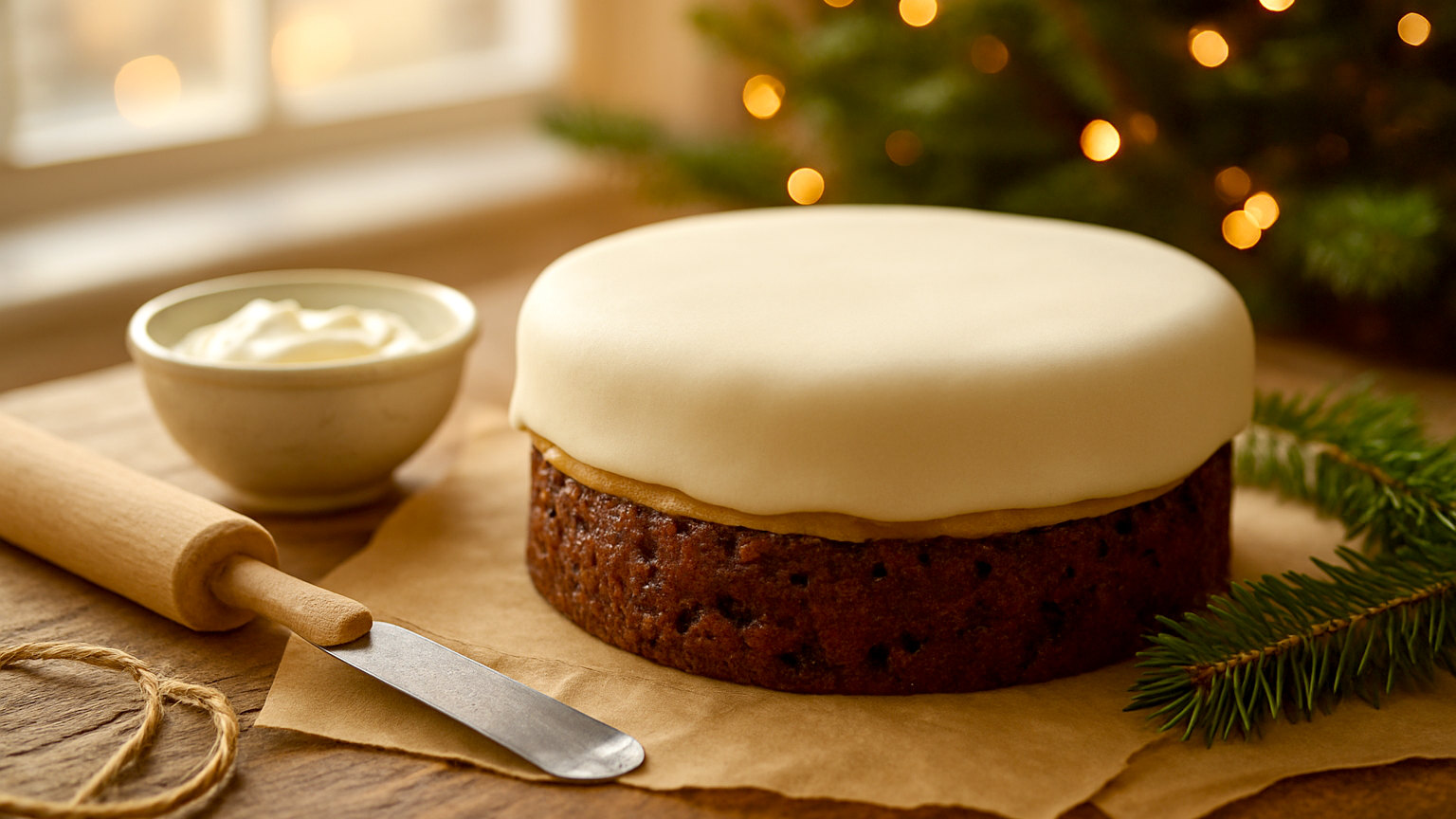
Icing a Christmas cake is a two stage job with a waiting period in the middle, and most of the problems people run into come from compressing it into one afternoon. Marzipan goes on first and has to dry. Icing goes on second. Neither stage is difficult, but both reward a bit of patience, and the whole thing is considerably easier than the results suggest.
Why does the marzipan go on first?
It seals the cake, stops the dark fruit staining the icing, and gives you a smooth even surface to work on. A fruit cake straight from the tin has an uneven top, sloping sides and a slightly crumbly surface, none of which icing will disguise. Marzipan is doing the same job as plaster before paint. Skipping it is possible but the result will be lumpy and will discolour within a few days.
What does the apricot glaze do?
It glues the marzipan to the cake. Warm a few tablespoons of apricot jam with a splash of water, sieve out the lumps, and brush it over the whole cake while still warm. Apricot is used because it is pale and mildly flavoured, so it does not colour the marzipan or compete with the cake. Without it, the marzipan slides and leaves air pockets that show up later as bulges.
How do you get a flat top?
Turn the cake upside down and use the base as the top, which is flat because it sat against the tin. If the cake has domed, level it with a bread knife first. Fill any gaps around the bottom edge with small pieces of marzipan pressed in, so the whole thing sits square on the board. Roll the marzipan to an even thickness of about half a centimetre using spacers or two rulers if you have them.
Leave the marzipan to dry for at least three or four days before icing. Almond oil seeping into royal icing produces yellow patches that appear a week later.
Royal icing or fondant?
Royal icing is the traditional choice: made from egg white or meringue powder and icing sugar, applied in thin coats, and either smoothed flat or peaked into snow with a palette knife. It sets hard. Fondant, the ready to roll sort, is draped over in one piece, stays soft and is far more forgiving for a beginner. Both are entirely legitimate. Peaked royal icing is the easiest of all, because it is meant to look rough.
How many coats does royal icing need?
Two or three thin coats give a better finish than one thick one, with a few hours of drying between each. Thin the icing with a little water to the consistency of thick cream for a smooth finish, or keep it stiffer for the snow effect. If you want a completely flat surface, a straight edge dragged across the top while the icing is still wet does most of the work.
How do you decorate it simply?
Restraint looks better than ambition. A wide ribbon around the side, secured with a pin, immediately smartens up an imperfect finish. A few well placed items on top, whether traditional figures, holly, or a scatter of silver balls, beat a crowded surface. Peaked icing with nothing on it at all is entirely acceptable and is how a great many cakes were finished before the age of elaborate decoration.
When should the whole job be done?
Marzipan around a week to ten days before Christmas, icing two or three days after that, and decoration whenever the icing is dry. An iced cake keeps well in a tin, so there is no advantage in leaving it late and every advantage in having it finished before the rest of the cooking begins. Do not marzipan a cake you are still feeding, since the alcohol has nowhere to escape.
What if the icing goes wrong?
Royal icing that has set badly can be scraped off and redone, since the marzipan underneath protects the cake. Fondant that has torn can be patched and the join hidden under a ribbon or a decoration.
If the surface is simply uneven, work the icing into peaks with a palette knife and call it snow. It is the traditional finish and it is deliberately irregular, which makes it the most forgiving option available.


