
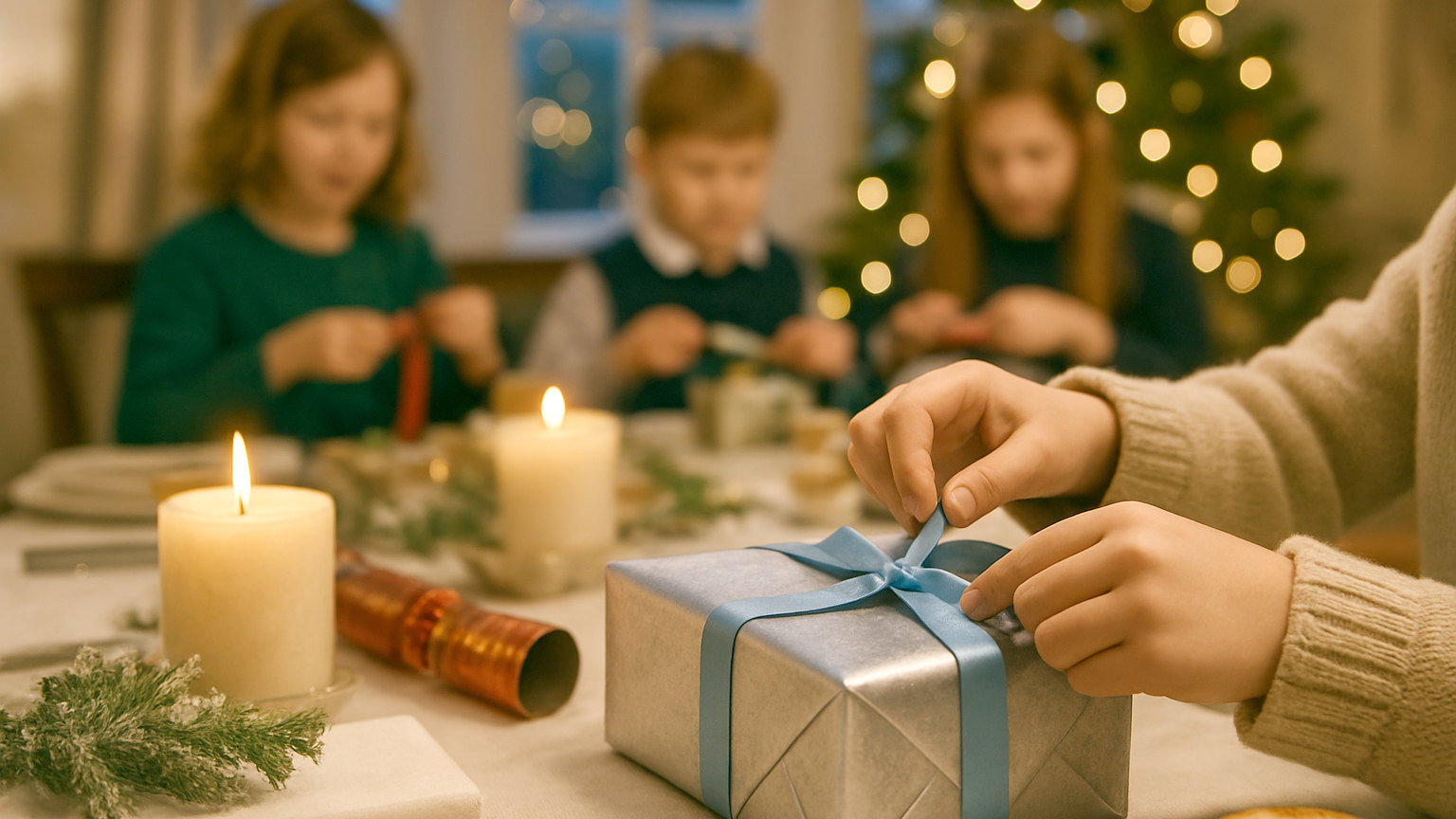
Christmas Day has two difficult stretches for children and they are entirely predictable. The first is between the presents being finished and the meal being served, which in most households is a couple of hours in which a cook is fully occupied and a child has nothing to do. The second is the flat hour after the meal when every adult wants to sit down. Planning for both changes the day considerably.
Why does holding presents back work?
Because a large pile opened at speed produces a child who is overstimulated by nine in the morning and has nothing left for the rest of the day. Keeping three or four parcels back, to be opened after the meal or in the late afternoon, spreads the pleasure across the whole day and gives you something to reach for exactly when the mood dips. It costs nothing and it is the single most effective intervention available.
What fills the morning gap?
Playing with what they have just been given, which is the obvious answer and works better if somebody sits down with them for twenty minutes to get it started. Beyond that: getting outside for half an hour, which resets everybody, a job in the kitchen that is genuinely theirs, laying the table, or a film. Anything that involves an adult paying attention will outperform anything that does not.
What should you have ready in advance?
A new board game, a jigsaw, a craft, a film nobody has seen, and batteries. Having these to hand rather than needing to find them means the gap can be filled in thirty seconds rather than becoming a discussion. Assembling anything that needs assembling on Christmas Eve rather than on the morning also avoids the worst twenty minutes of the day.
Hold three or four presents back for the afternoon. The dip after the meal is entirely predictable and this is what it is for.
How do you manage the afternoon crash?
Expect it, and treat it as tiredness rather than behaviour. Most children have been awake since before six, have eaten a great deal of sugar and have been the centre of attention for eight hours. A quiet hour with a film, a book or a nap is not giving in, it is what everybody needs. Pushing through it with another activity generally produces tears within the half hour.
What works with cousins in the house?
Games with simple rules and short rounds, which cover a wide age range. Something outdoors if the weather allows. A treasure hunt around the house, written in advance, which occupies a mixed group for half an hour and costs nothing. Giving the oldest a role in running something for the younger ones works remarkably well and takes them out of the age gap problem.
How do you get help without it becoming a battle?
Assign specific jobs rather than asking for general assistance. Laying the table, folding napkins, filling water jugs, handing out crackers, clearing plates and drying up are all complete tasks that a child can own. A named job is accepted where an unspecified request for help is not, and it also removes them from under the feet of whoever is cooking.
What about the days afterwards?
They are frequently flatter than the day itself, and holding something back for them helps. One present, one film, one outing kept for the twenty-seventh or the twenty-eighth gives the week a shape. A walk, a visit to relatives or a trip to see the lights all work, and by then most households are glad of a reason to leave the house.
What about screens?
Most households relax the usual rules on Christmas Day and there is nothing wrong with that. What is worth avoiding is a screen filling the gap before the meal, since it is very hard to get a child off one and back into a family activity afterwards.
Saving it for the flat hour in the late afternoon, when everybody wants to sit down anyway, uses it at the point where it does most good and causes least friction.


