
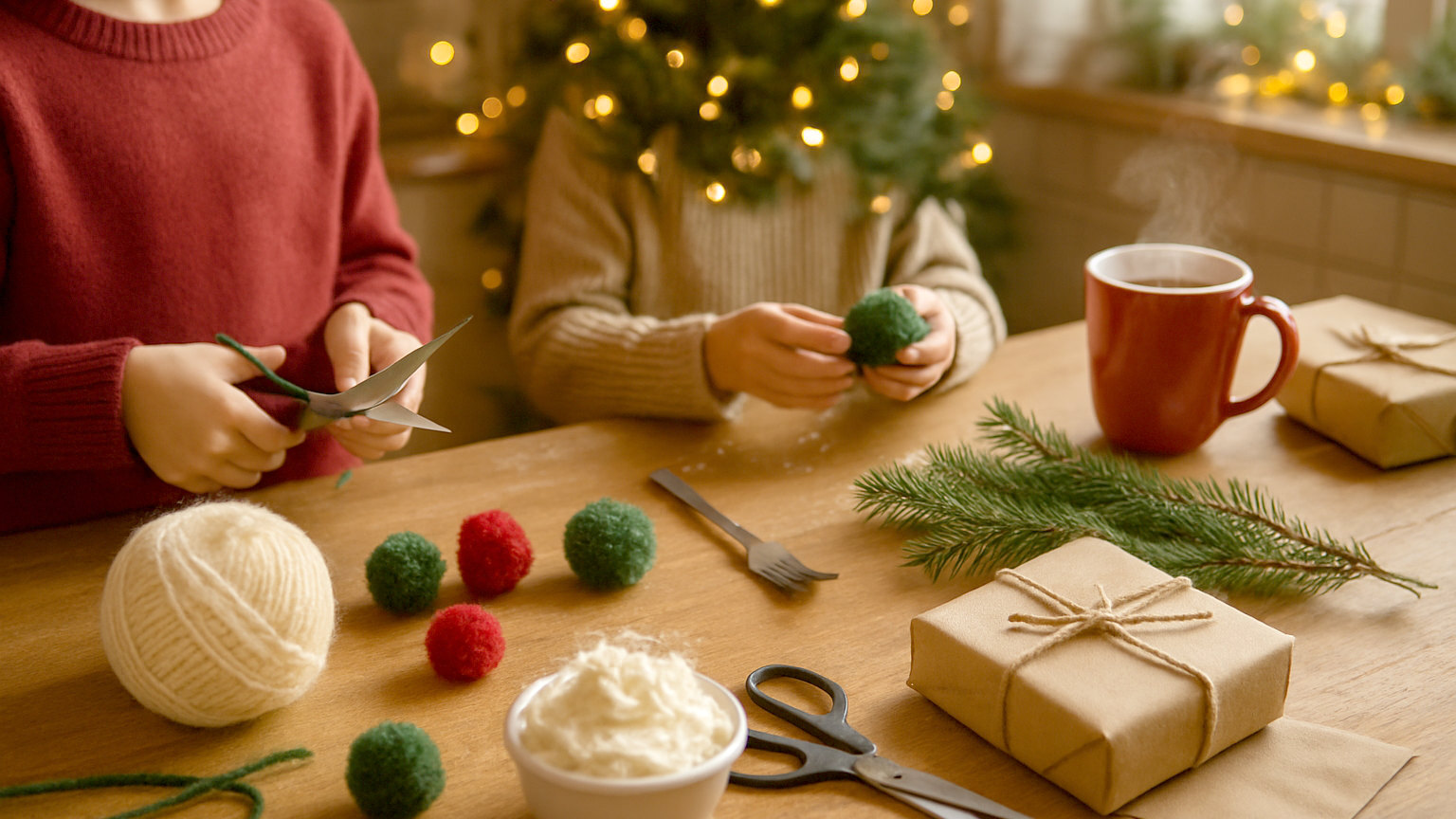
Pom poms are close to the perfect Christmas craft. They cost almost nothing, they use up wool scraps that would otherwise sit in a bag for a decade, they need no special equipment, and the moment where the wrapped bundle is cut and springs into a ball is genuinely satisfying at any age. They also last more or less indefinitely.
What is the fork method?
The simplest and the one for small pom poms. Wind wool around the prongs of a fork forty or fifty times, keeping it fairly loose. Thread a separate length of wool through the middle gap between the prongs, pull it round and tie it as tightly as you possibly can. Slide the bundle off, cut through all the loops at both ends, and fluff it out.
What is the cardboard method?
For anything larger. Cut two identical rings of card, like doughnuts, hold them together and wind wool through the hole and around the outside until the hole is almost full. Then cut around the outer edge, working the scissors between the two rings, tie a length of wool tightly between them, and remove the card. It takes longer and gives a much bigger pom pom.
How do you get them properly round?
Two things. Wind considerably more wool than feels necessary, since a sparse bundle produces a floppy ball. And tie the centre far tighter than seems reasonable, which is the step everybody underdoes. Then trim with sharp scissors, turning it as you go and taking a little off all over rather than attacking one side, which is how they end up lopsided.
Tie the centre tighter than you think, then tighter again. Almost every disappointing pom pom is one where the middle was not pulled hard enough.
What can you turn them into?
Baubles, threaded on ribbon. A garland, strung along twine at intervals. Snowmen, made from two of different sizes. Robins, with a scrap of red felt. Wreaths, by covering a card ring in dozens of them, which is a big project and looks spectacular. Parcel decorations tied onto string. A hat for anybody who knits.
What suits which age?
Three and up can wind wool, which is the long part, and can do the fluffing and trimming with safety scissors. Six and up can manage the whole fork method with help on the tie. Nine and up can do the cardboard version unaided. The cutting moment is the part every child wants, so save it for them rather than doing it yourself.
What wool should you use?
Whatever is in the house, which is the point. Chunky wool makes fast, dense pom poms and is the easiest for children. Fine wool needs far more winding and gives a neater result. Mixing two colours as you wind produces a speckled effect that looks deliberate. Charity shops sell bags of oddments for very little, which is where most craft wool comes from.
How long do they last?
Indefinitely, provided they are stored dry, which makes them one of the better homemade decorations. They do not fade, shatter or crumble, and they survive a loft without complaint. Write the year on a small tag tied into the centre thread before it goes on the tree, since that is the detail nobody remembers in fifteen years.
What do you do with the offcuts?
The trimmed ends are the useful part rather than waste, since short lengths of wool stuff a felt decoration, pad a card ring or make the hanging loops for everything else you have made that afternoon.
Keeping a bag of them in the craft box also means the next batch of pom poms can be made entirely from scraps, which is how most households end up making them every year.
How many do you need for a garland?
Around fifteen to twenty for a mantelpiece length, spaced a hand width apart on twine, which is an afternoon of winding for two people and considerably less if the wool is chunky.
Threading them on before tying the twine at either end is easier than adding them afterwards, and leaving a long tail at each end gives you something to tie with.


