
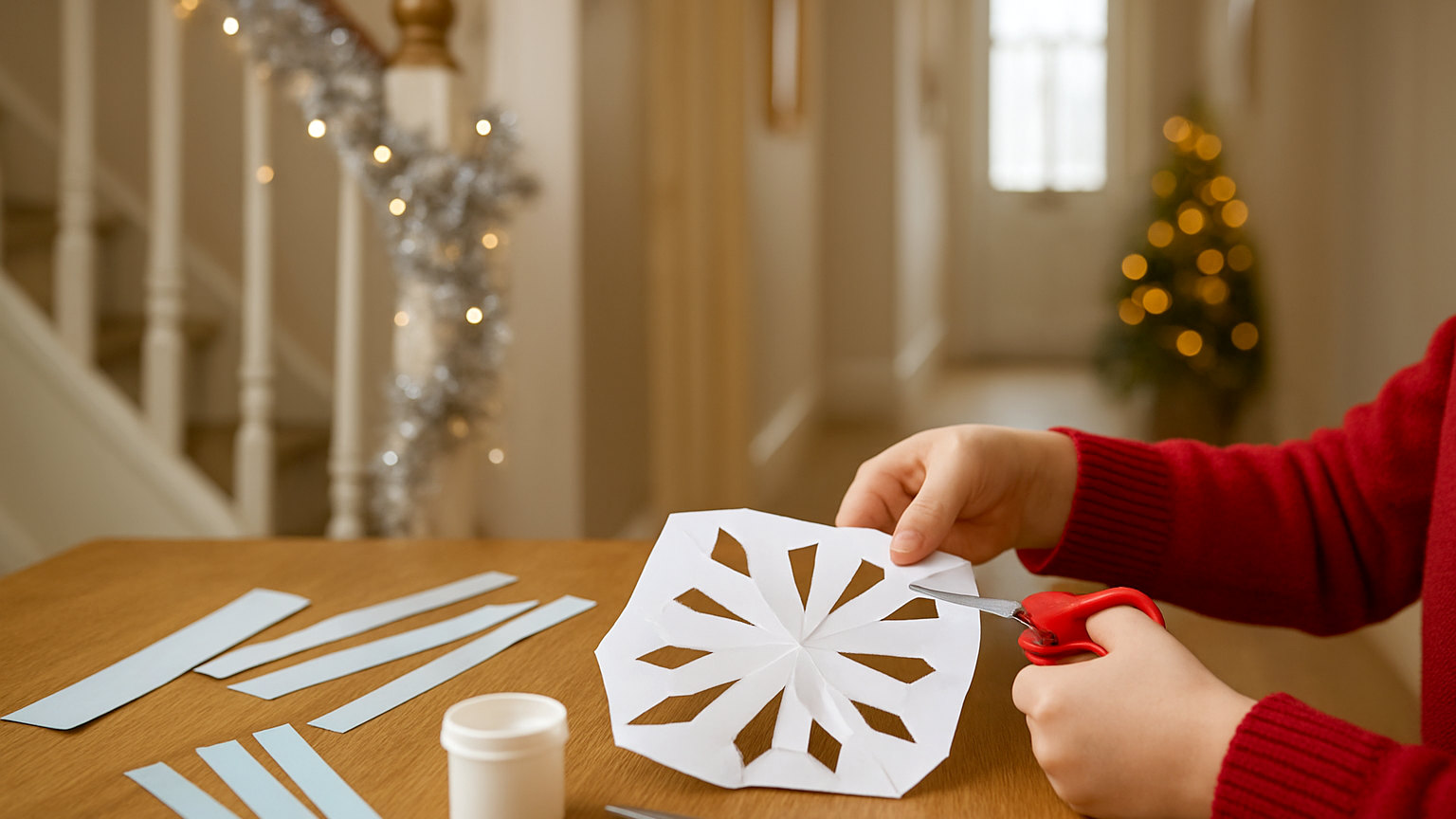
Paper chains and paper snowflakes are the two crafts everybody thinks they can already do, and both are usually done in a way that produces a slightly disappointing result. The chain falls apart, and the snowflake has four points, which no real snowflake has. Both are fixed by a small change in method rather than by any additional skill.
What paper works best for chains?
Something with a bit of body: sugar paper, thin card, or old wrapping paper, which is free and already patterned. Standard printer paper is too limp and tears at the joins. Cut strips about 2cm wide and 20cm long, which gives a link big enough to handle and small enough to look right. A guillotine or a paper trimmer makes cutting fifty strips a two minute job.
What holds a chain together?
A stapler, honestly, which is faster and stronger than anything else and is what most classrooms use. Failing that, PVA rather than a glue stick, which does not hold on shiny wrapping paper. Double sided tape works well and is the least messy option for young children. Whatever you use, overlap the ends by a good centimetre rather than just touching them.
How do you hang a chain without it sagging?
Support it every metre or so rather than at the two ends only, and let it hang in a gentle curve rather than pulling it tight. Adhesive hooks or small pieces of low tack tape work on a wall. Corner to corner across a ceiling looks impressive and needs a fixing at each end that will genuinely hold, since a chain that falls at the middle takes the tape with it.
A real snowflake has six points, not four. The six fold method takes one extra fold and produces something that looks right rather than merely symmetrical.
What is the six fold method?
Start with a square, fold it in half diagonally to make a triangle, then in half again to make a smaller triangle. Now fold that triangle into thirds, bringing one side across and then the other, so the folded shape is a narrow wedge. Trim the uneven bottom edge straight, cut your pattern into the folded edges, and open it out. Six points, every time.
Why do most snowflakes have four?
Because folding a square in half three times is the intuitive method and gives eight segments, or four points when opened. It is faster and easier, particularly for a small child, and it produces a perfectly nice decoration. It simply is not the shape a snowflake takes, and once you have seen a six pointed one the four pointed version looks wrong.
How do you get a good pattern?
Cut more than feels safe. The most common mistake is timidity, which produces a solid shape with a few notches. Cut deep into the folded edges from both sides, leaving thin connecting sections, and remember that anything cut on the folded edge becomes a hole in the middle. Thin paper folds more easily and cuts more cleanly than thick.
How do you hang the snowflakes?
On thread or fishing line from a ceiling or a curtain pole, which lets them turn. Taped flat to a window, where they read as silhouettes from outside and are lit from behind during the day. Pressed under a heavy book overnight first if they have crumpled. A cluster at varying heights looks considerably better than a row at the same level.
What can you do with the offcuts?
The waste from cutting snowflakes makes excellent confetti for a table or for filling a card, and the strips left from chains can be curled with scissors and used as parcel decoration.
Nothing needs to go in the bin at the end of a paper craft afternoon, and children generally enjoy the second use as much as the first.
Both crafts also scale up well for a group, which makes them the obvious choice if cousins are visiting and there are six children round a table rather than two.


