
A proper florist wreath involves wiring bunches of foliage onto a mossed ring in one direction, which requires more patience than most children under ten possess. There are three simpler versions that produce something genuinely worth hanging, and all of them can be done in an afternoon with a group of mixed ages working at different levels.
How does the paper plate version work?
Cut the centre out of a paper plate to leave a ring, which an adult should do. Then the child covers the ring with whatever is available: torn tissue paper, handprints cut from card, cotton wool, pasta, painted leaves, or pieces of old Christmas cards. Add a ribbon bow and a loop to hang it. It suits three to six year olds and takes about twenty minutes.
What about a foraged version?
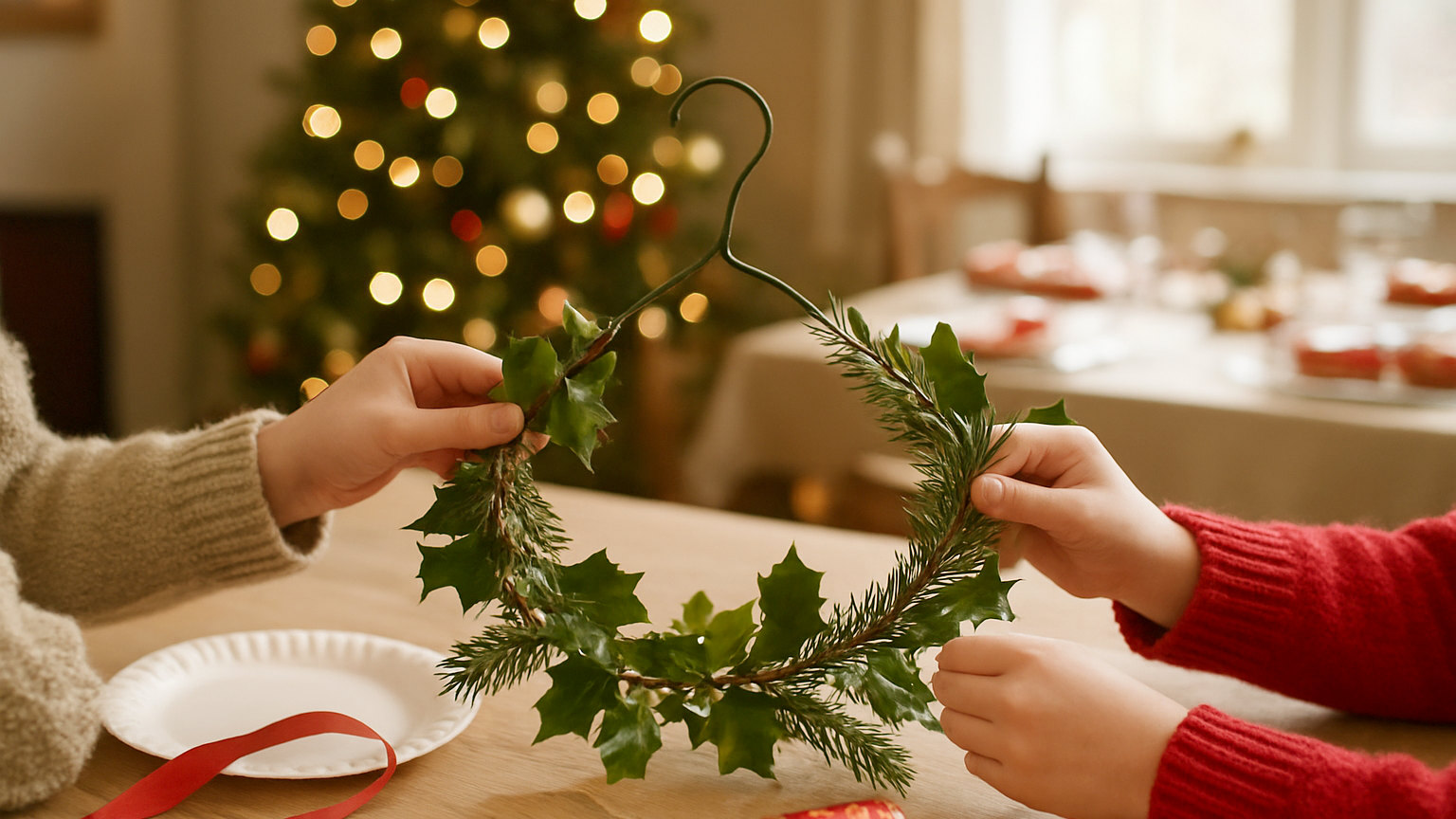
Collect ivy, conifer, holly, bay, rose hips, pine cones and interesting twigs on a walk, which is half the activity and gets everybody outside. Then wind the ivy around a wire ring or a bent coat hanger to form the base, and tuck the other pieces in among it. It needs no wire and no technique beyond tucking, which suits six to ten.
How do you use a coat hanger?
Bend a wire hanger into a rough circle, leaving the hook as the hanging loop, which an adult does. It then becomes the frame for anything: threaded foliage, tied strips of fabric, baubles wired on, or paper shapes. A hanger covered in tied fabric strips is one of the easiest wreaths there is and looks considerably better than it sounds.
Do the cutting and the wire bending yourself, and leave the rest entirely to them. An adult tidying a child wreath as they go is the fastest way to end the activity.
What should you know about foraging?
Take small amounts and never strip a plant, since birds feed on berries through winter. Do not take from private land without permission or from nature reserves. Holly berries, mistletoe and ivy are all toxic if eaten, which matters with a toddler in the house, so wash hands afterwards and keep the finished wreath out of reach of very small children and animals.
What suits the youngest children?
Sticking rather than tying. A paper plate ring, a pot of glue and a tray of things to press onto it will occupy a three year old for as long as their attention lasts, which is the realistic target. Handprints cut from green card and arranged in a circle is the version that grandparents keep, and it requires nothing from the child but a hand.
What can older children make?
A proper foliage wreath with a bit of help, using a wire ring and florist wire, working in one direction with small bunches. By nine or ten most children can manage this and take real satisfaction in the result. It is also a genuinely useful skill, and a child who has made one will make one every year afterwards.
Where should it go?
On a bedroom door, which is the honest answer for a paper plate wreath and is exactly what the child wants anyway. A foraged one can go on the front door alongside or instead of a bought one. Whatever it is, put it somewhere visible rather than somewhere tidy, since the point of a child making a decoration is that it gets used.
How long will it last?
A paper plate wreath lasts indefinitely and can be kept for years, which is the version most likely to reappear each December. A foraged one lasts three or four weeks indoors and longer on a cold door.
Misting a foliage wreath every few days will keep it green well past Christmas, and once it dries out it can go on the compost rather than in the bin.
What should you do with it in January?
Foliage and foraged material can go on the compost or in a green bin, and the wire ring or coat hanger keeps for next year in the decorations box.
A paper plate wreath is worth keeping and labelling with the year, since it takes almost no space and becomes one of the things that reappears every December for a decade.


