
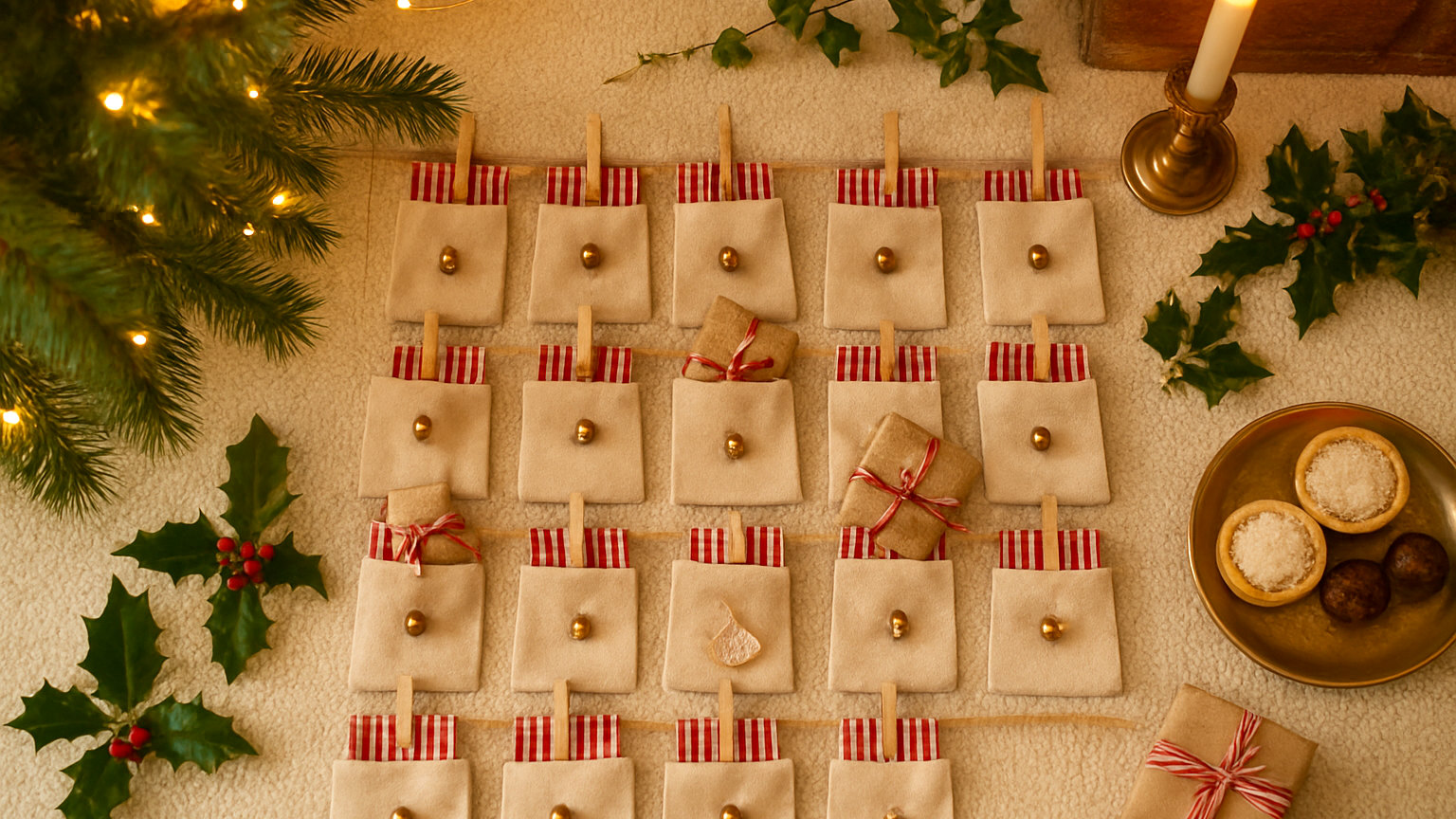
A reusable advent calendar costs something once and nothing thereafter, removes the annual purchase entirely, and becomes a fixture that children recognise from year to year in a way a cardboard one never does. Four designs cover almost every situation, and all of them can be made in an evening.
What is the simplest design?
Twenty-four small envelopes or paper bags, numbered, pegged to a length of string or ribbon strung across a wall, a bannister or a mantelpiece. It takes twenty minutes, costs almost nothing, packs flat into a large envelope for storage, and can be refilled indefinitely. It also holds slips of paper for an activity calendar perfectly, which is the most useful format.
What about fabric pockets?
A length of fabric with twenty-four small pockets sewn or glued on, hung from a dowel. It holds more than an envelope, it looks considerably better, and it lasts decades. It needs a sewing machine or a great deal of patience, which is the only obstacle. Numbers can be embroidered, printed onto fabric or written on small tags tied to each pocket.
What about a drawer or box calendar?
Small wooden drawers, matchboxes glued into a block, or a set of small boxes arranged in a tree shape. This holds the most, including small objects rather than only paper, and it is the format that suits Lego pieces or small toys. It is also the bulkiest to store, which matters in a flat.
Decide what it needs to hold before you decide what to make. An envelope calendar holding a slip of paper and a drawer calendar holding a toy are different objects.
What about a wrapped book calendar?
Twenty-four books wrapped in paper and numbered, stacked in a basket or under the tree. It requires no construction at all, most of the books can be ones you already own, and the wrapping is the only annual job. Wrap them in brown paper with the numbers written on so it can all be recycled or reused.
How do you number it?
Not in order, ideally, if the calendar is arranged as a display rather than a line. Scattering the numbers means the child has to find the right one each morning, which adds thirty seconds of activity for nothing. Numbers can be written directly, printed onto tags or stamped, and it is worth making them large enough to read from across the room.
What should go in it?
Whatever suits the format. Slips of paper naming an activity, which is the easiest and best. A mix of activities, small items and treats. A book a night. Sweets, if you want them, but in smaller quantity than a bought calendar contains. The format allows anything, which is exactly why deciding the contents first matters.
Where should it be stored?
With the rest of the decorations, in the same labelled box, so it appears at the same time as everything else. Envelopes and fabric pack flat. A drawer calendar needs proper space. Whatever it is, empty it completely in January, since anything left in a pocket for eleven months will not be worth opening the following December.
How do you make it look good?
Keep it simple and consistent. Plain brown paper bags with numbers stamped or written by hand look better than a mixture of patterns, and a single ribbon or twine ties the whole thing together visually.
If children are making it, let them, and accept that consistency is not what they are aiming for. A calendar they decorated themselves is used with considerably more enthusiasm than one that looks tidier.
Make it a size that suits where it will hang, measured before you start, since a calendar built to fit a wall you no longer have space for ends up in a cupboard rather than in use.
What should you do at the end of the month?
Empty every pocket, drawer or envelope completely before it goes away, since anything left in for eleven months will have melted, gone stale or been forgotten about entirely.
It is also the moment to note what worked, because the contents are the part you will have forgotten by the following November and the calendar itself is the part you will not.


