
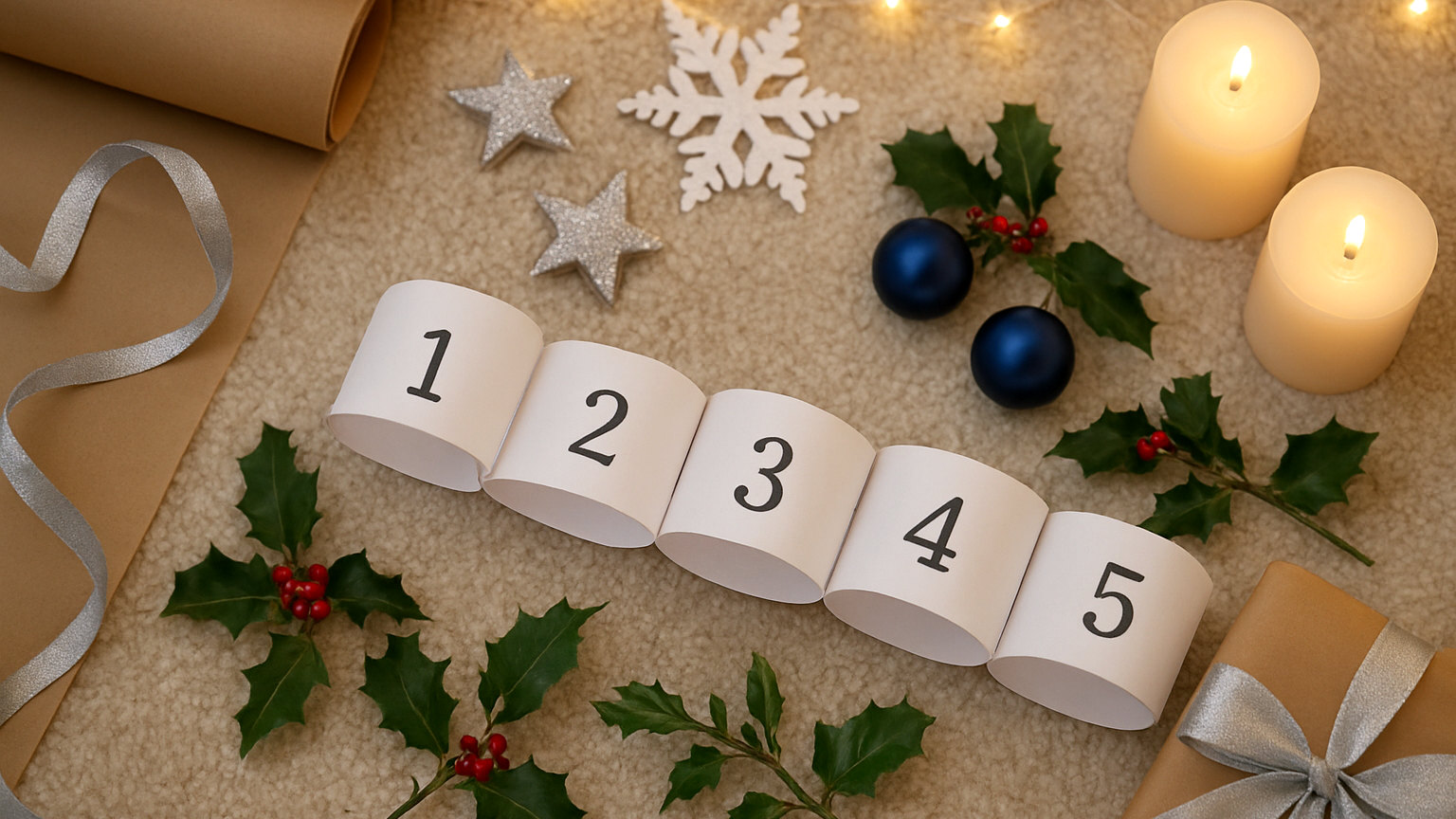
A countdown does not require twenty-four doors, a purchase or any shopping at all. Several of the alternatives are cheaper, more visible around the house, and better suited to a young child who cannot yet grasp what twenty-four days means. All of the ideas below cost nothing or close to it and can be started at any point in December.
How does the paper chain version work?
Make a chain with one link for each day remaining, hang it somewhere visible, and remove one link each morning. It is the most concrete countdown available, since the chain visibly shortens, which is exactly what a three or four year old needs. Writing a small activity inside each link before assembling turns it into an activity calendar at no extra cost.
What about a candle?
An advent candle marked with the dates, burned down to the next line each evening, which is the traditional European version and considerably older than the paper calendar. It gives December a daily ritual that involves the whole household rather than one child opening a door alone. Never leave it burning unattended, and keep it well clear of decorations and foliage.
What is a countdown jar?
A jar of folded slips, one drawn each day, each naming something to do. It takes twenty minutes to write and it plans your December in advance, which is the real benefit. It also scales to however many days are left, which makes it the best option if you are starting on the eighth and cannot face a calendar with sixteen empty doors.
A countdown that shortens visibly beats one with doors for young children. A chain getting shorter means something at three; a grid of numbers does not.
Does the book stack work?
Very well. Wrap a book for each remaining day, number them, and stack them in a basket. One is opened and read each night. Most can be books already on the shelf, so it costs nothing beyond a roll of paper, and the books go back on the shelf in January for next year. It builds a reading habit into the countdown without anybody noticing.
What suits a household without children?
A candle, a jar of things to do, or a simple chalkboard with the number of days written on it and changed each morning. For a couple, a jar filled by both people with things to do together is the version that works best and costs almost nothing. It gives December a rhythm without any of it being aimed at anybody in particular.
What about marking it outdoors?
Adding one decoration a day to a tree, a window or a mantelpiece, so the display builds through the month rather than appearing all at once. Children can be given the job. By the twenty-fourth the house is fully decorated and every element went up on a specific day, which is a small tradition with a nice shape to it.
When should a countdown start?
Later than you think for young children, since a month is beyond what a three year old can anticipate and a long countdown produces a fortnight of asking whether it is Christmas yet. Ten days or a fortnight is plenty at that age. Older children manage the full month happily, and starting on the first is the convention rather than a rule.
What if you start late?
Every idea here scales to whatever is left, which is the main advantage over a bought calendar with a fixed twenty-four doors. A chain of twelve links or a jar of nine slips works perfectly and nobody notices anything is missing.
Starting on the thirteenth for a twelve day countdown is also a legitimate tradition in its own right and considerably less work than a full month.
Whatever you use, keep it somewhere everybody passes rather than in a bedroom, since a countdown works by being seen several times a day rather than opened once.


