
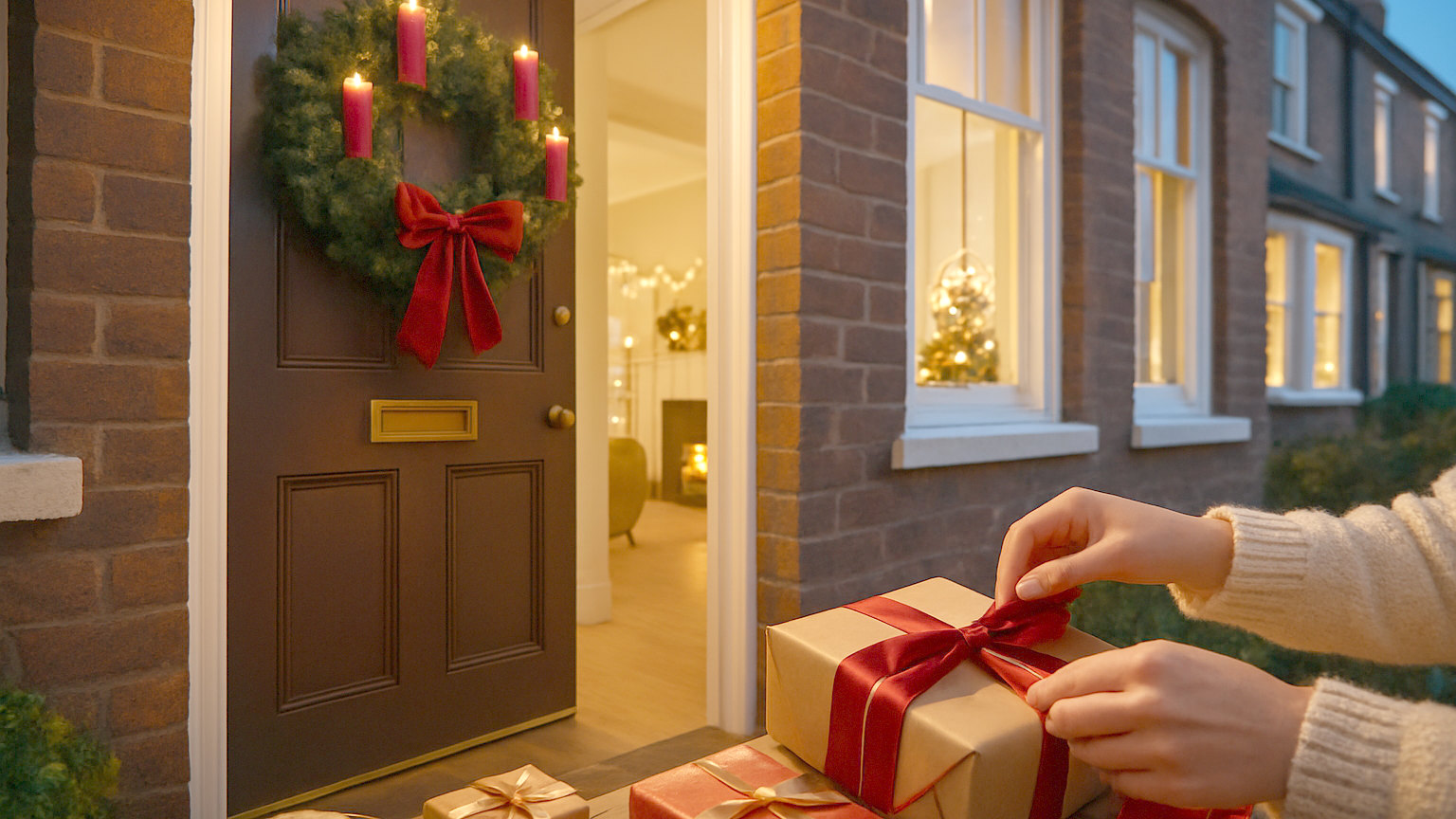
An Advent wreath is a ring of foliage holding four candles, one lit on each Sunday of Advent, so that by the Sunday before Christmas all four are burning. It is a considerably slower countdown than a calendar with a door every morning, and households that use one tend to describe it as giving December a rhythm rather than a daily prompt.
What do the candles mean?
In the most common arrangement, three are purple and one is pink, with the pink one lit on the third Sunday. Purple is the colour of Advent in many churches, reflecting its origins as a season of preparation, and the pink marks a Sunday of rejoicing partway through. Many wreaths add a fifth white candle in the centre, lit on Christmas Day itself.
Does it have to follow that scheme?
Not at all outside a church setting. Plenty of households use four candles of any colour, or four white ones, or whatever is in the cupboard. Some use red. The structure of one lit each Sunday is the part that carries the meaning, and the colours are a convention rather than a requirement.
How do you make one?
Take a ring, either a florist foam ring, a wire ring padded with damp moss, or simply a shallow dish or tray. Arrange foliage around it, tucking the stems in so no cut ends show. Then set the four candles into holders spaced evenly around the ring. Add cones, berries, dried orange or ribbon as you like.
Never leave a lit Advent wreath unattended, and keep the flames well clear of the foliage. Greenery dries out considerably over four weeks and dry conifer catches quickly.
What is the safety that matters?
Candles must sit in proper holders on a non flammable base rather than being pushed into foliage. Keep flames clear of the greenery, which dries out over the four weeks and becomes genuinely flammable. Never leave it burning unattended, never within reach of a child or an animal, and put it out before leaving the room. If any of that is difficult, use LED candles, which are widely available and look convincing.
How long should the candles burn?
Long enough to mark the occasion rather than all evening, which is typically fifteen or twenty minutes over a meal or a reading. That also makes the candles last the four weeks, since the first one is lit four times and the last only once, and a candle burned for an hour each Sunday will not survive to Christmas.
Which foliage lasts four weeks?
Conifer, bay, laurel, box and eucalyptus, all of which are tough evergreens. Ivy holds up well. Avoid anything soft leaved or flowering, which will wilt within a fortnight. Misting it every few days and keeping it away from radiators makes a considerable difference, and an artificial base with a few fresh sprigs is a legitimate compromise near a fire.
When does it start?
Advent Sunday, which is the fourth Sunday before Christmas Day and falls between the twenty-seventh of November and the third of December depending on the year. It is worth checking the date rather than assuming, since it moves annually and does not align with the first of December except by coincidence.
Can you make one without candles?
Yes, and several households do. Four battery tealights in holders, switched on one at a time, keeps the structure entirely and removes the safety question, which matters in a house with small children or animals.
The alternative is a wreath with the candles set well clear of the foliage in tall holders, which is what most churches do and which reduces the risk considerably without giving up the real flame.
Where should it go?
On a table where the household actually sits, since the point is that it is lit while people are together rather than that it looks good on a mantelpiece. A dining table is the traditional position.
It should also be somewhere it can be watched while lit, which rules out a hallway or a windowsill behind a curtain, both of which are common and both of which are unsafe with a real flame.


